Minds of the Movement
An ICNC blog on the people and power of civil resistance
Self-organized protests against the Ortega-Murillo regime grew into a peaceful civic uprising that spread across the country
The revolutionaries said that violence had the role of midwife in historical development, that the traumas of social upheaval were like birth pains. In Nicaragua, as in other latitudes, revolutions, wars, and military barracks have reproduced on a large scale the fratricidal complex of Cain over Abel and that of Romulus over Remus. Now the Nicaraguan has become aware that his challenge is to transition to democracy, assuming the political philosophy of nonviolent struggle and internalizing a new paradigm of social change: peace as the midwife of History.
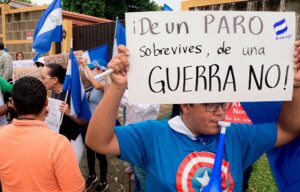
The swarm of anti-government protests in Nicaragua, which began in April 2018, revealed thoughts and feelings that converged into the general will to carry out a democratic transition. Civil pressure actions were deployed to achieve collective change, with a focus on the universal value of peace. The self-convened social protests against the autocratic Ortega-Murillo regime evolved into an authentic civic and peaceful insurrection that spread to various parts of the country.
 The April Rebellion was savagely repressed by police and parapolice groups, causing a severe sociopolitical and human rights crisis, which in fifteen and a half months left a death toll equal to or greater than 355 people (of which 27 were children and adolescents), and at least 2,000 people were injured. More than 1,600 people were arbitrarily deprived of liberty. To date, it is estimated that around 170,000 people have been displaced due to political and economic causes. Additionally, there are more than 170 political prisoners (including older adults), more than 150 unjustified expulsions of university students, and countless dismissals of public servants as political retaliation.
Practicing a political culture centered on peace in a structurally and culturally violent society (as defined by Johan Galtung) carries the risk that all social mobilization, with a civic, peaceful, and civil spirit, will be denatured by disturbances caused by agitators and extremists. and impostors who are agents of chaos. To tell the truth, the April rebels revolted against the subjugation of the State-party-family trident. Faced with a political order of “let’s go with everything” (attributed to Vice President Rosario Murillo), the position of those who embraced nonviolence was not to give the State an excuse for increasing the excessive and unequal use of force with lethal weapons. Unfortunately, the idea of the heroic tends to be linked more to violence and less to peace (as if the death instinct predominated over that for life). A stubborn display of patriotism increases the number of fatalities.
Nonviolent struggle requires a lot of emotional intelligence and spiritual strength. Non-cooperation as a method of struggle refers to actions through which citizens, deliberately and consciously, withdraw their support for economic and social cooperation activities. Specifically, economic noncooperation (boycotts and strikes) is refusing to buy, sell, handle, or distribute specific goods and services. This method is directly related to responsible consumption. It is about denying money to those who are authors and accomplices of human rights transgressions (not purchasing their products).
The conscious and emerging leadership after the social explosion is committed to nonviolent struggle for the democratic transition, so that in the most acute moments of the crisis, methods of economic non-cooperation were adopted as a tactic and strategy to erode the dictatorial regime. To the bizarre Sandinista slogan “free homeland or die,” the blue and white movement responded “free homeland and live,” which elucidated a new paradigm of political struggle reaffirming and protecting the right to life (in opposition to martyrological heroism).
Escalating Economic Non-Cooperation
Below are the most belligerent economic non-cooperation actions observed since the April Rebellion:
- Four national strikes were called between June 2018 and May 2019, which slowed down the country’s economic and social activities for 24 hours on each day of protest. The strikes prompted the Government to accept the entry of the Inter-American Commission on Human Rights (IACHR) into the country and demonstrated overwhelming support for the democratic transition.
- Land transportation of goods was blocked, and collective urban transportation became irregular due to popular barricades (colloquially called “tranques”) that obstructed the country’s streets and highways.
- A 24-hour strike was carried out by the taxi drivers' union, which reduced the selective transport service to a minimum.
- Thousands of contributors disaffiliated from the public social security system due to widespread distrust of the pension governing institution stemming from financial insolvency. A payroll was circulated with the privileged salaries of the entity’s officials and public servants (the government reform of social security was one of the triggers for the social protests in 2018).
- Calls were made for consumer strikes and tax disobedience, which had an impact on the service economy, specifically, on the contraction registered in the commercial and tourism sectors. Some companies owned by those close to the Government were identified so as not to buy their products, and the names of their owners were published.
- An electrical blackout was declared at a certain time, as the electricity marketing company has government participation.
- Citizen consumption of fuel offered by the service stations of the National Petroleum Distributor (DNP) of the Nicaraguan Petroleum Company (Petronic) was drastically reduced. The non-consumption of fuel and subsequent international economic sanctions affected the state company, resulting in the closure of many of its service stations.
Regime Repression in Response
The tactic and strategy of economic non-cooperation generated a radicalization of the ruling family in its desire to retain power for its own sake. In response, the autocratic regime deployed mechanisms of collective economic repression, namely:
The Government banned social protests and threatened to impose jail time on social, student, and business leaders who, from now on, call for a strike. In addition, the regime warned that it would prosecute businessmen who joined the strikes, reporting cases of people and companies besieged by the police force.
Parapolice groups carried out the armed offensive known as “Operation Cleanup,” which violently dismantled the roadblocks and reestablished land transportation for goods and people.
The National Assembly, acting under the direction of the Presidency, approved reforms to social security and the tax system, without consultation or social consensus, which increased contribution and tax rates to the detriment of the working class and the business sector.
The state machinery imposed a tax collection policy known in public opinion as “fiscal terrorism”, since the taxpayer (especially if they are an opponent or critic) is a victim of legal and judicial harassment. The Tax Administration arbitrarily alters tax debts without respecting the rights of citizens (for example, exemptions for retirement or claiming legal prescription).
The actions of economic non-cooperation were effective and preceded the individual economic sanctions decreed by the International Community to the detriment of the discredited and illegitimate regime. It is thought that a sustained and unwavering support of the Nicaraguan commercial and financial capital represented by unions in the Superior Council of Private Enterprise (COSEP) for the self-convened actions of economic non-cooperation would have had a much more forceful, intense, and prolonged effect to pressure due to a resignation of the leaders or due to an advance of general elections.
Today, the Government is heavily indebted, with the Central American Bank for Economic Integration (CABEI) as its main financier. It would not be unwise in the future to ignore the public debt contracted with CABEI, as this organization distorts its own institutional mission by not being consistent with an approach that supports the modern conception of what is globally understood as economic development, humane, and sustainable, based on rights, freedoms, and capabilities.
The organized opposition is going through a phase of recomposition due to the imprisonment, siege, and exile of its leadership. The political call to reduce monetary remittances from abroad (to pay less taxes) has had no echo or support because Nicaraguan families depend heavily on these money transfers to satisfy their consumption needs.
In this sense, it could be more tactical to adopt a skeptical attitude and reject the macroeconomic figures that present a country as completely discordant with the perception people have of its microeconomic environment. That is, it would be smarter to capitalize on citizen distrust of government institutions, misinformation from those in power, and social unrest due to adverse economic conditions. The rest remains to be seen. It is wise to take one step back and two steps forward. Small steps are necessary to achieve great ideals.
Note: This article was originally published by FLACSO