Minds of the Movement
An ICNC blog on the people and power of civil resistance
A Nation in Transit...
This is the fourth winter of the full-scale invasion. And it is very difficult. Russian ballistic missiles and drones deliberately target the energy grid, the very infrastructure that civilians depend on for survival. In January and February, temperatures plunge to minus 20 degrees Celsius in the country. Ukrainian cities are literally freezing. Millions of people have interrupted or no access to heat, water, or electricity. The UN has classified Russia's actions as crimes against humanity.
I remember 2022, when the Russians first began striking energy infrastructure. A photo of a Kyiv schoolteacher appeared online. She was wearing a red down jacket and a warm hat, sitting on tiptoe next to a metal post on which she had placed her computer, right outside, somewhere near a shop where a generator was running, and there was internet. And there, in the freezing cold, she was giving a lecture to her students. I remember thinking that the Russians came to take everything from us - our land, our freedom, our future, and our children’s education. And this Kyiv teacher decided to give them nothing. Even something as simple as teaching children became an act of resistance.
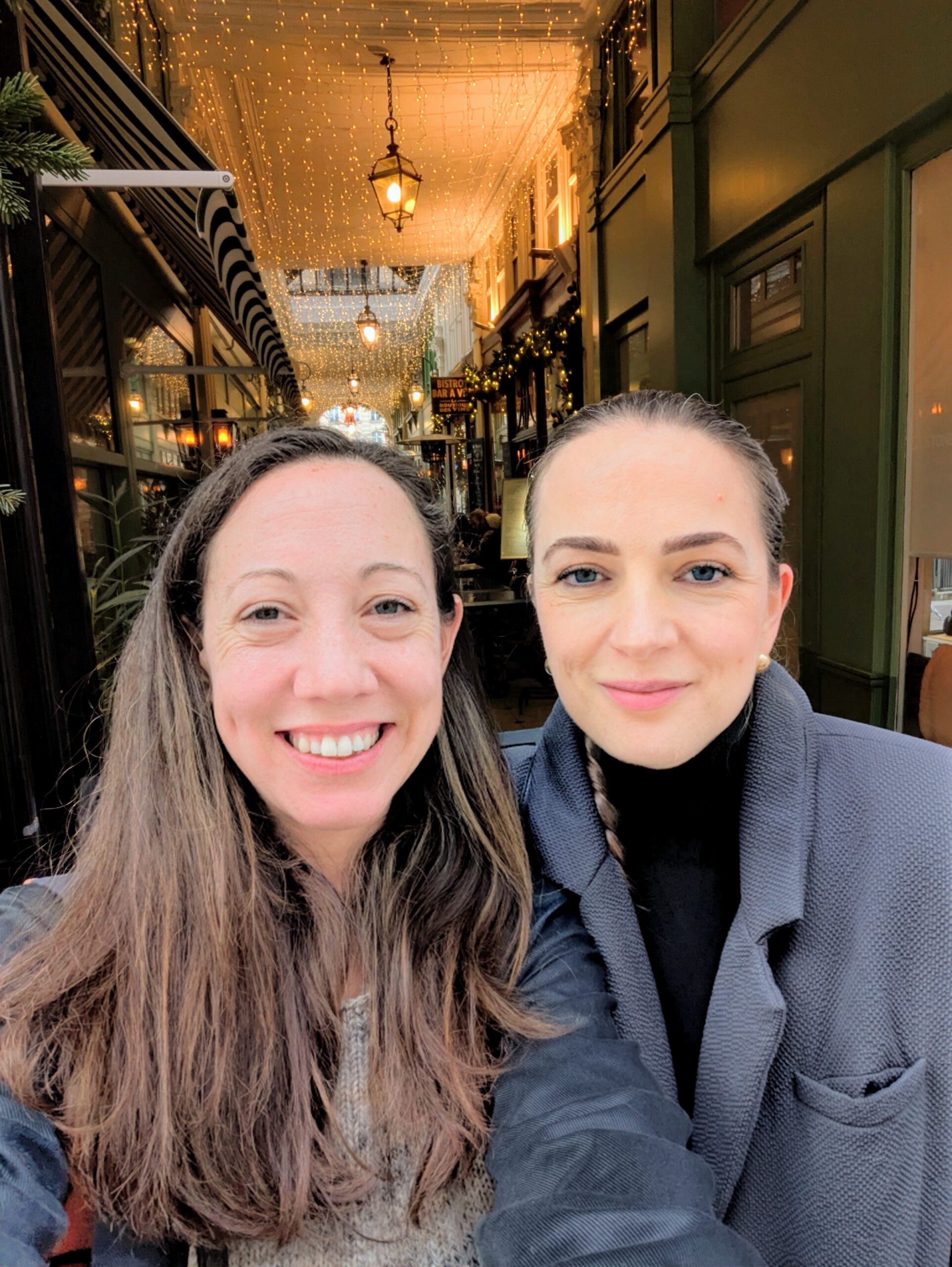
Amber French-Griette, Ukrainian Freedom series editor and Director of the Organization for Nonviolent Movements (Paris), alongside foreword author Oleksandra Matviichuk, Director of the Center for Civil Liberties (Kyiv)
I know from my own experience when you cannot rely on the international system of peace and security, you can still always rely on people. We are used to thinking in terms of states and intergovernmental organizations, but ordinary people have much more power than they even imagine.
Four years ago, I decided to stay in Kyiv when Russian troops were trying to encircle my city. No one believed that Ukraine could withstand such an enormous opposing power. When not just Putin, but all international experts were confident that Ukraine would fall in just three or four days. I remember how international organizations evacuated their personnel. But ordinary people remained. Ordinary people started to do extraordinary things.
I mentioned this story for a reason. The Russians imagined the war as mathematics, so they assessed Ukraine exclusively from a quantitative perspective. The optics of Western societies were focused exclusively on institutions. Both those and others did not see the human beings behind the numbers or ratings.
Ukraine regained its independence only in the 1990s after the collapse of the Soviet Union. It is a nation in transit. This means that people in Ukraine have never had the luxury of relying on effective democratic institutions. Therefore, they have developed appropriate life strategies. Ukrainian resilience lies in local democracy, grassroots self-organization, rapid adaptation to new circumstances, and the agency of ordinary people.
For three centuries, Ukraine lived in the shadow of the Russian empire. Ukraine entered this war as a society without context. Our history was not written by us. People on other continents knew only one thing about our part of the world: that Russia existed here. An empire is not only about controlling land, resources, and people. It is also about controlling knowledge about the world and about one another.
Putin openly says that there is no Ukrainian nation, just as there is no Ukrainian language or culture. For twelve years, we have documented how these words have turned into horrific practices in the occupied territories. Where the Russians physically eliminate active people, ban the Ukrainian language, loot Ukrainian cultural heritage, and raise Ukrainian children using Russian textbooks in which Ukraine does not exist as a state.
This war has not only a military dimension but also an informational one. This dimension has no borders. People spend more and more time on social media, which is flooded with fakes and disinformation. People are losing the ability to distinguish truth from lies. Residents of the same small community no longer have a shared sense of reality. And without a shared sense of reality, they are incapable of collective action. Without collective action, how can people defend their freedom?
Putin launched a full-scale invasion not just to occupy more Ukrainian land. Putin did it in order to occupy and destroy the whole of Ukraine and move further. He sees Ukraine as a bridge to Europe. His logic is historical. He dreams about his legacy. Russia is an empire. An empire has a center, but no borders. Therefore, people in European countries are safe only because Ukrainians do not let the Russian army move further.
It’s time to develop security autonomy for Europe. A military technological revolution is taking place before our eyes with the development of unmanned systems, massive drone attacks, battlefield transparency, and mass, cheap, precise long-range weapons. In four years, all the military experience of the 20th century became irrelevant. Therefore, the EU's security policy should include Ukraine as an integral part of European security.
But the main thing is the human dimension. Only a society that is ready to defend its values has a future. The resilience of the Ukrainian people should not be taken for granted. Civil society in Ukraine must be supported.