Minds of the Movement
An ICNC blog on the people and power of civil resistance
Peaceful demonstrators hold up the Chadian flag in the streets of N'Djamena.
I was five or six years old when I first understood the price of opposing the government in my country. That night, soldiers from Moundou and N’Djamena had surrounded Beinanmar, my hometown in southern Chad. They were searching for activists from the URD, a party fiercely opposed to the ruling regime. My older brother Jean-Claude was on their list. Alerted in time, he managed to flee to Cameroon. Others were not so lucky: uncles and cousins, taken away and then executed just outside the village.
The next day, I asked my mother what they had done. She replied, matter-of-factly, “They were opponents.” That’s how I learned, very early on, that in my country, opposing power could cost you your life. That childhood trauma has never really left me. It became, though I wasn’t always aware of it, the silent foundation of everything I would go on to do.
The Wind of Civic Movements
Then came the wind of civic movements that swept across the African continent. The Arab Spring in Tunisia and Egypt in 2010, “Y’en a marre” in Senegal in 2011, La Lucha in the DRC in 2012, and Balai Citoyen in Burkina Faso in 2013. Everywhere, connected young people took to the streets, the last bastion, the final recourse in the face of entrenched powers. Chad could not remain on the sidelines of this movement.
In 2015, at the University of N’Djamena, IYINA, “we are tired” in the local Arabic dialect, was born. It was the largest youth movement the country had ever seen: a lightning-fast mobilization across the entire country, driven by students, artists and civil society. We were the generation that rejected the Déby family’s monarchical legacy.
When one movement runs out of breath, another must take up the torch
IYINA lost momentum, like so many other movements before it. Exhuastion, repression, and internal divisions eventually wore down what, just a few years earlier, had seemed indestructible. This is a reality familiar to almost all civic movements born out of urgency: they arise from a cry, a collective outburst, but a cry cannot be sustained indefinitely. At some point, structures that can sustain the mobilization beyond its initial momentum are needed.
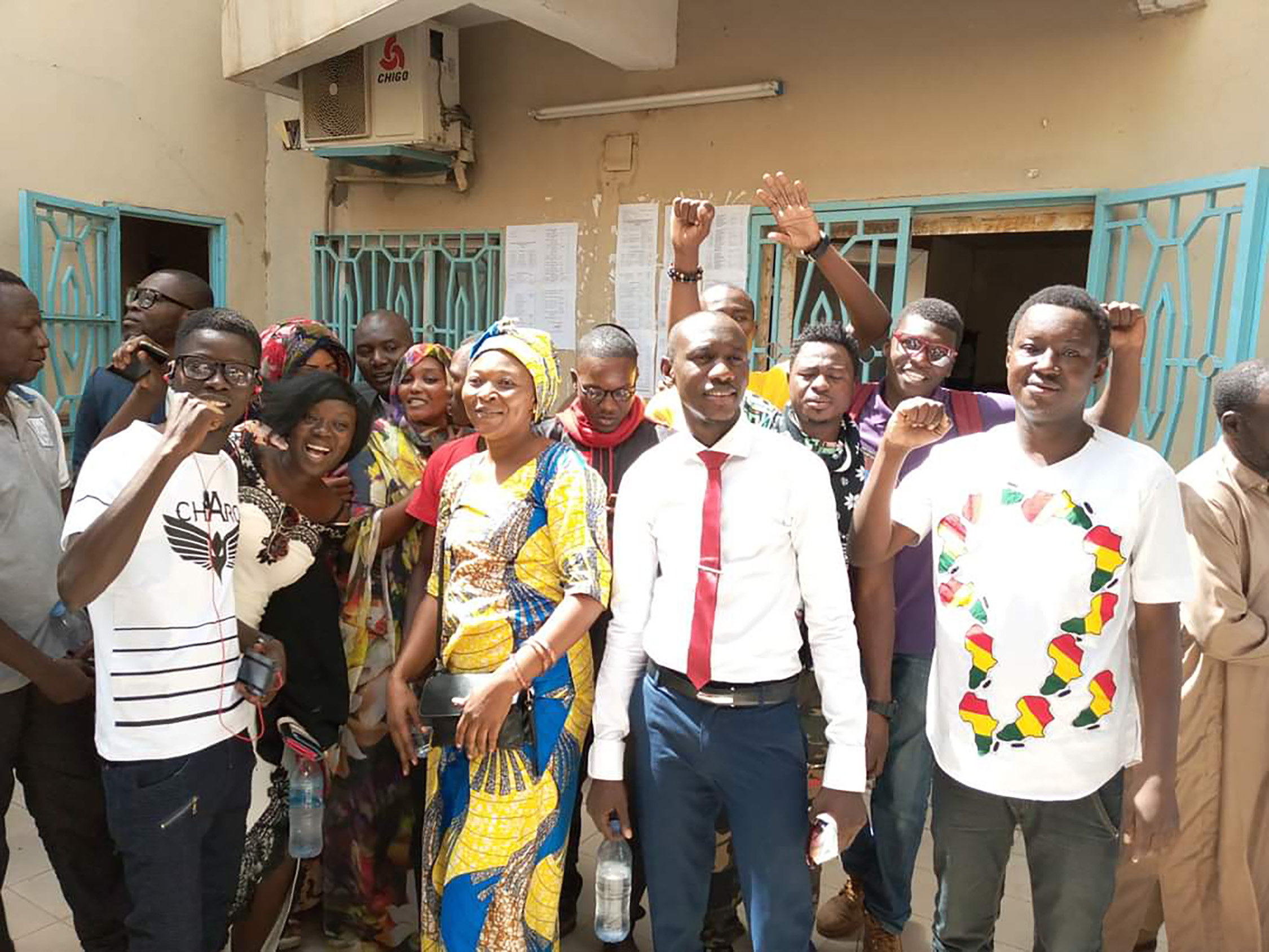
Emmanuel after his release from prison, having been detained following a demonstration.
That is precisely what we sought to do by founding the citizen movement “Le Temps” which means “It is time” in French. It was not a matter of starting from scratch, but of taking up the torch from IYINA in a Chad where civic space was no longer merely restricted; it had become a prison. New name, same struggle. Same arrests. Same threats. But also a lesson learned from the exhaustion of the previous movement: the need to view the struggle not as a sprint, but as a long-distance race. With the citizen movement “Le Temps,” we positioned ourselves as a force for proposals and citizen mobilization through civic education and grassroots actions. While maintaining its focus on social justice and good governance, “Le Temps” has taken up non-divisive issues such as environmental protection, voter registration, compliance with traffic laws, and the responsible use of social media among young people, and so on.
Nevertheless, this reorganization did not shield “Le Temps” from state repression. On June 26, 2025, the Chadian government issued a ban on all activities of the Wakit-Tama citizen platform (political section) and the “Le Temps” Citizen Movement throughout the entire country. The Minister of Territorial Administration cited “unauthorized gatherings that cannot operate legally” in a ministerial decree. Consequences: Under this decree, these two movements are no longer authorized to organize demonstrations or political activities in Chad.
In this context, where civic space is restricted, where the opposition and the independent press do not exist, and where demonstrations are brutally suppressed, many activists have been forced into exile. Yet our commitment to our country has not wavered.
When the streets are closed, the internet remains
My relationship with the digital world did not begin in exile. It dates back to my first blog, which I started in the early 2000s, when I realized that the written word could reach just as far as a megaphone. But it was the repression that turned the digital world into much more than a space for expression: it became a space for survival and for the struggle to continue.
When protesting risks imprisonment, disappearance, or death, when every physical gathering becomes a calculated risk, the digital space becomes one of the last places where citizens’ voices can still be heard. It is no coincidence that, in Chad as elsewhere on the continent, regimes that repress peaceful activism in the streets also methodically target freedom of expression online: internet shutdowns, surveillance of social media, and intimidation of digital voices. The digital realm is disruptive precisely because it works.
Documenting, Verifying, Exposing
From exile, my struggle has changed in form but not in nature. I continue to write, document, and share what is happening in Chad through platforms such as Voice for Thought in the Netherlands and the newspaper Le Pays in Chad, as well as through my personal social media accounts, which serve as spaces for me to express myself. In a context where disinformation and official narratives seek to cover up abuses, the work of verifying and cross-checking information becomes an act of activism in itself. Restoring the facts, naming things accurately, resisting erasure: this is another way to continue the fight I waged in the streets with IYINA and then with “Le Temps.”
Digital technology also allows me to maintain a living connection with those who have stayed behind in my home country and with the Chadian diaspora, scattered yet connected. It enables us to coordinate without physically gathering, to bear witness without directly exposing ourselves, and to build a collective memory of the abuses that silence would seek to erase. These are modest gestures, almost invisible when taken one by one, but which, when added together, form a counterforce.
What the history of IYINA and “Le Temps” has taught me, I find today in my digital activism: a cause survives not because it shouts the loudest, but because it knows how to evolve without betraying itself. Street activism gave me my convictions; exile and the digital world have given me the means to continue upholding them, in a different way, but with the same commitment.
I do not claim that the screen replaces the street, nor that an article can substitute for a protest. But in a country where physical resistance can cost one’s life, the digital realm remains a space where we can still say no, document, and hope. As long as this space exists, the struggle for human rights in Chad will continue.