Minds of the Movement
An ICNC blog on the people and power of civil resistance
A free society's most advanced defense system is its active, informed, connected citizens. Credit: Author.
Ukraine’s ability to withstand Russia today is often explained by the courage of the Ukrainian people, Western military assistance, and battlefield innovation. All of that is true. But it is not the whole truth. Ukraine also stands because it changed – institutionally and socially – after 2014. A mature civil society did something unusual for a country at war: it helped rebuild the state’s capacity to defend itself while at the same time insisting that the defense sector become more accountable, less corrupt, and more effective.
This connection between civic maturity, anti-corruption, and national defense did not appear suddenly. It was built slowly, through years of pressure, cooperation, and institutional learning. It was not always visible. It did not always produce immediate results. But it shaped the foundations of Ukraine’s resilience far more deeply than many realize.
The defense sector, a battlefield of reform

Ukraine's achievements and challenges in fighting corruption were discussed in spring 2025 at a Steering Committee Meeting of the EU Anti-Corruption Initiative (EUACI). NAKO LinkedIn page.
After the Revolution of Dignity, Ukrainian civil society entered a new phase. It was energetic, legitimate, and capable of mobilizing people and resources at scale. But its most important transformation was conceptual. It no longer focused only on changing individuals in power. It demanded a change of rules. The state was no longer seen as something external, distant, or hostile. Governance became a shared responsibility. This shift marked the birth of a different kind of political culture.
2014 was also the moment when the cost of corruption became a matter of national security. Russia’s occupation of Crimea and the outbreak of war in Donbas shocked Ukrainian society. Ukraine did not lose territory only because Russia was aggressive, authoritarian, and imperial. It also lost territory because its defense system had been weakened from within. Under the pro-Russian and kleptocratic president Viktor Yanukovych, material readiness and human resources in the Armed Forces deteriorated systematically. Corruption, excessive secrecy, and post-Soviet management practices hollowed out institutions that should have guaranteed deterrence and defense.
In the defense sector, corruption meant, and sometimes still means, broken supply chains, distorted procurement, compromised decisions, and weakened command structures. It means soldiers without proper equipment, ammunition that does not arrive on time, and resources that disappear into opaque systems. In short, it means vulnerability. That is why, after 2014, the defense sector became one of the central battlefields of reform.
Civil society responded on two levels.
Working from outside and within

Ukraine's civic shield extends well beyond its role in fighting corruption. Here, citizens provide support auxiliary to the military. Credit: Author.
First came the wave of volunteering that filled urgent gaps. Ukrainians supported the army directly: supplying equipment, medical kits, vehicles, tactical gear, and training. Organizations such as Army SOS, Aerorozvidka, Povernys Zhyvym, Volunteer Medical Battalion, Legal Hundred, Crimea SOS, Vostok SOS, Prytula Foundation, and many others emerged almost overnight. They supported soldiers, veterans, displaced people, and frontline logistics. These organizations were created because the state was unable to perform many of these functions quickly and effectively. By 2017, public trust in volunteer organizations exceeded trust in government institutions many times over. Volunteering became a form of emergency state-building.

A Ukrainian delegation including a NAKO representative met with officials of the U.S. Department of State and Congress members in fall of 2025. U.S. partners praised Ukraine’s achievements in fighting corruption, even amid the ongoing war. Credit: NAKO LinkedIn page.
The second response was quieter and more complex: reforming governance architecture. Laws, institutions, procurement rules, oversight mechanisms, corporate governance – the invisible structures that determine whether a defense system can function under pressure. This work required expertise, patience, and the ability to operate inside a sector designed to remain closed.
After Euromaidan, civil society organizations united in the Reanimation Package of Reforms, a coalition that pushed systemic change across almost all sectors of governance. Many people from that ecosystem later became officials and parliamentarians. Yet defense and security remained among the least developed areas of reform. Defense was not a traditional civil society field, and international donors were cautious about funding work in such a sensitive sector. Precisely because of that, it became one of the most dangerous blind spots in Ukraine’s reform agenda.
Anti-corruption saves lives
Globally, defense reform rarely begins with governance. Most resources go to weapons, tactics, and operational readiness. Governance is treated as secondary, sometimes even as a distraction. Ukraine learned the opposite lesson: pouring money into a corrupt and poorly governed defense sector does not increase security. It undermines it.

In addition to anti-corruption work in Ukraine, NAKO engages international advocacy, travelling to Europe with captured Russian drones to demonstrate the scale of sanctions evasion and the use of Western technologies in Russia’s military equipment. Credit: NAKO LinkedIn page.
This was the context in which the Independent Anti-Corruption Commission (NAKO) was launched in late 2016 by Transparency International Defense and Security and Transparency International Ukraine. The idea was straightforward: Ukraine needed an independent, professional civil society actor capable of working inside one of the most closed sectors of the state. In early 2019, NAKO became an independent Ukrainian NGO, the most established and go-to institution in defense sector governance.
Its role was not confrontation for its own sake. NAKO was translating civic pressure into policy, and policy into institutional change. Through research, monitoring, and expert engagement, it helped connect civil society, parliament, the Ministry of Defense, and international partners. Over time, a consistent reform logic emerged:
- Assessment and awareness.
- Public and international pressure.
- Constructive collaboration and institutional design.
Early work focused on areas where corruption risks intersect directly with human lives: security assistance, medical supply, housing, and logistics. Civil society experts were invited to help rewrite technical requirements for individual first-aid kits used on the frontline, reducing corruption risks and improving quality standards.
Defense procurement became one of the central reform fronts. Ukraine needed a system that minimized corruption risks, increased planning transparency, and strengthened civilian oversight. Civil society experts contributed to shaping the Law on Defense Procurement and to advocating for the creation of a more professional and independent procurement agency within the Ministry of Defense.
The trigger event

"How can Ukraine’s anti-corruption efforts be communicated at home and abroad? Without any special tricks — civil servants simply need to stop stealing." NAKO Head of Communications Юлія Бєглєцова discusses the challenges of presenting information on corruption cases in Ukraine, winter of 2025. Credit: NAKO LinkedIn page.
If procurement was one pillar, transformation of the defense industry was the other. Ukroboronprom, a conglomerate of more than 100 state-owned defense enterprises, had long been plagued by corruption, inefficiency, and Soviet-style governance. Oversight was resisted, and management remained opaque.
Here again, the three-stage mechanism worked.
Assessment came through international indices and audits that showed Ukraine among the weakest in Europe on defense anti-corruption standards. A “triage” assessment revealed that only a small share of enterprises generated most profits, while many produced no defense goods at all.
Pressure came in 2019, when investigative journalists published the Army.Friends.Cash investigation, exposing corruption schemes involving smuggled Russian parts and inflated prices during an active war with Russia. The scandal triggered public outrage, dismissals, and criminal cases. Defense corruption became politically unavoidable.
Collaboration followed. A joint working group including government institutions, parliament, international partners, and civil society drafted reform legislation. In 2021, the law on corporatization entered into force. It embedded OECD corporate governance standards, introduced supervisory boards and compliance systems, and put the defense industry on a path toward restructuring.
Then came 2022.
Anti-corruption under missile strikes
In the first months after the full-scale invasion, Ukrainian society made a conscious choice to suspend criticism. For almost six months, governance failures and corruption risks were set aside. Not because they disappeared, but because survival came first. Civil society focused entirely on defense: mobilizing resources, securing weapons, supporting the army, evacuating civilians, and sustaining international attention. It was a moment of extraordinary unity.
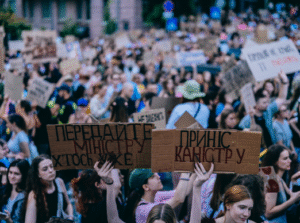
Ukraine's 2025 Cardboard Revolution was a remarkable flexing of civic muscle to push back against executive overreach, even in the midst of war. Credit: seameer via Instagram.
But democratic societies cannot live without oversight. And in Ukraine, that pause was temporary.
In early 2023, the so-called “eggs scandal” became a turning point. Journalists revealed that the Ministry of Defense had signed food supply contracts at prices far above market levels, including eggs reportedly priced at around 17 hryvnias (roughly 0,33€ each). In a country at war, where volunteers were raising money for drones and protective gear, this was unacceptable. The issue was not only financial. It was institutional and moral.
The scandal lifted the informal taboo on criticism. More importantly, it shifted the conversation from outrage to solutions. Society demanded mechanisms, not just resignations.
This led to the creation of the Ministry of Defense Reform Office and the Anti-Corruption Council under the Ministry of Defense – a permanent civilian oversight body embedded inside the defense system. Fifteen members were selected through a nationwide online vote, with more than 100,000 citizens participating. It was the largest civic online voting in Ukraine’s history. Democratic oversight was being built under missile strikes.
The Council, headed by Yuriy Hudymenko, a veteran and volunteer leader, continues to function today, reviewing procurement practices and identifying corruption risks.
At the same time, Ukraine’s broader anti-corruption architecture continued to function. Independent institutions such as NABU, SAPO, the High Anti-Corruption Court, and the National Agency on Corruption Prevention, created after the Revolution of Dignity, remained operational.
This system faced a critical test in the summer of 2025, during what became known as the Cardboard Revolution, when young people protested near Kyiv's Franko Theatre against political attempts to weaken the independence of anti-corruption institutions. Their pressure worked. Institutional autonomy was preserved. That victory of civil society proved decisive later the same year, when NABU exposed one of the largest corruption scandals in Ukraine’s history, centred on the nuclear energy sector and touching defense procurement. In the defense-related part of the investigation, it was revealed that attempts to force procurement of low-quality or overpriced body armor failed precisely because Anti-Corruption Council monitoring mechanisms were already in place.
A free society's most advanced defense system... its active, informed, connected citizens
Ukraine’s resistance in 2022 was not built in 2022. It was built through the painful lessons of 2014, through volunteer mobilization, and through years of institutional reform. Civil society worked by not only filling immediate capability gaps through mobilization and solidarity, but by building long-term institutional capacity through law, oversight, compliance, and governance reform.
That is the quiet frontline. And it is one of the reasons Ukraine still stands.