Minds of the Movement
An ICNC blog on the people and power of civil resistance
Credit: NOVACT/ICIP
This article is part of the Ukrainian Freedom Series, powered by ActionAid Denmark and the Organization for Nonviolent Movements.
The transformation of contemporary conflicts reflects the profound crisis of the international order. The intensification of hybrid warfare—characterized by the combined use of non-military tactics, technological tools, and multidimensional strategies operating in the so-called “grey zone”—challenges traditional security frameworks and constrains state responses. Instruments such as disinformation, cyber warfare, and economic coercion do not operate in isolation; they aim to destabilize from within, eroding social cohesion and paralyzing institutional responses. These dynamics operate simultaneously across the military, political, economic, and cognitive domains, blurring the boundaries between war and peace.
The diffuse and protracted nature of contemporary threats requires more comprehensive security approaches capable of articulating both institutional and civilian action. This implies a cultural and structural transformation of defense policy, incorporating society as an essential actor rather than a passive object of protection. From this perspective, civilian-based defense emerges as a necessary strategic concept of national defense based on systematically organized, prepared, and sustained nonviolent resistance by the civilian population to deter and confront external aggression or internal authoritarian takeover. From a deterrence standpoint, it strengthens a society’s capacity to become socially ungovernable to an aggressor, economically non-exploitable, politically unmanageable, and culturally unsubduable.
Credit: NOVACT
This article examines this paradigm through the case of civil resistance in Ukraine since 2022 and the community resilience that has sustained defense efforts in the face of Russia’s full-scale invasion. Beyond the strictly military dimension, the mass mobilization of civilian actors has played a decisive role in constraining occupation, managing local crises, and maintaining national cohesion—dynamics widely documented in scholarship on nonviolent resistance and society-based defense. The evidence supporting these findings draws on systematic field research I have conducted in Ukraine since April 2022, including more than 185 semi-structured interviews and the documentation of over 300 civil resistance actions.
The analysis addresses three central questions: (1) What has been the role and impact of the civilian population in response to invasion within a hybrid warfare context? (2) What social, organizational, and institutional dynamics enable the development and sustainability of a mass nonviolent resistance movement? (3) What are the limits and opportunities in the interaction between civil society and public authorities—including military structures—within a comprehensive defense framework?
The tip of the iceberg: Role and impact of civil resistance amid large-scale combat operations
To date, numerous scholars have documented—and continue to investigate—the stages, impact and evolution of nonviolent civil resistance in Ukraine. Yet even extensive documentation reveals only the tip of a deeper, decentralized infrastructure of popular power. One of the first lessons is that civil resistance was mass-based and adopted multiple forms in response to the emerging crises triggered by the invasion.
In the early phases, civilians defended critical infrastructure and strategic locations. On March 2, 2022, residents of the small town of Enerhodar erected barricades to prevent the occupation of the Zaporizhzhia nuclear power plant. Meanwhile, in the north, workers at the Chernobyl nuclear waste management facilities prevented Russian occupation forces from entering key installations, remaining at their posts for weeks without rotation to reduce risks to nuclear safety systems.
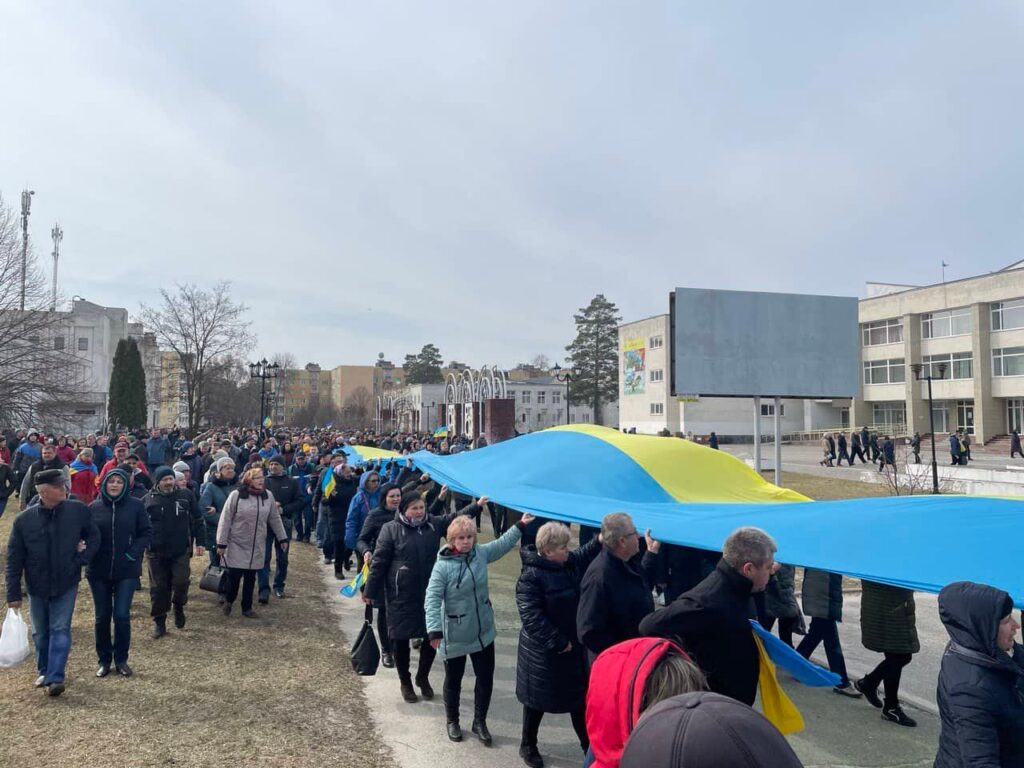
Urban centres became inhospitable terrain for occupying forces due to sustained civilian mobilization. In Kherson, daily demonstrations featuring national symbols and physical interposition in front of military convoys disrupted occupation routines; in Svatove, Luhansk region, rapid citizen mobilization, through monitoring and information-sharing mechanisms, obstructed the occupiers from seizing control of public buildings; in towns across the Chernihiv region, residents blocked tanks advancing towards Kyiv. These actions contributed to buying time for the reorganization of territorial defense and mitigating damage to critical infrastructure.
Beyond visible protest, everyday resistance evolved into structured forms of non-cooperation. In Melitopol and other occupied areas, teachers refused to implement imposed curricula, workers declined to construct fortifications, shopkeepers limited supplies to occupation forces, and public officials refused collaboration. These acts of disobedience undermined the institutionalization of occupation by depriving it of administrative capacity, legitimacy, and social obedience.
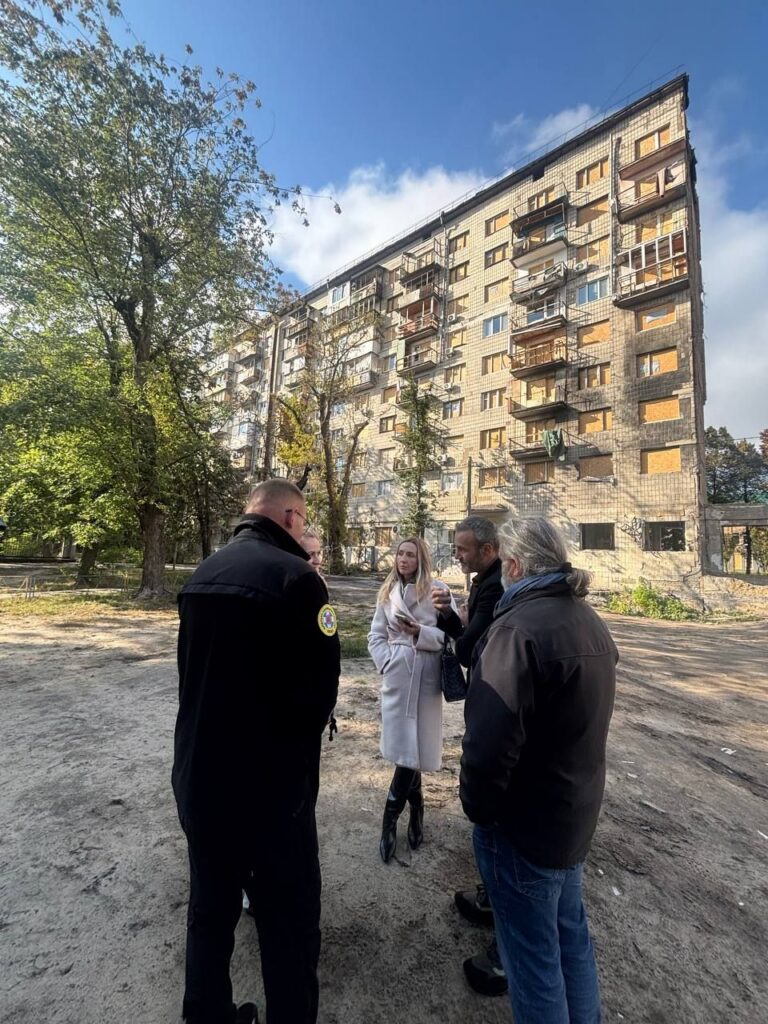
In parallel, this agency was rooted in the assumption of individual and collective responsibility—consistent with Gandhian nonviolent principles such as self-sacrifice and self-rule (swaraj)—enabling resistance against a militarily superior actor. This translated into the co-production of public services: humanitarian aid, healthcare, education, and local security, often in coordination with municipal authorities. Where administrations collapsed, residents developed alternative forms of governance to ensure basic public security and humanitarian aid provision, in besieged cities such as Sumy, decentralized communication systems enabled evacuation corridors and the delivery of medical supplies.
Democratic resistance: The heart of a massive nonviolent movement

Credits: NOVACT/ICIP
The defense of collective identity and the national political project have constituted a central ideological framework for mass mobilization. For large sectors of the population, the war represents a decisive moment in a longer historical process of emancipation from imperial domination that has constrained language, culture, and political development. The construction of a civic nation anchored in democratic and pluralist values operates as a normative horizon guiding organization and mobilization. Civil resistance therefore unfolds along a dual axis: contributing to defense against military aggression while simultaneously reinforcing democratic state-building.
The emergence of a vast volunteer movement—operating both in rear areas and near front lines—involved an unprecedented exercise in community organization. Physical and digital coordination hubs enabled decision-making, resource distribution, and conflict resolution based on trust, solidarity, and shared responsibility. The systematic reproduction of these principles formed the movement’s DNA, reinforcing democratic practices through bottom-up mobilization.
Organizationally, the Ukrainian case mirrors core features of contemporary nonviolent movements, characterized by distributed coordination hubs and horizontally structured networks. This diffuse character enhances resilience under repression, as the detention or intimidation of prominent figures does not dismantle the broader movement. In several occupied territories, when NGO leaders or local officials were detained or disappeared, new leaders emerged organically from community networks. Resistance did not depend on individual personalities but on a social ecology capable of reproducing leadership and collective agency.
Civil resistance has also been marked by decentralization, local rootedness, and adaptability. Ukrainian society has shifted between public protest and clandestine organization, between humanitarian support and post-liberation reconstruction, demonstrating strategic flexibility in volatile environments. These dynamics did not emerge from centralized planning but from decentralized informal networks oriented towards action. Ukraine’s self-government practices, rooted in historical traditions, have contributed to a political culture in which initiative and self-organization are deeply embedded. This cultural substratum facilitates spontaneity and rapid decentralized response, crucial in hybrid warfare contexts where information is fragmented and timing is decisive.
Cooperation between local authorities and civil society proved equally vital. In frontline regions where instructions were unclear or delayed, civilians and local self-government bodies co-produced public services and organized crisis responses. Post-2014 decentralization reforms strengthened local administrative capacity and leadership, creating institutional infrastructures that could be activated rapidly under crisis conditions.
Roadmap toward civilian-based defense in Europe
Ukraine’s highly sophisticated "civic shield" provides a roadmap for European states that may soon see the value in developing a credible and functional civilian-based defense. The main endeavour they will face is to create and reinforce the structural conditions that allow civil resistance dynamics to flourish. The first step is identifying the normative core of what is being, or should be, defended. Sustained mobilization depends on a shared moral conviction. When democracy loses legitimacy, social justice erodes and vulnerable groups are marginalized. Thus, the collective willingness to assume risk in defense of the political order declines. Rebuilding inclusive, equitable, and socially just democratic frameworks is therefore not merely an ethical imperative — it is a strategic necessity. In this context, nonviolent action provides both a practical response to emerging crises and a space for reimagining a more just and democratic “horizon of future”.
Credit: NOVACT/ICIP
Second, investment in social agency and community power-building is essential. Mass training in civilian protection, community organization, crisis management, negotiation under occupation, and nonviolent discipline expands the repertoire of collective action available in hybrid warfare scenarios. This requires allocating resources to resilient civil infrastructures: local networks, youth centers, secure digital platforms, and autonomous coordination spaces. The objective is not the militarization of society but the strengthening of its capacity for self-organization.
Third, generational and geographic cohesion matter. Ukraine’s large-scale youth mobilization was built upon years of regional exchange, volunteering, and civic socialization. Horizontal solidarity and interregional bonds reinforce national resilience. Across Europe, mobility, volunteering, and youth cooperation program developed since 2014 provide a potential foundation for fostering democratic identities and transnational social capital relevant in cross-border hybrid threat environments.
A fourth lesson involves recognizing and integrating the civilian dimension at strategic levels of national defense. Traditional paternalistic views of civilians as passive victims or auxiliary actors underestimate their strategic significance. In asymmetric conflicts marked by polarization tactics, society becomes a central battlefield. Including community leaders and civil society actors in crisis management, threat analysis, and preventive planning enhances innovation and adaptive capacity.
Finally, effective civil-based defense promotes strategic autonomy. Its strength lies in social deterrence — the capacity to render occupation politically costly, administratively unworkable, and morally unsustainable. This combines moral and strategic dimensions of nonviolent action. In Ukraine, numerous local negotiations secured the release of detainees, enabled safe passage through checkpoints, and prevented consolidation of the occupation. The case of Slavutych, the city of Chernobyl workers, is illustrative: following mass mobilization demonstrating the population’s potential ingovernability, local actors negotiated troop withdrawal and the release of the detained mayor. Such episodes show how organized collective civilian resistance can significantly raise the political, economic, and operational costs of both conventional and unconventional military aggression.