Minds of the Movement
An ICNC blog on the people and power of civil resistance
A makeshift memorial for the fallen heroes of the Ukrainian Armed Forces in Kyiv’s central Independence Square. Credit: Oleksandra Keudel.
Since 2022, Russia’s war of aggression has unleashed overlapping crises—attacks on civilians, destruction of infrastructure, mass displacement, and economic downturn. Many assume such emergencies demand strict central control. Ukraine’s experience shows the opposite: resilience has come from polycentric governance—state and non-state actors working together, drawing on local knowledge, pooling resources, and strengthening social cohesion.
Municipalities have been central to this model. Resilience here means more than managing crises caused by the invasion. It’s about preserving the core functions of institutions while adapting everything else. Many municipalities maintained regular administration and decision-making processes through democratically legitimate collegial bodies. Under occupation, some relocated operations to other municipalities under government control and maintained networks to serve their displaced residents nationwide. In practice, local governments upheld their public mandate and democratic legitimacy while becoming crisis hubs: organizing shelters, coordinating aid, ensuring education and social services, and linking government action with civil society, volunteers, and businesses.
Resilience is not the same as crisis management
Resilience is often framed as government preparedness and risk reduction: disaster plans, clear responsibilities, government-directed action. That works for short, sudden shocks like floods or technical failures. But it falls short when crises are prolonged, cross multiple sectors, or are deliberately engineered, as in Russia’s war against Ukraine. In these conditions, resilience depends less on advance planning and hierarchical steering and more on flexibly linking government action with civil society, business, and local capacities.

A sculpture of the Ukrainian word “Volia” (Воля), which means both “freedom” and “will,” created from the remains of the street sign of a Liubymivka village in Kherson region, damaged by shelling. Credit: Oleksandra Keudel.
Indeed, Ukraine shows that resilience does not necessarily come from perfect preparation. Before the Russian full-scale invasion, few municipalities had contingency plans or supplies in place in case of war. Instead, resilience emerged through action: coordinating volunteers, involving affected groups, and adapting existing structures to new demands. Crisis management focuses on short‑term stabilization—quick decisions, damage control, restoring order. Resilience building goes further: it asks how societies can preserve their core capacity to act, learn, and maintain trust under sustained pressure. Both are essential, but resilience is what ensures that institutions and communities endure beyond the immediate emergency.
How stakeholder coordination helps sustain societal resilience
Ukraine’s resilience rests on foundations built before the war. Decentralization since 2014 has given local governments political and fiscal strength while opening space for civil society and business to participate in local decision-making. Under wartime conditions, this practice of participation became the backbone of four mechanisms that turn short‑term crisis response into long‑term resilience.
Knowledge circulation
Formal expertise alone isn’t enough in fast-moving crises. Municipalities tapped local, often tacit knowledge from volunteers and affected groups. Information centers, hotlines, and messenger groups provided both updates and feedback. In Novovolynsk, a volunteer hub helped organize humanitarian logistics by leveraging volunteers’ practical project management expertise and international networks to coordinate aid.
Resource mobilization
War deepened fiscal and organizational bottlenecks, so municipalities leaned on partnerships with non-state stakeholders to mobilize additional resources. In Lviv, the IT cluster worked with the city to establish the UNBROKEN rehabilitation center. In rural Novoiarychiv, entrepreneurs offered “social taxis” to replace missing public transport. Resilience emerged when municipalities acted as coordinators of distributed resources rather than as sole providers.
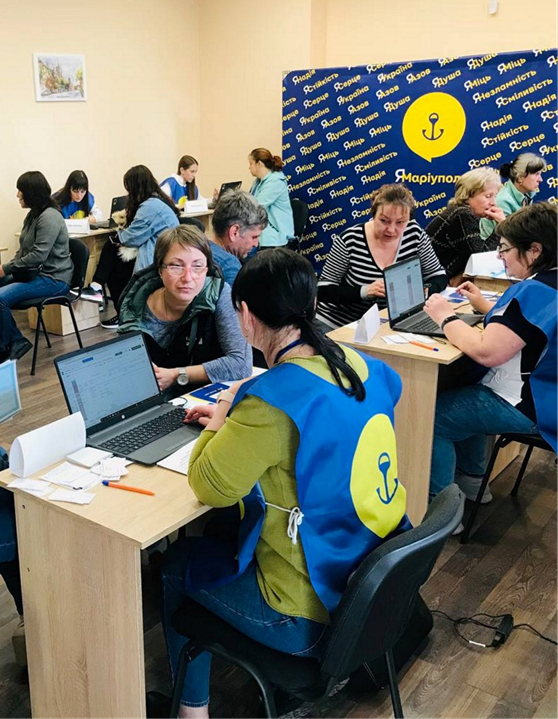
The City of Mariupol, illegally occupied by Russia since May 2022, has opened a dozen I’Mariupol centers to support displaced residents across Ukraine.
Innovation and experimentation
Many solutions were pragmatic adaptations of existing structures and instruments. In Fastiv, the youth council, originally focused on youth policy, assumed the humanitarian aid coordination, using its volunteer networks. Civil emergency plans proved useful with adjustments, and digital tools became central. In Zhytomyr, displaced persons created chatbots to record their skills and needs, which directly informed municipal decisions, including hiring displaced people. The City of Mariupol, illegally occupied by Russia since May 2022, adapted its municipal structures by opening a dozen I’Mariupol centers supporting the internally displaced residents of the city in other Ukrainian cities.
Social cohesion
Crises intensify social tensions, especially when resources are scarce. Municipalities used participation formats to strengthen cohesion and moderate conflicts between locals and displaced persons. In Uman, authorities paired assistance for displaced people with open invitations to all residents, preventing narratives of envy or exclusion. Participation here serves less for co-decision-making than for legitimization, fairness, and the stabilization of social relations.
What Ukraine teaches about European resilience
Ukraine’s experience offers lessons for Europe, though it cannot and should not be copied wholesale. Russia’s war shows that many crises, such as infrastructure failures, supply shortages, or population displacement, may appear to be disaster situations but differ fundamentally because risks are not random; they are deliberately created by an adversary. This means the resilience policy must be strategic: communication, coordination, and participation should aim to circulate knowledge, mobilize resources, encourage limited experimentation, and strengthen social cohesion. The goal is always to protect the core capacities or functions that societies value, even under different threat scenarios.
Resilience has limits.
Ukraine’s experience shows that resilience is not endless. Adaptability depends on available resources, social forces, and time. Amid permanent Russian escalation, many solutions remain fragile and difficult to sustain. Resilience is therefore a process of stabilization, learning, and institutional consolidation, not a one-time fix. That is why Ukrainian experience is instructive: not as a blueprint, but as a rich example of how societies can remain capable of acting under extreme conditions, and where that capacity reaches its limits. At the same time, it makes clear that resilience should not replace the primary goal of stopping Russia's aggression.
Acknowledgements
The authors would like to thank the Congress of Local and Regional Authorities of the Council of Europe for kindly granting permission to use the survey data. In addition, the empirical analysis is based on further data generated in the context of the following projects: “Local Democracy and Resilience in Ukraine: Learning from Communities' Crisis Response in War” by the Kyiv School of Economics, funded by the Swedish International Center for Local Democracy (ICLD); “Kyiv Dialogue Policy Study: Local democracy and social integration of IDPs in Ukraine during the Russian full-scale invasion” by Kjiwer Gespräche; and the ReLoaD project of the Institute for European Politics. The authors thank the Association of Ukrainian Cities, the All-Ukrainian Association of Communities, People in Need Ukraine, and the National Platform for Resilience and Cohesion for support in data collection. The authors previously published some of these ideas in the resources of the Center for East European and International Studies and the Maecenata Foundation.