Minds of the Movement
An ICNC blog on the people and power of civil resistance
"My brother, a member of 110th Separate Mechanized Brigade, is not just a part of statistics - he's a human being." This photo was taken at a peaceful gathering about returning our defenders from Russian captivity. Such protests became a part of spiritual resistance, especially for people who lost their family members. Credit: Valeriia Sheverhina.
This article is part of the Ukrainian Freedom Series, powered by ActionAid Denmark and the Organization for Nonviolent Movements. Check back through March 2026 for many more articles in this series.
“Some of us became activists without fully realizing it. And partially, it wasn’t our choice, but a calling of circumstances and deep emotion that we could no longer suppress.”
- Anonymous Ukrainian activist
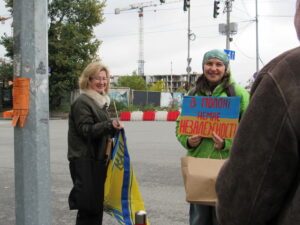
Credit: Valeriia Sheverhina.
The full-scale invasion of Ukraine in February 2022 affected all sectors of the country, including two groups less visible in today’s conversations about security and defense: activists and feminists. As co-founder of the feminist NGO, Me.We.Women, I have seen our collective work expand far beyond equal rights. Now, it is also about survival, civic resilience, reconstruction, and modernization of society. Many feminist initiatives across the country quickly shifted their focus to providing assistance to internally displaced people, women from vulnerable groups, victims of violence, and others. New tensions emerged, too, notably on how to reconcile criticism of patriarchy, militarism, and patriotism with the defense of the country. Everything about war is controversial.
Or is it?
In some ways, the war set Ukrainian feminist NGOs back several years in terms of progress. We must now “put fires out” and help save lives, in addition to advancing gender equality in the midst of increased violence against women perpetrated by Russian soldiers. Further, the war deepened economic inequality and the burden on the care sector, which is predominantly made up of women.
Almost overnight, humanitarian action became part of our nonviolent resistance, and this opened the door to countless numbers of Ukrainians becoming both activists and defenders of their country. And that is a silver lining, which others facing threat and aggression beyond Ukraine can learn from. Emergency situations build unity and camaraderie around the common goal of helping and sustaining those in need. Ukrainian people power–the less visible, human dimension of war–provides the backbone when all else seems divisive and insurmountable.
“A light for each other”
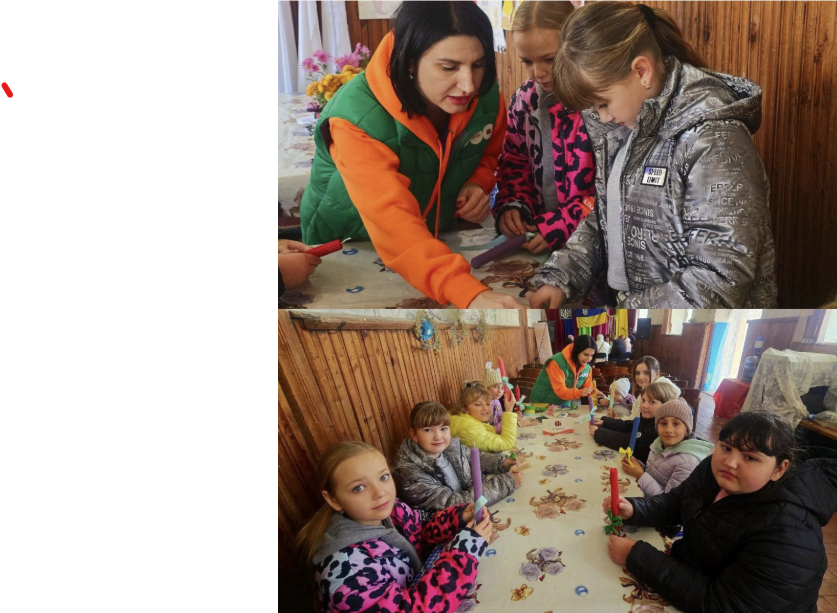
A psychosocial support meeting called “Light Inside” was held in the Kryvyi Rih district in winter of 2025 by Divchata (NGO Girls') mobile brigade. Credit: NGO Girls LinkedIn.
Before the full-scale invasion began, the mother of my respondent, Olena, whose name has been changed to protect her identity, worked as an assistant cook at a social assistance center from Kryvyi Rih, a city three hours’ drive north of Kherson. In the first days of the invasion, her work became part of a greater cause: helping people in need. Doors opened to internally displaced people from Luhansk, Donetsk, and other regions. People who fled literally “naked and barefoot” from the explosions at the last moment found temporary shelter, clothing, and food there, brought by the center's employees and other caring people. Items with noticeable defects were usually cut into long pieces and woven into fishing nets to make camouflage nets.
The center was filled with an atmosphere of warmth, mutual respect, and genuine human communication. “Despite the difficult times, my mother and other employees of the center not only did their jobs, but also prepared preserves, stews, baked goods and, in general, everything that could be sent to the front line at their own expense,” my respondent shares.
By March 2022, when an attack on Kryvyi Rih was being prepared and the city became quite dangerous to stay in, most of the internally displaced people moved to the western regions, and the center then pivoted 100% to providing material assistance to Ukrainian soldiers in the region.
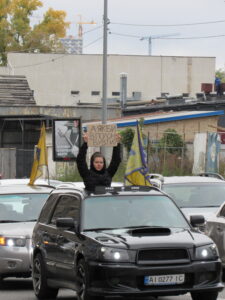
"People took part in peaceful protests even though they understood the danger it posed." Credit: Valeriia Sheverhina.
That month was a turning point. After the occupation of part of the Kherson region, both civilian activism and supporting the armed forces were considered equal forms of resistance, which manifests in a variety of physical, moral, humanitarian, and informational forms. Even in extremely difficult conditions, people continued to help each other, spread the truth about life under Russian occupation and aggression, and preserve their culture and dignity.
“After the full-scale war began, I saw another, even stronger side of our community. People took part in peaceful protests even though they understood the danger it posed. My neighbors shared what little they had: food, water, supplies,” Olena tells me. Her mother tried to make their basement shelter as comfortable as possible for all their neighbors. She brought blankets, chairs, a kettle: “If she could, I think she would have moved the walls to let in even more people,” she says.
“When I talk about my experience in a frontline territory, it’s not just memories of difficult years for me,” Olena tells me. It is a story of a community that did not break, a reminder that even in the darkest times, people can remain a light for each other. And it is this light that drives Kherson and all of Ukraine forward today.
A forcefield of protection
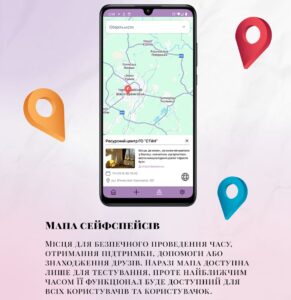
Me.We.Women recently launched a mobile app with articles on rights, activism, feminism, mental health, the LGBTQIA+ community, and volunteering in Ukraine; verified; hotlines for mental and emotional support; and much more. Credit: Me.We.Women LinkedIn.
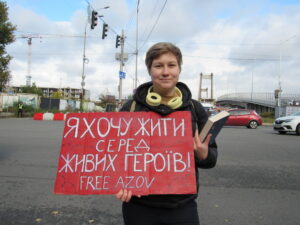
"I want to live among alive heroes." Credit: Valeriia Sheverhina.
To some extent, local media recognize feminist and LGBTQIA+ activists for their acts of mutual aid and solidarity, for creating safe spaces for people, and for championing discrimination even in the midst of war. But their activities rarely reach national, much less international news.
Indeed, a Detector Media NGO study from 2024 shows that over 60% of informational materials about the regions of Donetsk, Luhansk, and Kherson involve military topics and wartime content. Societal, cultural, and civic narratives are mentioned in less than 10% of news in these regions.
Ukrainian media work on military time, and the flow of information is aimed at the topics of defense, security, and warfare. Because of that, stories of local initiatives and people's struggles, especially those concerning the well-being of the LGBTQIA+ community and gender equality, fade into the background. I would like to think we are more of a forcefield–we go unnoticed by most, but we are still more effective at protecting people than nothing.
Insights for European observers
Despite our invisibility, I still believe that our European neighbors have as much to learn from Ukraine’s unarmed defenders as they do from our armed ones. In any case, we are inseparable due to our shared humanity. Many Ukrainian NGOs help our armed forces with supplies, donations, and support, because they need our help too. Civil-military relations are difficult for some outsiders to understand, particularly those driven by pacifist ideology. Simply put, war is awful, and everything about war is controversial–what is essential is doing your part and staying human.
Stories like mine, revealing realities that Ukrainian activists face every day, can become a foundation for building European-Ukrainian dialogue on how to build resilience. I hope these stories can open new channels for solidarity with the Ukrainian people, too. Civilians expand the pie by adding a novel theory of victory into the mix–people power, complementing that of institutional efforts.
In addition to our armed forces, there are many queer, feminist, environmental, educational, and other projects that are worthy of European support, too. We are all fighting, in whatever way we can, to preserve everyday livelihoods and human dignity for all. How we do this is our prerogative, but at least unarmed resistance adds a more ethical option for supporting us, for those outside of Ukraine who want one.
Precisely how can Europeans support the Ukrainian people? One idea is civil society supporting research and collaborative projects with Ukrainian civic groups that focus on cultural heritage preservation, ecology, infrastructure development, and protection of vulnerable groups. Another idea is to share online and in-person platforms with Ukrainian civic actors, inviting them to write and speak at conferences and events in Europe. The Ukrainian experience is important for the collective fight for freedom and dignity, across our continent.
Editor's note: Send us an email at contact@nonviolent-conflict.org for more information about engaging in such support.