Minds of the Movement
An ICNC blog on the people and power of civil resistance
Olga Kravets and Anni Pohto undertake a roadtrip from France to Kyiv, recovering Olga's divided, and divisive, family history. Credit: Author.
This is part 1 of a two-part article inaugurating the Ukrainian Freedom Special Series, powered by ActionAid Denmark and the Organization for Nonviolent Movements (France).
Read part 2 here: "When Your Motherland Wants to Annihilate Your Fatherland".
Check back through March 2026 for many more articles in this series.
"Uncle Samuil, what could you tell me about my grandfather Maxim?"
I sat in front of the cheerful and energetic man in his 70s, bearing a striking resemblance to myself, just in a masculine version. I hadn't seen him since I was a teenager.
The early autumn sun was reaching through the fruit trees and vines into the windows of an old wooden house, in a rare moment of calm in the Kyiv suburb, just minutes' drive from infamous Bucha.
Samuil's face got serious.
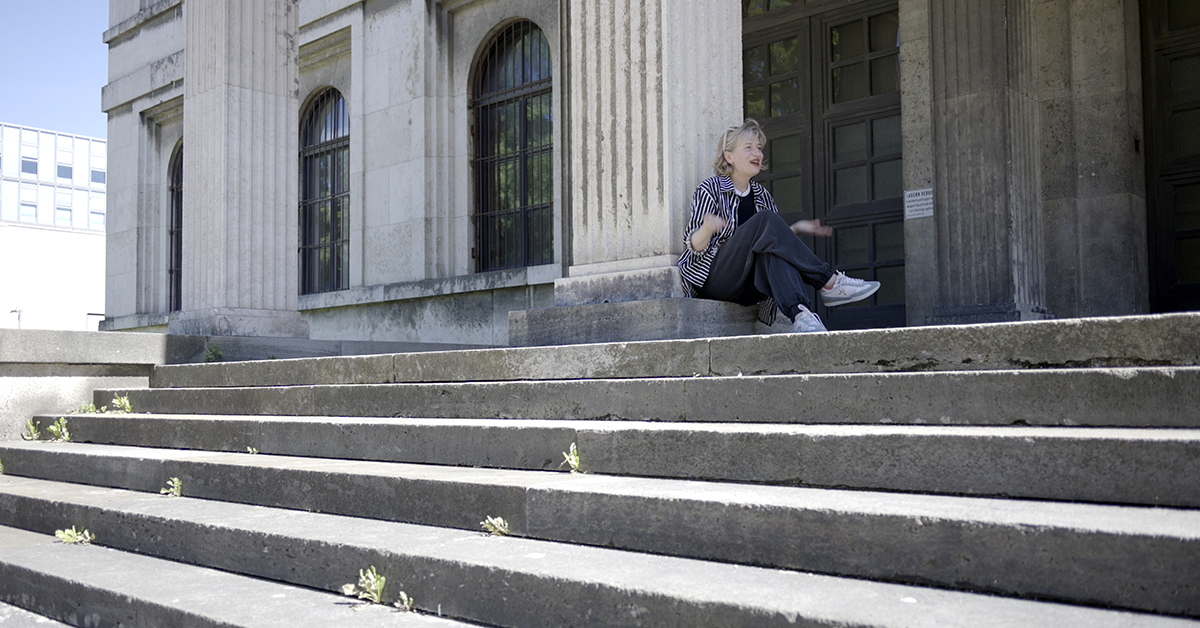
"In Munich, I sat on the stairs of Führerbau, a Nazi architecture gem, conceived for Hitler by his favorite architect Paul Ludwig Troost..." Credit: Anni Pohto.
"Your grandfather was in the labor army somewhere around Lake Baikal. But I don't know the details. I'm not even sure at this point if I had heard this from him directly, or if this is something I just [overheard] working alongside him in his atelier when I was a teen."
For those who don't know, the labor army was the predecessor of gulag, just under a different name.
Facing Samuil, I felt an overwhelming mix of solace and shame. History suddenly felt much less abstract. The Soviet repression was in my bloodlines too. But how could I have been living with the illusion that my entire tribe had been miraculously spared?
For 20 years, I have been filming, photographing, and interviewing people in more than 20 countries, cross-checking documents, collecting and organizing archives. If the country of my mother, Russia, had not decided to try to erase the country of my father, Ukraine, from the face of Earth, I might have never gotten to investigate my family history.
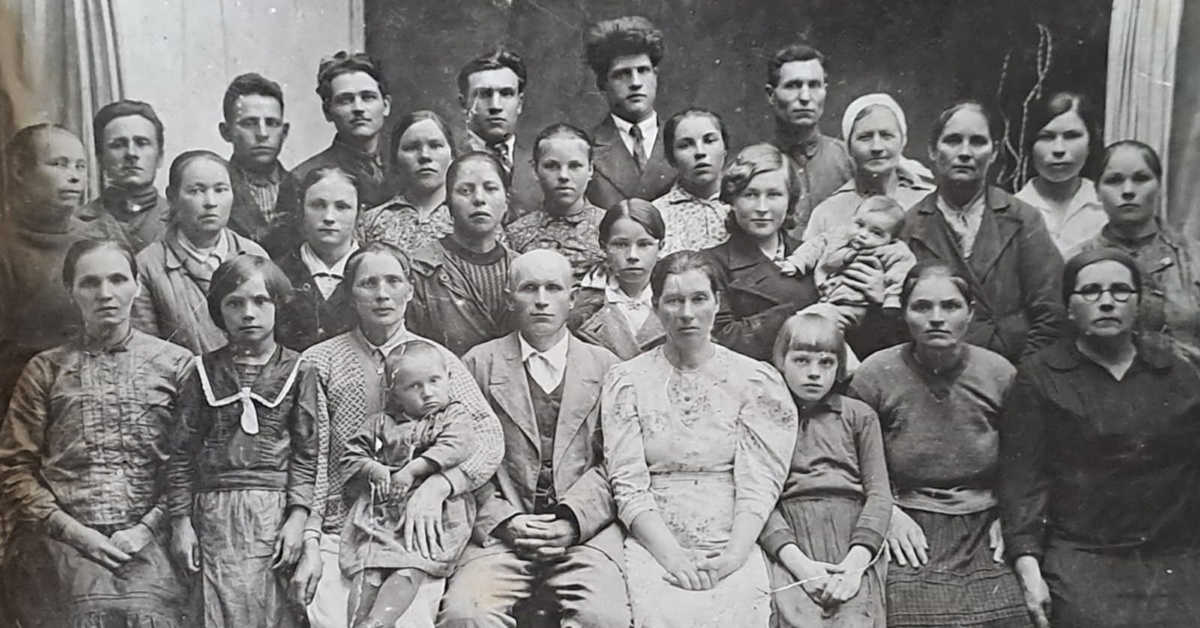
A 1938 photograph from the village of Kotsyubynske outside Kyiv. During the Great Terror, despite religious persecution, the Pentecostal community posed for a group photo. Among them were my grandparents, Maxim and Teklya. Credit: Author.
Putin's war is threatening half of my family. However, it is not only lives that the war threatens. Part of the genocidal Russian intent to prove that Ukraine is not a real nation is the threat to destroy the historical artifacts and cultural heritage across the country. I count among them the archives that can shed light on my family history beyond oral transmission.
So using my journalist skills to investigate my own family story has become my act of nonviolent resistance in the face of this erasure attempt. The Kremlin's actions can be described as crime against history, a term coined by a prominent historian Antoon de Baets.
In my particular case, it was my maternal Russian grandmother who had committed a crime against history in our family. I was raised by her between two and 11 years old and I bathed in a narrative I can now describe as Soviet-colonial.
She was a communist to her bones, a celebrated veteran of the Great Patriotic war [ed: the Soviet way to refer to World War II] working at a local party cell. We ate party rations of red caviar for every important holiday. We did not have a samizdat copy of The Gulag Archipelago [ed: written by a Russian dissident in the 1950s and 60s] at home. My grandmother once dropped along the lines that we had some “very bad relatives who deserved to be sent to a gulag.” Did she know about my paternal grandfather Maxim? Or had she been referring to her cousins who were dispossessed by Stalin and whom I have since found in the repression database by Memorial NGO? I will never know.
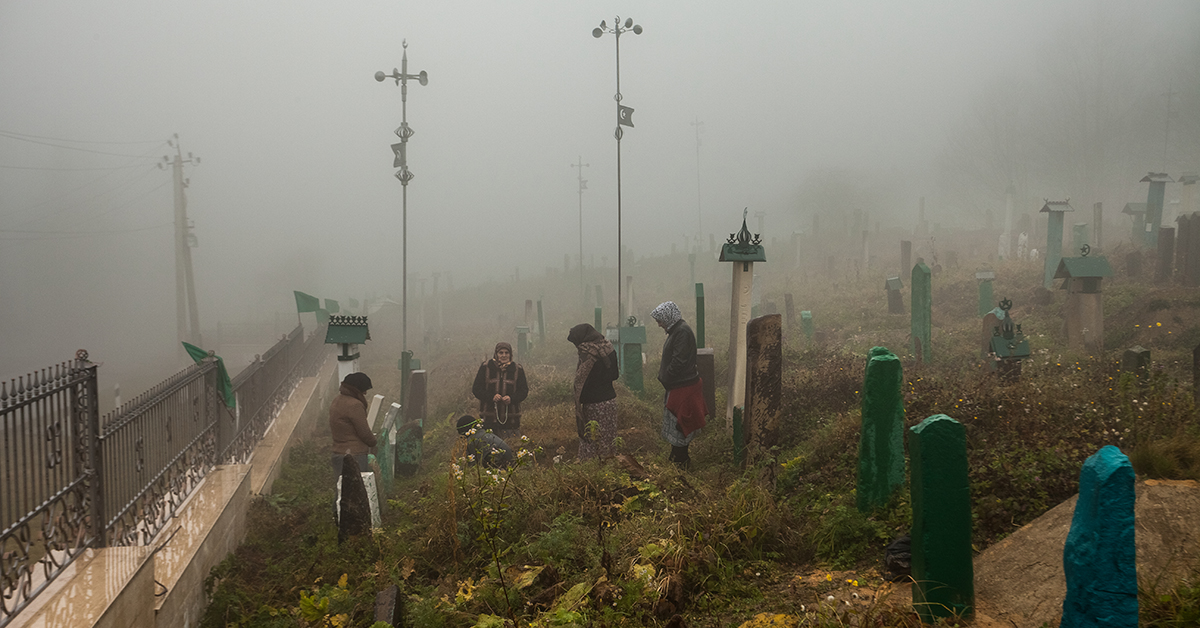
November 8, 2013. A family is praying at a grave in the Khazhi-Yurt cemetery in Chechnya. Credit: Author.
My Russian grandmother must have hated the Ukrainian identity of her son-in-law, my father. The reason my French is a million times better than my Ukrainian is that the authoritarian grandma exercised a ban on “speaking regional languages in the capital”, Moscow, where I was born and lived till I left half of my life ago, so my father didn’t teach me his native language. Now I understand why exactly I didn’t feel at home there. She tried to raise me as purely Russian while I clearly was not.
Through my career as a conflict reporter I forged myself a culturally fluid identity and an international family of women and men who have a couch for me in pretty much every city across Europe and Middle East. At some point I have cut down on nomadic lifestyle and committed myself to living in France, where I have become a citizen.
Between 2004 and 2018, I covered Russia’s war and the aftermath in Chechnya. On the way to and from Grozny, my childhood friends often called me a killjoy at their parties in Moscow, when I shared the stories from the field and said that the Russian war machine was using Chechnya as a training ground to then expand beyond the borders.
I wish I had been wrong. But when I heard the first reports of the Bucha massacre, it vividly reminded me of my nightmares based on testimonies collected in Chechnya. But now Samuil and other family members were part of these nightmares. And I was now again a killjoy... but at Parisians soirées. Again I was trying to warn people that Putin is not going to stop in Ukraine if Europe does not stop him in Ukraine. I was trying to convince people to vote in elections while they still have a chance to enjoy democracy. And once again, I was kindly asked to change the subject.
So I organized a soirée of my own, where that was the main theme. My Finnish friend, singer and songwriter with a geopolitics degree, Anni Pohto came to play at my countryside house. For Anni, playing at people’s homes is an act of resistance against the gatekeeping of the music industry and creating her very own community across Europe. For me, it had a larger-than-life meaning. Forbidden songs were often played at homes of dissidents across the Soviet Union’s eleven time zones. In the society, where free expression didn’t exist, often the most powerful stages were the living rooms.
During my darkest moments, I would blast her song "Amor Mundi" in my car and sing along. This song, inspired by Hannah Arendt, also speaks of Finland being forced to join NATO. Anni’s grandfather fought Russia in the Continuation War, survived and wrote memoirs. Anni and myself were born on the opposite sides of the Iron Curtain that descended in our early childhood and now is up again. We have many things in common as an artist duo.
So Anni and her piano, and myself with my cameras decided to go to Ukraine together. We interrailed to Ukraine, breaking the cliche of the travel movie genre often featuring male buddies doing something crazy. Along the way, before we knocked on Samuil’s door, Anni played at homes in Geneva, Munich, Prague and Warsaw, cities that defined Europe’s war and peace history.
This slow descent into the war zone convinced us of the necessity to wake up European minds. Imagine your terrace is burning, but you are sitting in your fire-proof bedroom in the blissful belief that fire will not reach you... this is how it feels to cross five comfortable European countries on the way to Kyiv to live the reality of drone warfare there.
In Munich, I sat on the stairs of Führerbau, a Nazi architecture gem, conceived for Hitler by his favorite architect Paul Ludwig Troost. Today this place houses a Music Academy. But in 1938 it was where France, the United Kingdom, Italy and Nazi Germany signed the agreement breaching the territorial integrity of Czechoslovakia and let Hitler annex Sudetenland. The Munich accord was much needed for Paris and London to delay the war in order to rearm. Think Crimea in 2014, Russian “polite green men” coming to protect “the rights of Russian-speakers on the peninsula”, coming back to attempt all of Ukraine in 2022.
In Warsaw, I felt a clash between the banal beauty of a quiet day and the imminence of conflict when I opened the news at a public laundromat and saw that Poland had never been as close to an open conflict since World War II. That night, for the first time, Russian drones damaged Polish houses. More drone incidents in Europe came fast, as we continued to Ukraine...
Read Part II here for the rest of the story!