Minds of the Movement
An ICNC blog on the people and power of civil resistance
Ed. note: The author’s choice to write “russia” with a lowercase “r” has been honored.
How do I begin a story I wish I never had to write? I ask myself this not to break the curse of the blank page—I genuinely do not know. Just like four years ago I did not know the difference between the sound of a russian missile being shot down versus the sound of one hitting its target. Being Ukrainian now means learning things you never thought you would need. And doing things you never thought you had the guts to do.
Two years ago I had just returned to my Kyiv apartment after fleeing abroad on February 26, 2022. Even though somebody lived in it while I wasn't there, time stood still, the air was the same. I was different. At the beginning of the full-scale invasion and for some time after, everything seemed to last forever. Will I see my city again after fleeing from it? When will I meet again my dear friend who magically brought me gas when I was stranded in the middle of nowhere, on my way to cross the border? Will I find the way back to my parents' house after the russians bombed and destroyed the bridge leading to it? All the answers felt like NEVER.
Now, looking back, I almost want to laugh at myself for being a drama queen (even though it was totally appropriate in the moment). Now I know: this too shall pass. Now I know: the only question to answer with "never" is "when will this war end?"
At the beginning of the full-scale invasion, all TV channels in Ukraine stopped airing entertaining content, the commercial market was dead, the film industry collapsed. I knew, as a creative producer and screenwriter, that I would never find a job in Ukraine again. And the job found me literally the day after I returned to my Kyiv apartment. Akim Galimov called me and asked if I wanted to produce a documentary series on civil resistance to russian occupation.
If you talk to any Ukrainian civilian with an emotional intelligence more advanced than a sea horse's, they will probably tell you they are not doing enough. That's exactly what I thought, even though I fundraised and volunteered, managed to provide cars, radios, and ammunition for the military. So I jumped right away at the opportunity to do something meaningful and to gather the voices of those who were so much braver than I was.
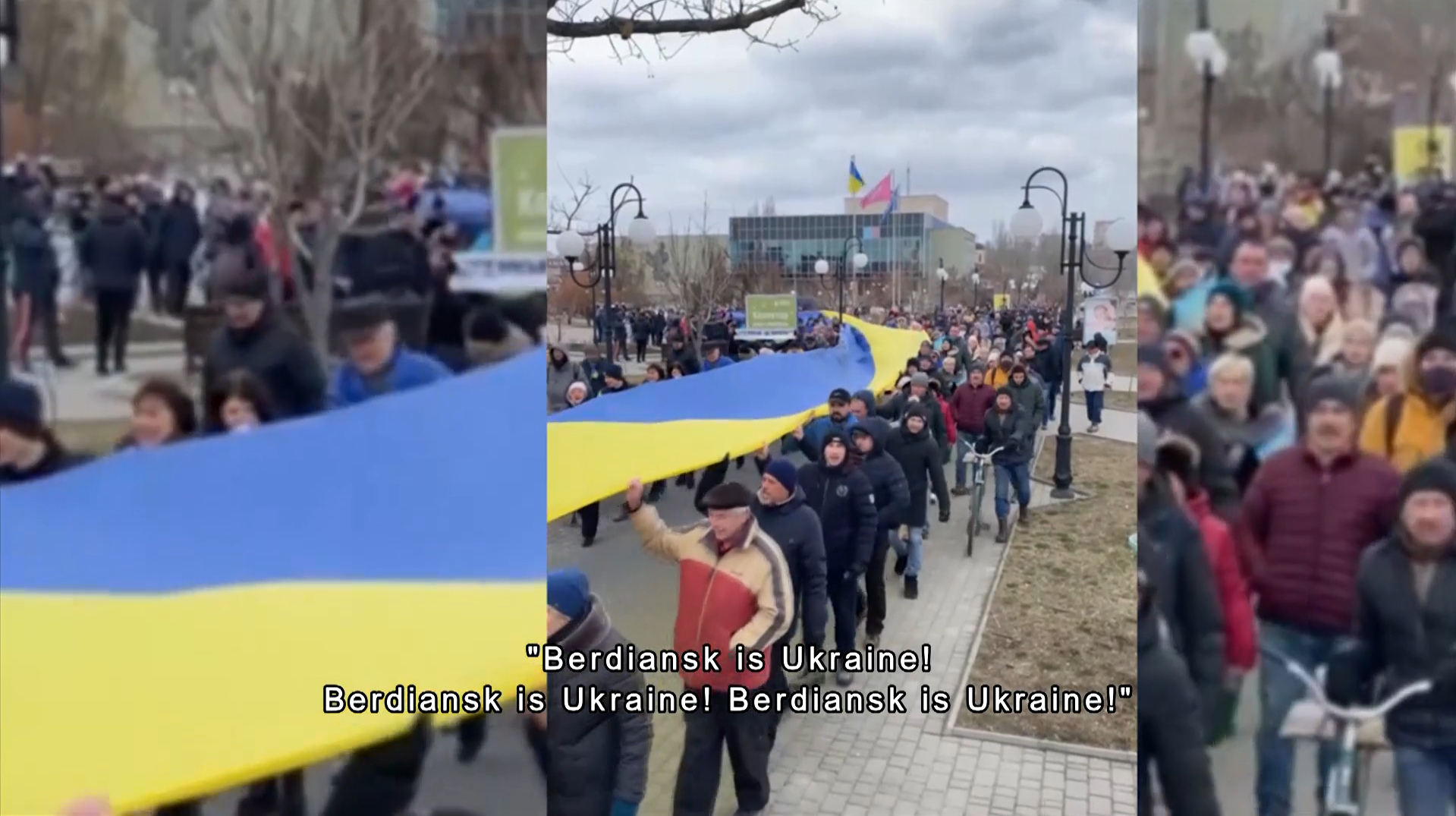
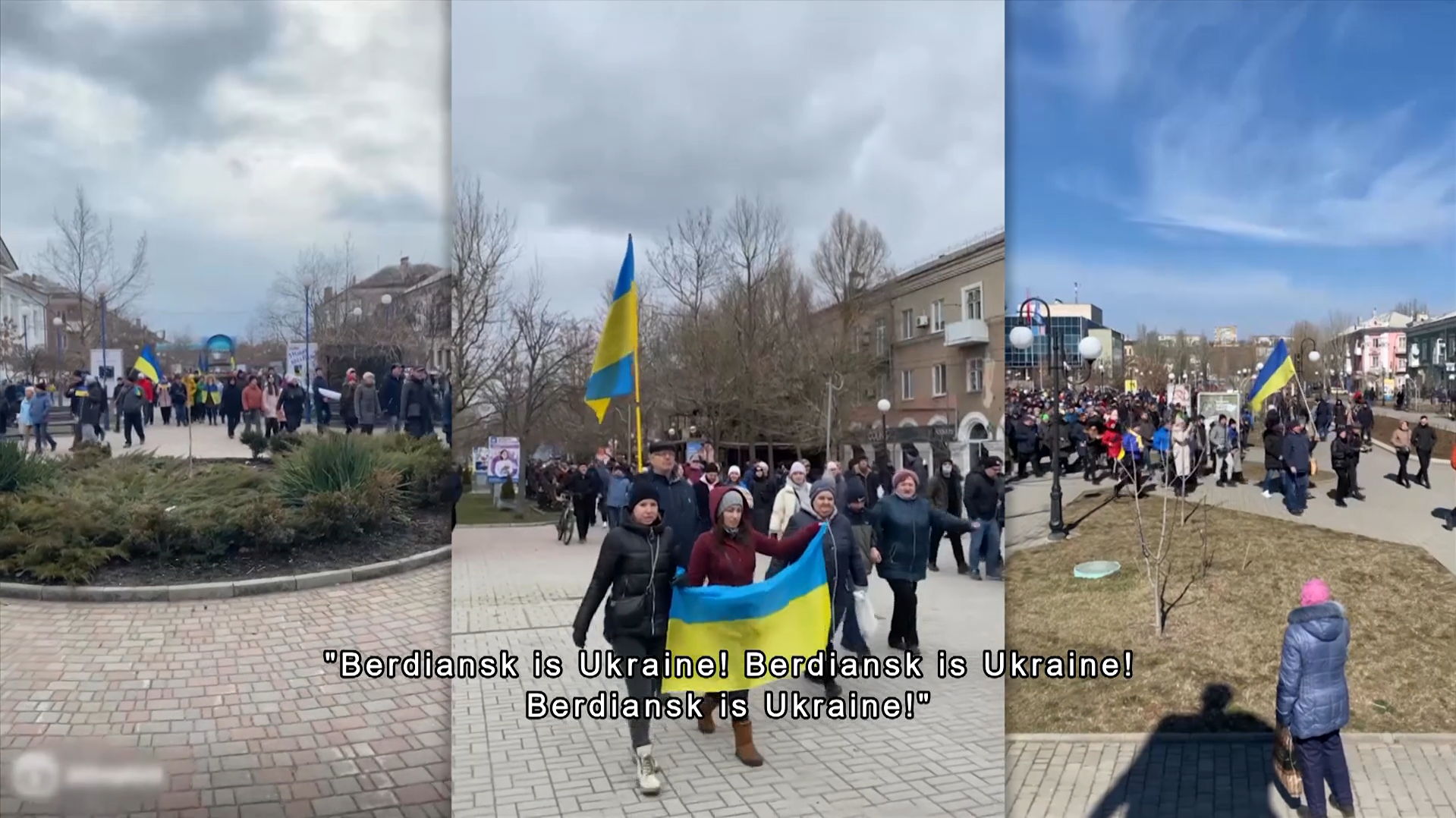
When russians occupied the south of Ukraine, they said: we'll be here forever. Here are our guns, and tear gas grenades, and water cannons, and propaganda. What are you going to do? How about sewing a 50-meter-long Ukrainian flag and gathering at the central square in front of you and your guns? This was the answer Tetiana Tipakova came up with. She was one of four people who became the heart of civil resistance in Berdiansk in February and March 2022. Challenging the status quo. Showing up. Presenting her agency.
We met for an interview with Tetiana in the building of the Institute of Journalism in one of the central districts of Kyiv. This woman looked impeccable: freshly dyed hair with a styled blowout, a manicure, light makeup. You would never guess that when leaving her hometown—the town where she had built her perfect life—she left behind all of her personal belongings. The space in the bags was needed for sausage and vodka to bribe the russians at the numerous checkpoints on the way to Ukrainian-controlled territory. Sausage and vodka to buy yourself a LIFE. That is almost all you need to know about russians.
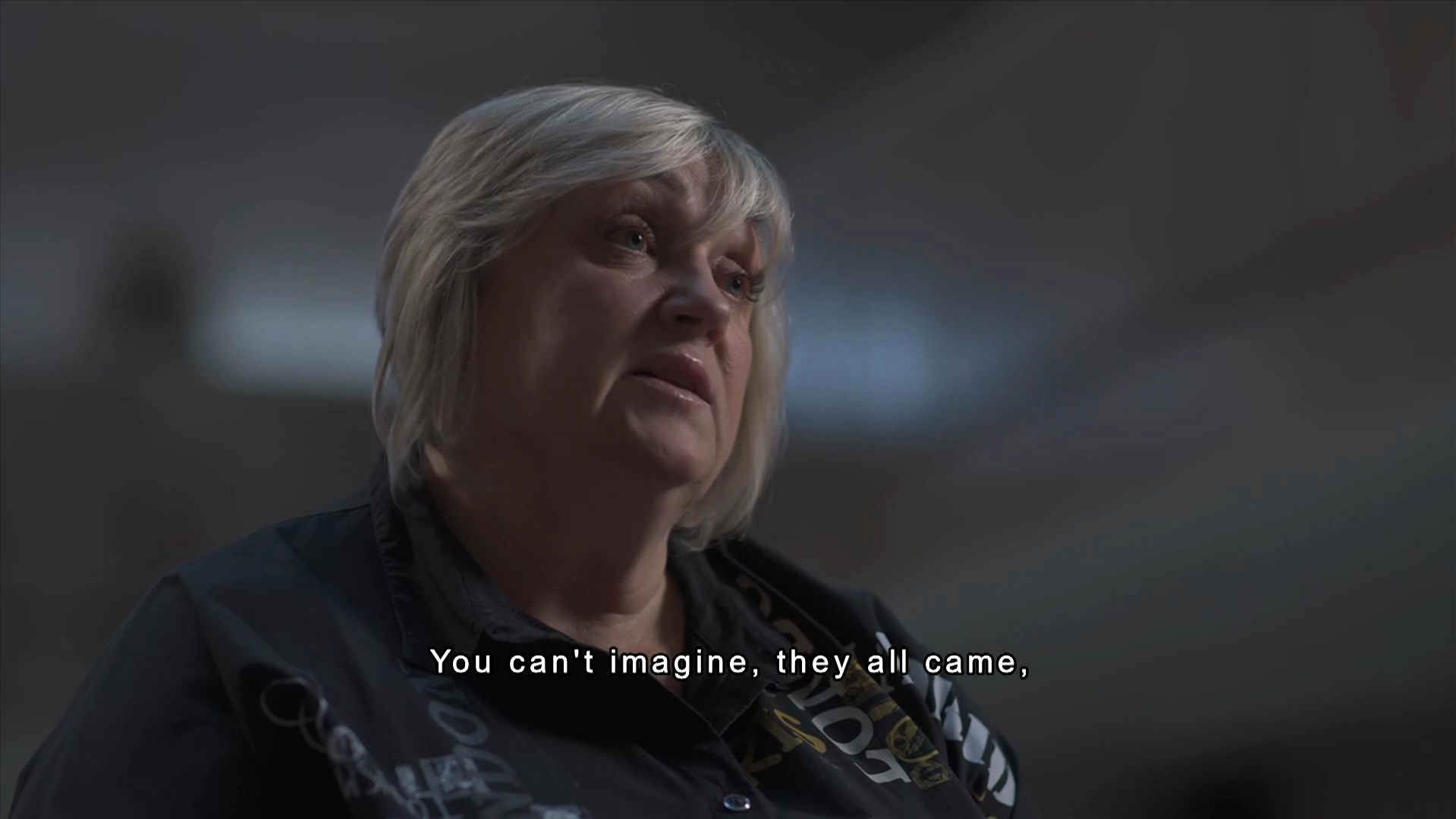
Tetiana Tipakova, A screen capture from the Resistance series
Before meeting for interviews with the protagonists of the four films in our documentary series, my editors, Tetiana Kononenko and Oksana Korobytska, and I went through more than 200 stories of civilian resistance amid russian occupation. One-hundred-seven people—that's exactly how many we spoke with by phone or in person, before sitting down and piecing these puzzle fragments of courage into a single canvas. If you want the details, they sound rather cynical: out of these examples of genuinely brave acts, we were looking for stories monumental enough to build a three-act narrative. But that does not mean the stories omitted are undeserving of respect. There are different forms of resistance and different ways of shining a light on them.
This was precisely our task. Having gathered the stories, we got stuck on the question: by what logic do we divide them into four different films? And eventually we arrived at the idea of dividing them by result. What result did this resistance lead to?
That is how we ended up with four themes.
Resistance disrupts the occupiers' plans
Here we focused on the Ukrainian south and the peaceful protests thanks to which, at the beginning of the full-scale invasion, the world learned that Ukraine is not "a part of russia," that we have a war, not a "territorial conflict", and that we do not want to be occupied.
Resistance saves lives
In the second film we told the stories of those who refusied to follow russian orders, saving hundreds of lives. Among them were the volunteer Mykhailo Puryshev, who evacuated hundreds of people out of occupied Mariupol; and the head doctor of a hospital in Kyiv Oblast, Tetiana Vovk who, risking her life, did not let the russians into the hospital and continued to provide care to Ukrainians.
Resistance liberates Ukrainian territories
Here we focused on civilians who helped our military with intelligence living under occupation. After all, we did the series about different kinds of resistance, so it was logical to include those civilians who cooperated with the military, too. We told how their actions in Kherson Oblast helped liberate the region from the russians. We also conveyed how this kind of resistance started in Luhansk Oblast back in 2014, long before the full-scale war. Because the war did not start in 2022. And it was crucial for us to remind people of this. That's why the fourth film had the theme of…
Resistance preserves Ukrainian identity
We showed, among others, the story of the Crimean artist Bohdan Ziza, whose street art in many ways resembles that of Banksy. The russians sentenced Bohdan to 15 years in a penal colony for “acts of terrorism” after throwing blue and yellow paint at the occupiers’ administration building in Yevpatoria.
What unites all these people is that they exercised their free will and showed up. Just like the thousands of other Ukrainians who chose to show up at the beginning of the invasion to defend their land with weapons. How people choose to resist is personal.
We really wanted to convey this idea not only through interviews but also through the visual part. That's why the series director, Serhii Krymskyi, proposed the concept of "a small person in big circumstances."
But this isn't the same "small person" term that russians use so often to refer to themselves. Originally, the "small person" is a type of literary hero that appeared in russian literature with the arrival of realism in the 1820s and 1830s. It describes a person who occupies a low position in the social hierarchy, and this circumstance determines the person’s behavior. In the modern context, russians often call themselves small people, meaning that nothing depends on them, so there's no point in even trying to change anything.
In our directorial concept, though, the “small” person in circumstances bigger than themselves made the CHOICE to fight. They did not break. They became bigger than the circumstances.
And so we started looking for huge spaces in which to shoot the individual interviews. For the producing team, this was a bit of a challenge. Let's not forget that we were shooting in winter, when russia strikes hardest at the energy grid. And bringing a generator for all the equipment, and also lighting a massive space from that generator—that's a real challenge. But we pulled it off.
 In the interviews themselves, we strived to document russian crimes and our heroes' courage, but without retraumatizing them. As far as that is possible in a world where this damn rule of the complete sentence exists. "Did you think then that one of you might die?" — "No." "You understand, my question won't be audible, there won't be any voice-over either, so it's important that you say the whole phrase in a complete sentence: 'We didn't even think at that moment that any of us might die.'" Where is the balance between a complete sentence and respect for the feelings of the person sitting in front of you in the frame?
I can confidently say that, aside from "repeat that in a complete sentence", we performed no manipulations on our heroes. If you do not document the truth, what is the point of any of this? Tetiana Tipakova, who led the peaceful protests against the russians in Berdiansk, told us about torture with an electric current (the russians call it "the little crocodile", because the clamp attached to the prisoner's finger resembles a crocodile's jaw) and psychological abuse, such as a mock execution. They stood Tetiana against the wall, raised their weapons, racked the bolts, and then let her go, saying that next time it would be for real. They wanted Tetiana to confirm that she loved russia and putin and to agree to organize rallies in support of russia. Tetiana refused.
Only two years later, in a New York Times piece about women who were subjected to sexual violence by russian occupiers, did Tetiana reveal that the russians went much further than torture. We suspected as much back then, but we chose not to steer her onto a topic she was not ready to share.
The interview I remember most is hers, and not just because the scale of her personality overshadows literally everything. It was the first shooting day. And the location was my alma mater, the Institute of Journalism. The huge central hall with the sofas where we used to skip classes 20 years ago. During a break between shootings, my editor and I went to have lunch in the cafeteria. I was poking my fork into the same salad I ate 20 years ago (cabbage, corn, crab sticks, and mayonnaise) and thinking about this day, this interview, and this place. This salad used to feel like the pinnacle of culinary mastery—until later when I tried food that was actually good.
Because the more we absorb of the world around us, the higher our standards become. The standards of journalism were taught to me inside these walls. Taught to always-always give a voice to both sides. Should the voice of the other side be present in our story? What of value can "the other side" say—the side that came to someone else's land with weapons and invented the idea of calling the torture of people, purely for considering themselves Ukrainian, "the little crocodile"? If you just see the REAL world and what is actually going on in it, it becomes very obvious: we desperately need new standards.
I do not have a proper conclusion to all of this. I wish I never had had the material to write this in the first place. All I wish to convey is my experience, however disjointed. Stories do not always have clean plots and happy endings, but even those are worth telling, especially in a world where russians weaponize information. Truth-telling is and will forever be my personal resistance.
-
Note: Akim Galimov is a Ukrainian journalist and TV producer known for creating historical and documentary projects. President Volodymyr Zelenskyy awarded him in April 2026 the Order of Merit, 2nd class, for his contribution to the development of Ukraine’s media landscape, in particular: creating and producing historical and documentary projects that promote Ukrainian history and identity, his informational work during the war, including projects that counter russian propaganda, and strengthening national awareness through media. He created the film series mentioned in this article, Resistance: https://www.youtube.com/watch?v=dLKzUR5SYMc. A screen capture from the Resistance series serves as the cover of the present book.