Minds of the Movement
An ICNC blog on the people and power of civil resistance
Demonstration in front of the customs office in Belladère, Haiti to demand a ban on Styrofoam (July 10, 2022). Credit: Francophone Action Group for the Environment (GAFE).
I grew up and attended school in Haiti. I watched a country that once had a semblance of stability fall further into chaos each day. I lived through repeated periods of pays lock (country lockdown) over fuel prices, the PétroCaribe corruption scandal in which billions "vanished," the assassination of President Jovenel Moïse in 2021, and the rise of gangs that now control whole neighborhoods and choke off economic life. After every hit, people would say, “That’s it, we can’t get any lower than this.” Yet another wave of events would always arrive to prove us wrong.
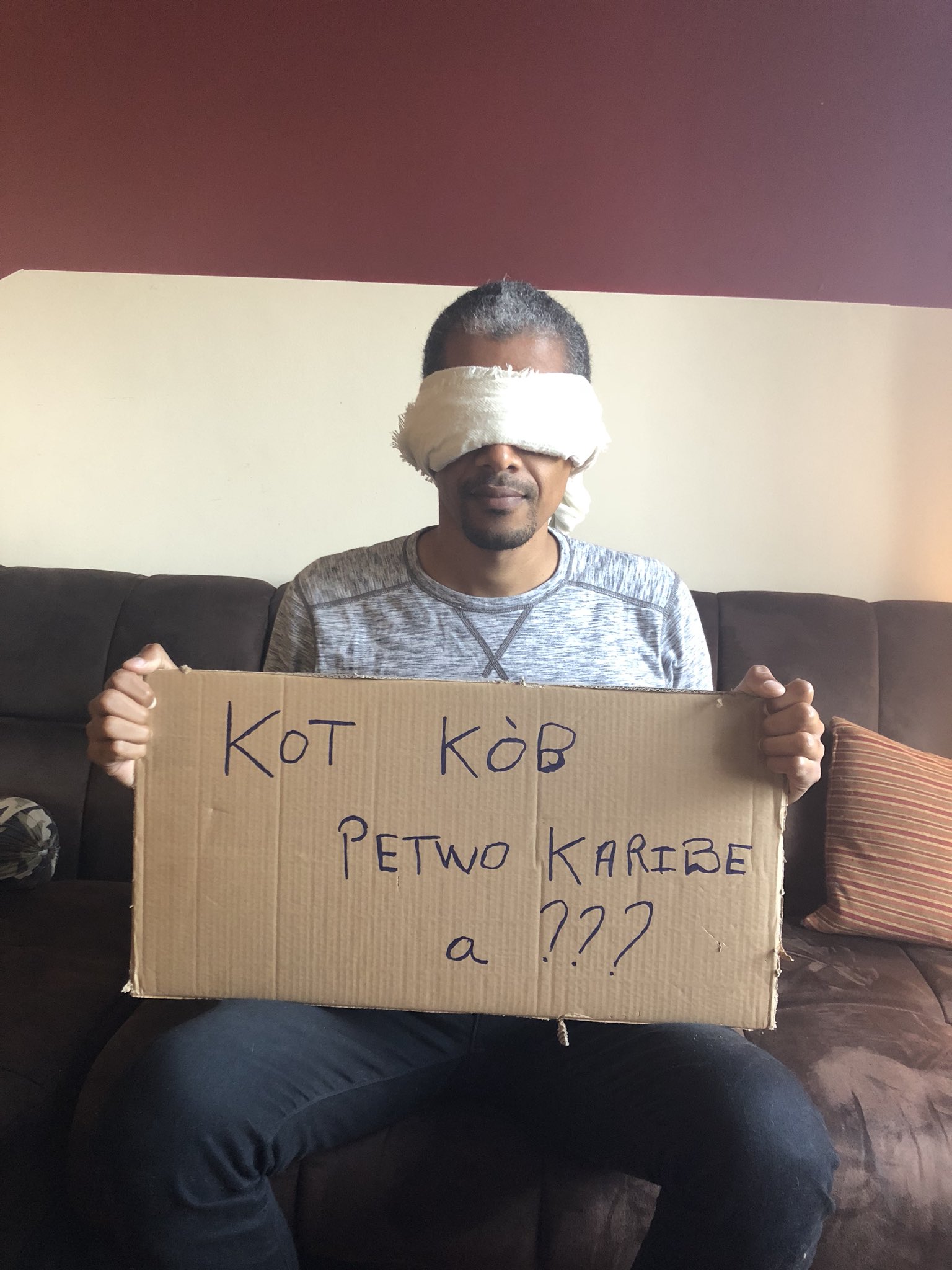
"Where is the PétroCaribe money???" in Haitian Creole. Source: Twitter user @GibszZZz.
Growing up in Haiti over the past decade has become increasingly difficult. Schools do not operate as they should, making access to education and social services a rare privilege. As young people, we face endless worries and uncertainty about our future, even those of us from relatively privileged backgrounds. It is hard to cultivate hope for a better tomorrow, especially when watching so many people pack up and leave. You inevitably ask yourself: Why stay? What is left for young people here aside from gangs and violence? How can anyone live an honest life without the resources others have?
Staying is Resistance
Although some might view it as madness, staying in Haiti is, above all, an act of resistance carried out in a spirit of complete nonviolence. Many people, including activists, possess the financial means, personal networks, and paperwork required to leave. Yet they choose to stay, continuing to send their children to school and go to work even when gunshots echo just meters from their offices. That does not mean fear vanishes; on the contrary, it is ever-present. But fear does not automatically compel everyone to run away.
Those who choose to stay do far more than just exist. They engage directly and speak out with strength and bravery, often at great personal risk. Some have entered politics as candidates in upcoming elections to push for change. Others join social movements or utilize social media to expose corruption, violence, and inequality. Despite gang terror, civic initiatives like the Village of Climate Alternatives continue to mobilize thousands of activists who never stop striving for a prosperous, just, and peaceful country.

Village Alternatiba, Cité-Soleil (2017). Crédit: GAFE.
The 2025 edition of the “Village of Alternatives” event took place in Ouanaminthe from September 19 to 21, with 110 volunteers, 29 exhibitors, 10 conferences, 4 permanent exhibitions, children's activities, and a climate march along the Haitian-Dominican border. Over three days, more than 2,000 participants gathered to address pressing issues, including the environmental impact of Unigold’s mining operations in the northwestern Dominican Republic and territorial boundary disputes. Public advocacy on critical political governance issues, such as the rejection of the draft constitution, remains vibrant because activists stay on the ground. Those who stay are not passive; they make significant contributions to countering the unjust system poisoning Haiti.
Leaving is not abandoning
Some activists believe they can fight more effectively from outside the country by advocating on television programs or in international forums where decisions regarding Haiti are made. For instance, activists lead advocacy efforts warning that the European Union’s Global Gateway initiative risks replicating resource extraction models incompatible with environmental justice, democracy, and human rights. Others work to secure funding for new projects aiming to rebuild Haiti.
When young people go abroad to study, work, or engage in activism, we should not view it negatively. Their presence abroad supports local efforts by amplifying activists' work in Haiti, expanding advocacy networks, raising awareness within international institutions, and securing resources. They help elevate voices that might otherwise struggle to be heard from inside the country.
There is no single "right" way to fight for Haiti. Staying isn't the only way to resist, and leaving doesn't mean turning your back on your homeland. Some find their impact magnified from abroad, while others are most effective within the country. The essential goal is for everyone to find their place and leverage their position, knowledge, network, and influence to help Haiti overcome its present crisis.
Having recently left the country to pursue my studies, I struggled with this very dilemma, carrying a heavy guilt, feeling as though I had abandoned both my homeland and the family I left behind. At first, I feared I would become useless, reduced to hearing distant echoes of news while slowly detaching from home. But I soon realized that giving up was simply the easier path, and that my contribution was far from over. I can join global discussions and conferences that address Haiti's reality, share authentic stories with those whose understanding is shaped only by brief news headlines, stay deeply informed, and champion our rich culture. What matters most is ensuring Haiti is never forgotten or hidden away in the dark, but that the courageous struggles of her activists remain front and center. In a world where so many lose faith, I refuse to stop fighting until Haiti once again shines as the "Pearl of the Caribbean."