Minds of the Movement
An ICNC blog on the people and power of civil resistance
Flooded neighborhoods, dry taps, and avoidable loss: Kenyans protest peacefully against a crisis of neglect and unequal access. Credit: Okaka Onyango
At dawn in Nairobi’s informal settlements, water is already being bought and sold—often at prices higher than in the city’s wealthiest neighborhoods. For many residents, access to water begins not with a tap, but with a transaction. Yet these daily experiences of exclusion have also produced resistance. Across Kenya, grassroots organizations, women’s collectives, and social justice centres are organizing to challenge unfair pricing, defend shared water sources, and push for more accountable and equitable water systems.
Water scarcity in Kenya is not simply a natural or technical problem; it is also shaped by political and economic decisions. Across informal settlements, rural communities, and arid regions, access to clean and safe water remains deeply unequal. Since the 1990s, privatization and cost-recovery reforms have reshaped water governance, often shifting it away from public need and toward market-based systems. While these dynamics are visible in Kenya, they also reflect a wider pattern in which access to essential resources is increasingly influenced by profit, private control, and unequal infrastructure.
How Scarcity Is Produced and Why It Triggers Organizing
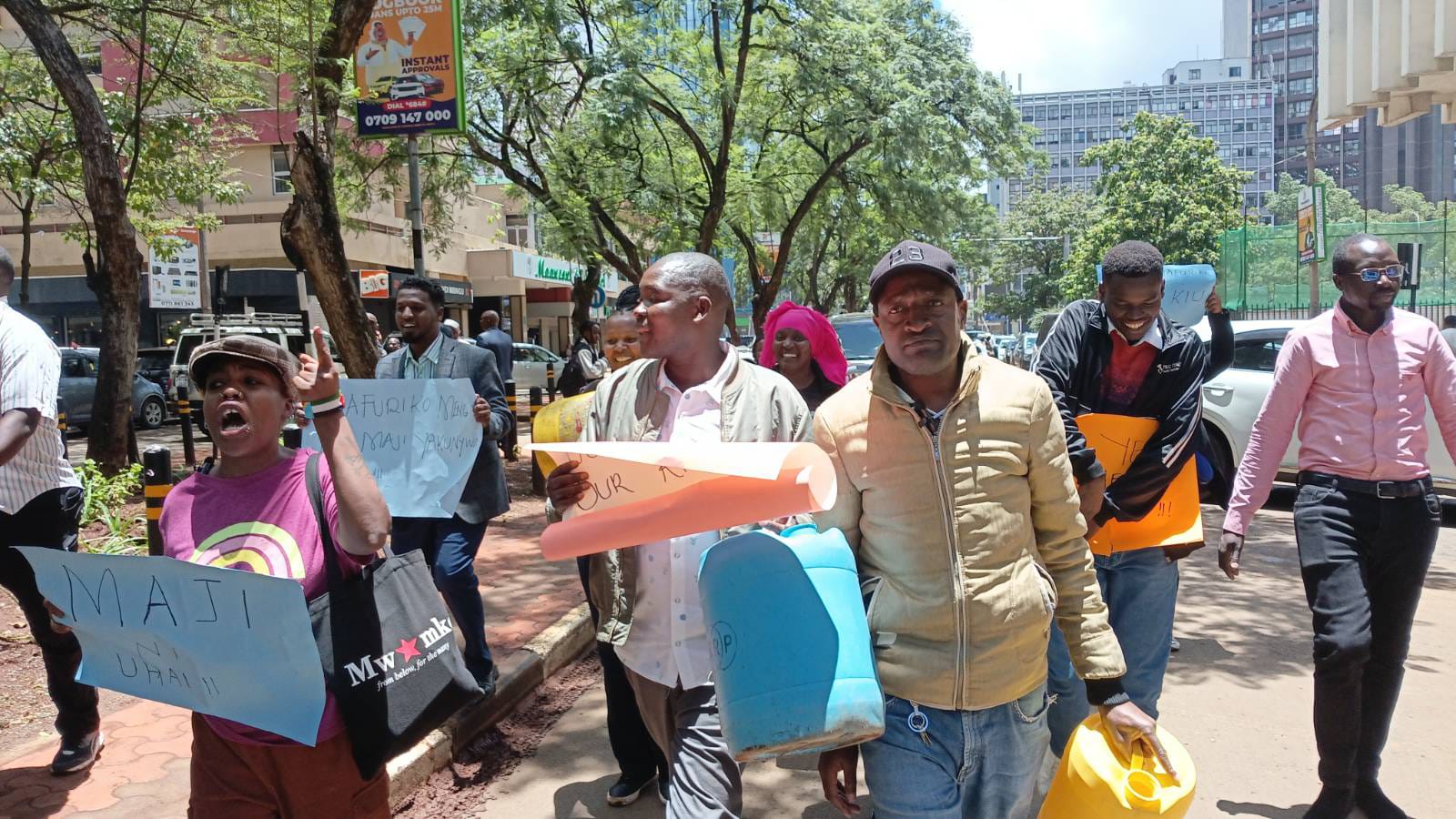
In a peaceful protest, Kenyans demand action on flooding, loss of life, failing drainage, and the ongoing denial of clean and safe water for domestic use. Credit: Okaka Onyango
Kenya’s water crisis is shaped not only by environmental stress, but also by decisions about control, distribution, and public investment. Across the country, privatization, land concentration, and unequal infrastructure have pushed many communities further from water sources they once relied on or managed collectively.
In places such as Naivasha and parts of the Rift Valley, large commercial farms use vast amounts of water for export crops such as flowers and avocados, while nearby communities face depletion, pollution, and growing insecurity. In Nairobi’s informal settlements, unequal service delivery creates another layer of exclusion: residents often pay far more for water than wealthier neighborhoods connected to formal pipelines.
These conditions do more than explain inequality; they also help explain why water has become a site of organizing. When access is shaped by exclusion and unequal power, communities respond through mutual support, public pressure, local resistance, and coordinated campaigns for fairer access and accountability.
Grassroots Resistance: Organizing for the Right to Water
Across Kenya, communities are refusing to accept water exclusion as inevitable. They are responding to state neglect, commercial control, and unequal service delivery through grassroots organizing. These efforts show how everyday grievances around access, price, and contamination can become the basis for sustained collective action.
Social Justice Centres and Urban Water Activism
In Nairobi’s informal settlements, community-based organizations such as Kayole Community Justice Centre (KCJC) have become important voices in the struggle over water access. We have organized against illegal disconnections, price exploitation by water cartels, and contamination caused by broken sewer systems.
Through participatory community research, these groups document how inequality is built into the city’s water infrastructure. They also use murals, street theatre, photography, and other public-facing forms of protest to make water injustice visible. By linking local grievances to constitutional protections such as Article 43, which guarantees access to clean and safe water, they show how community organizing can turn everyday exclusion into a platform for nonviolent resistance and public accountability.
Women’s and Rural Organizing for Water Access
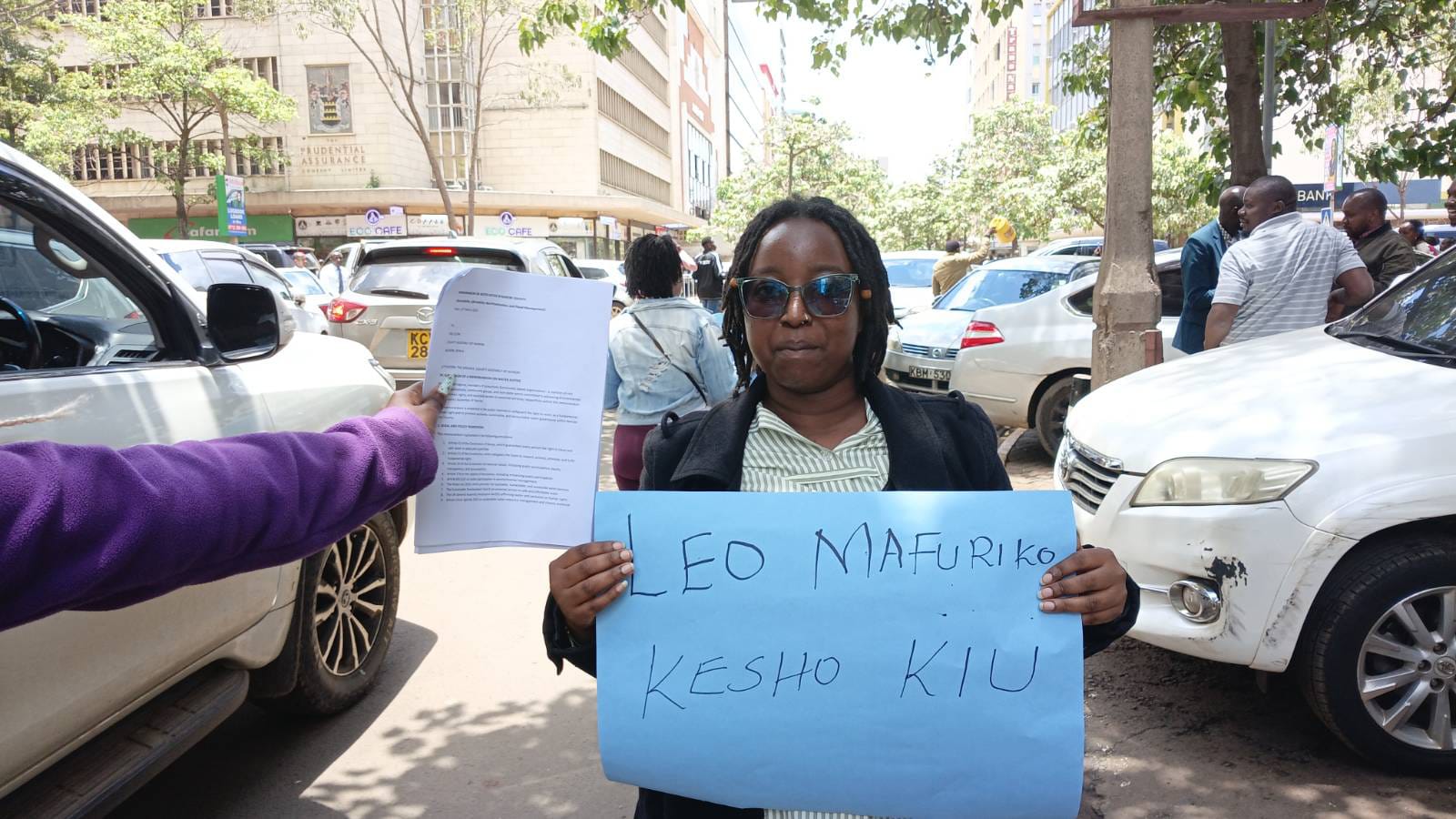
Leo Mafuriko, Kesho Kiu " Floods today, Thirst tomorrow" Credit: Okaka Onyango
Women and indigenous communities are leading some of the most sustained grassroots efforts to defend shared water resources from exclusion and privatization. In counties such as Kitui, Turkana, and Kajiado, women’s collectives and self-help groups have reclaimed community boreholes, built rainwater systems, and developed cooperative management structures rooted in care, reciprocity, and ecological balance.
Groups such as the Ngare Ndare Women’s Network have resisted land grabs and water privatization by combining traditional knowledge, collective labor, and legal advocacy. Their organizing links gender justice with environmental protection, showing that sustainable water management must center on women’s leadership.
Indigenous Organizing and Defense of Shared Resources
In pastoralist regions such as Samburu, Turkana, and Isiolo, indigenous groups, including Friends of Lake Turkana (FoLT) have resisted dam projects and state encroachment on shared water resources. Through social media, legal petitions, and cross-border alliances, they have connected local struggles to broader environmental and climate concerns.
These efforts show how communities defend water not only through protest, but also through coordination, alliance-building, and locally rooted systems of stewardship. They also demonstrate that water struggles are rarely isolated: they are tied to land, livelihoods, displacement, and the right of communities to shape decisions affecting their survival.
Challenges, Creative Tactics and Strategies of Resistance
Despite growing resistance, organizers face criminalization, surveillance, limited resources, and funding constraints, making sustained organizing costly both individually and collectively. Even so, Kenya’s water movements show that resistance is not only about opposing exclusion. It is also about building alternative systems of care, coordination, and accountability. Communities employ diverse strategies and tactics, including:
- Localizing the struggle: movements ground the struggle in lived experience. Community-led research helps residents document how exclusion works in practice and gives campaigns a strong local foundation.
- Intersectional organizing: organizers connect water to other issues rather than treating it in isolation. Questions of class, gender, land, public services, and ecology all shape how communities experience water injustice and how they mobilize against it.
- Creative resistance: movements use creative tactics to make hidden inequalities visible. Murals, storytelling, photography, and public performance allow communities to communicate grievances in ways that are accessible, collective, and difficult to ignore.
- Network building: organizing grows stronger through networks. Alliances across urban settlements, rural communities, women’s groups, and indigenous movements help link local struggles to wider demands for accountability.
- Alternative systems: communities not only resist harmful systems; they also build alternatives. Cooperative water access models, collective management structures, and shared systems of care show that communities are not just demanding change from above, but also practicing it from below.
From Resistance to Reclamation
The struggle for water in Kenya reveals how essential resources can be controlled in ways that deepen exclusion rather than meet public need. But it also shows how communities reclaim agency under difficult conditions. Through organizing, solidarity, and practical alternatives, people are redefining water justice to mean not only access, but also dignity, accountability, and community control.
These movements remind us that resistance is not only reactive but also creative. In defending water sources, exposing injustice, and building local alternatives, Kenyan communities are advancing a vision of democracy rooted in shared struggle and collective responsibility.