Minds of the Movement
An ICNC blog on the people and power of civil resistance
Youth organisers of Zambia’s Bush Protest against corruption, poor governance and restrictions on freedom of expression. Lusaka, Zambia, 22 June 2020. Credit: Open Parliament Zambia
When repression makes a planned demonstration too dangerous, should organizers cancel it or change their tactics? Zambia’s June 2020 Bush Protest offers one answer: preserve the objective, change the method.
On 22 June 2020, a group of fellow activists and I organised a protest against corruption, poor governance and restrictions on freedom of expression under President Edgar Lungu’s Patriotic Front (PF) government. We expected thousands of citizens to join us. The government responded with threats of physical harm and a heavy police presence in Lusaka. The threats were not abstract. One of the most notable came from Tutwa Ngulube, then a PF Member of Parliament, who publicly urged police to deal forcefully with protesters, saying they should “break their bones if possible.” Stephen Kampyongo, then Home Affairs Minister, also warned that we “should not say we were not warned when the wide police dragnet catches up with us.”
Police also refused permission, citing COVID-19 restrictions, while gatherings seen as favorable to the government went ahead.
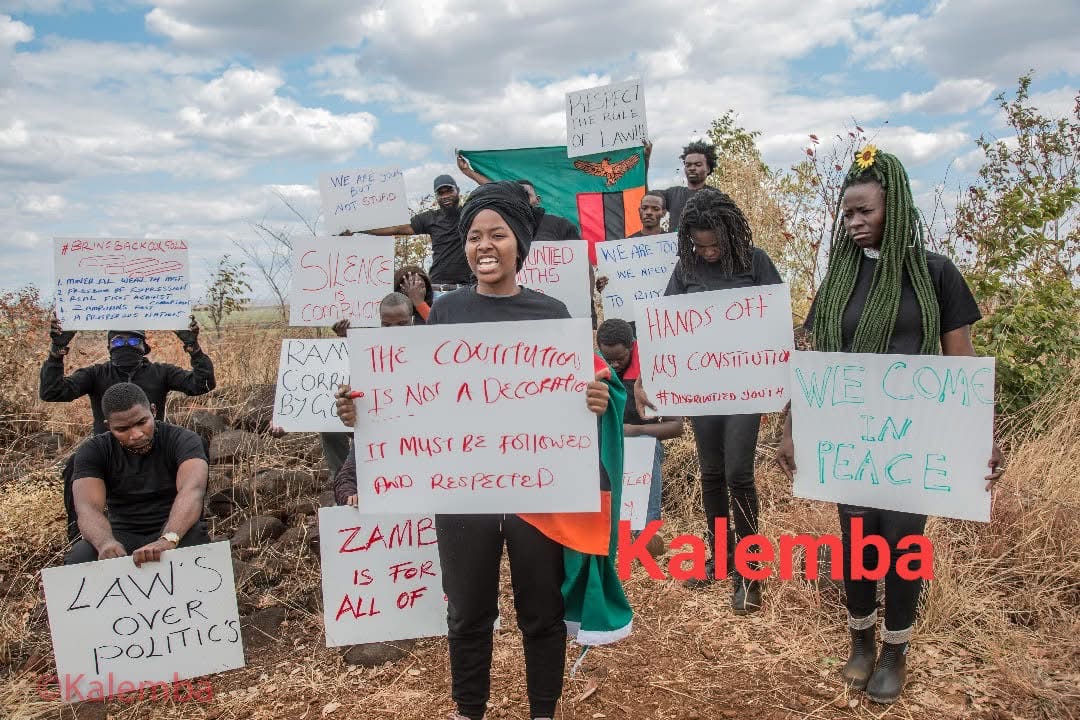
Thirteen of the organizers gathered at an undisclosed location and livestreamed the protest. Credit: Kalemba
Rather than expose protesters to arrest and assault or abandon the action, we changed its format. We decided together on the night before the protest. We considered postponing, but we were unlikely to be granted permission regardless of the date. The bush offered a location police were unlikely to reach quickly.
Thirteen of us gathered at an undisclosed location outside the city and livestreamed the protest. We arrived dressed in black, carrying handwritten placards. We sang the national anthem with a passion I had rarely experienced before, alongside protest songs and individual statements. One song, drawn from the Cha-cha-cha era, recalled the hardships of sleeping in the bush and living alongside snakes during the struggle for independence. A generation born into an independent Zambia had found itself in the bush to exercise freedoms earlier generations had fought for.
The protest proceeded, but not where the authorities expected. When a journalist who claimed to want to cover the protest asked for our location, we gave him Chalala, a Lusaka neighbourhood, as a decoy. Shortly afterwards, police surrounded Chalala, while we remained elsewhere. No one was shot, beaten or arrested, and hundreds of thousands of people followed the protest online.
Adapt the tactic, not the objective
Our objective was to express dissent and make young people’s demands heard. A street protest was one method of pursuing it, not the objective itself. Changing the format kept the action alive while reducing the number of people exposed to physical danger and disrupting the state’s preparations. It also came at a cost: we gave up the public presence a mass street protest can create. But we weighed that against the real risk of exposing people to violence or arrest.
Livestreaming was central to how we sustained the protest and extended its reach. By broadcasting through our own social media accounts, we could communicate directly with the public rather than depend entirely on traditional media to tell our story. We invited only a few journalists we trusted. This gave us greater control over how the protest was presented and allowed young people across Zambia to feel part of the action, even if they could not attend. We asked people to stay home and post photos of themselves dressed in black with placards, and to share and comment on the livestream.
Digital organizing had a cost too. In the days before the protest, competing announcements and counter-messages about the protest’s location, timing and even whether it would go ahead caused confusion among supporters. We learned to speak with one voice: we designated one person to deliver our video announcements and agreed on common messaging.
Turn attention into demands
In my assessment, the attention the protest drew made the authorities take it seriously. President Lungu openly criticized the Bush Protest and its social media audience in a national address, while announcing a K30 million youth empowerment scheme.
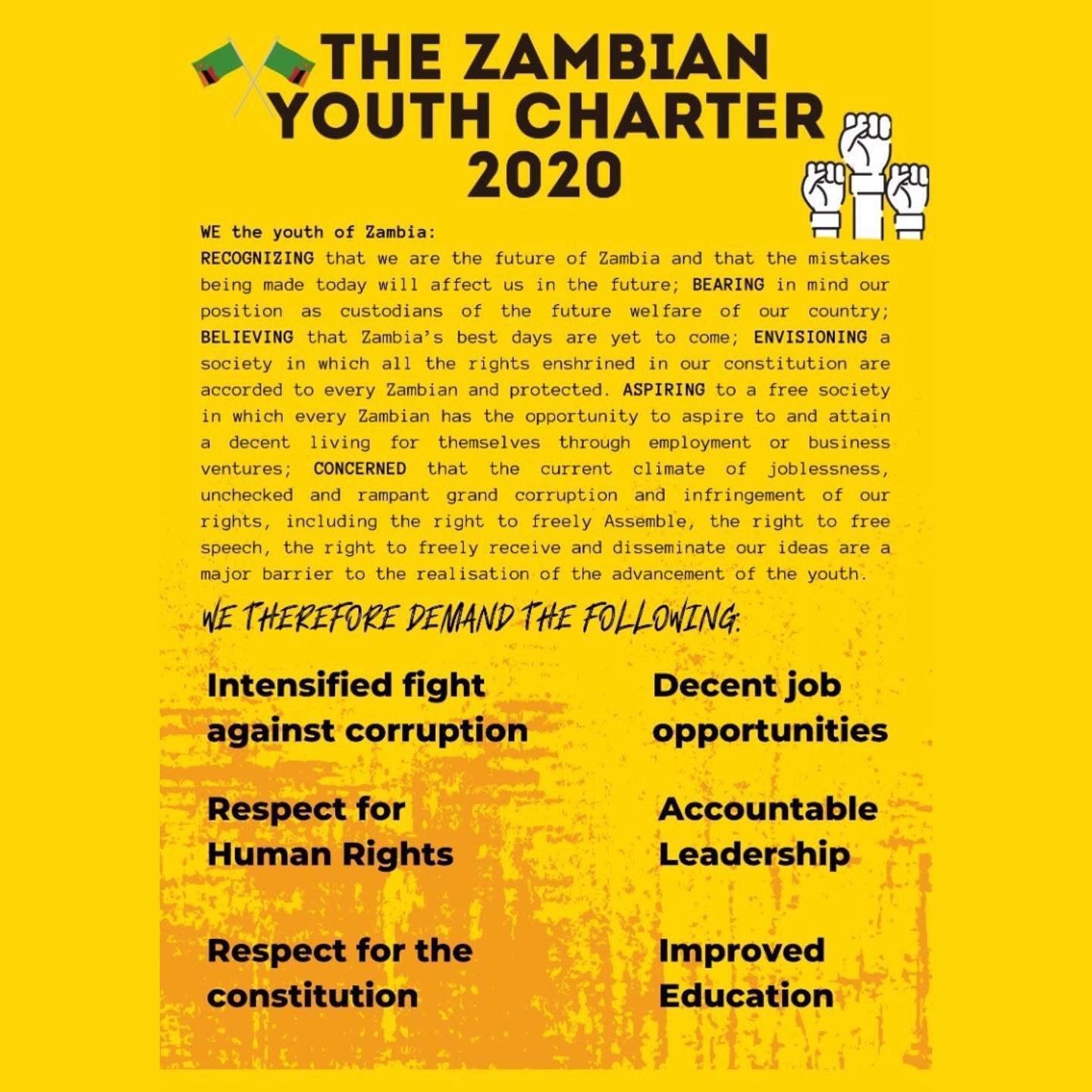
The Zambian Youth Charter 2020
Our next challenge was to spell out what we wanted beyond the protest itself. After the protest, we wrote a Youth Charter setting out our demands, including accountable leadership, action against corruption, respect for human rights and better opportunities for young people. We circulated it online and presented it to the government, which did not officially respond.
But the organizers were individual activists who already worked in their own spaces, and after the Bush Protest we largely returned to them. The experience showed how hard it is to sustain collective momentum beyond a single event.
Define success before taking action
Looking back, one shortcoming stands out: we had not set specific, measurable indicators of success. I believe the action contributed to greater political participation among young people, including the large voter turnout in 2021 and increased political conversations on social media. But we had not agreed on clear criteria against which to evaluate the results.
Would success mean reaching a particular audience, securing a formal response, sustaining participation, or specific policy change? Each requires different measures and follow-up. Without agreed criteria, it is hard to assess what worked, what didn’t, and what should happen next.
Reassess tactics when the context changes
I would not assume the same strategy would work in Zambia today. While the PF government’s repression was often visibly physical, I see the current UPND government as relying more on laws and institutions. That difference changes the conditions under which movements organize.
If I were organizing the Bush Protest today, I would place more emphasis on digital security. Social media remains essential for reaching people, but I would be more deliberate about the platforms we use, how we protect organizers, and how we account for surveillance and cyber laws that could expose people to risk.
The Bush Protest showed that a nonviolent action can survive when its original form becomes too dangerous. Whatever the context, assess the risks, preserve the objective, and change the method.