• Americas
      • Dutch
      • English
      • French
      • Mayan
      • Portuguese (Brazilian)
      • Spanish
    • Central & South Asia
      • Bangla
      • Dari
      • Dhivehi
      • English
      • Farsi
      • Kyrgyz
      See More
    • East Asia & Oceania
      • Indonesian
      • Burmese
      • Chin (Burma)
      • Chinese
      • Portuguese (Continental)
      • English
      See More
    • Europe & Eurasia
      • Armenian
      • Azeri
      • Belarusian
      • Catalan
      • Portuguese (Continental)
      • Croatian
      See More
    • Middle East & North Africa
      • Arabic
      • Azeri
      • Dari
      • English
      • Farsi
      • Hebrew
      See More
    • Sub-Saharan Africa
      • Afaan Oromo
      • Amharic
      • Arabic
      • Portuguese (Continental)
      • English
      • French
      See More
  • Learn More About ICNC's Translations Program

International Center on Nonviolent Conflict

  • About
    • What Is Civil Resistance?
    • Our Work
    • Our Impact
    • Who We Are
    • Jobs & Internships
    • Join Our Mailing List
    • Contact Us
  • Services
    • Online Courses
    • Interactive Workshops
    • Staff Training
    • Coaching
    • Training of Trainers (ToT)
  • Programs
    • Column 2
      • Minds of The Movement Blog
      • ICNC Publications
      • Nonviolent Conflict News
      • ICNC Online Courses
      • Regional Institutes
      • Sign Up
      • ICNC Webinars
      • For Activists & Organizers
      • For Scholars & Students
      • For Policy Community
  • Resource Library
    • English Language Resources
    • Translated Resources
    • ICNC Films
  • Media & Blog
    • For Journalists and Press
    • ICNC Newsmakers
    • Minds of the Movement Blog
  • Translations
    • Afran Oromo
    • Amharic
    • Arabic
    • Armenian
    • Azeri
    • Bahasa Indonesia
    • Bangla
    • Belarusian
    • Burmese
    • Chin (Burma)
    • Chinese
    • Croatian
    • Dutch
    • Estonian
    • Farsi
    • French
    • Georgian
    • German
    • Hebrew
    • Hindi
    • Italian
    • Japanese
    • Jing-Paw (Burma)
    • Karen (Burma)
    • Khmer
    • Kiswahili
    • Kituba
    • Korean
    • Latvian
    • Lingala
    • Lithuanian
    • Macedonian
    • Malagasy
    • Mayan
    • Mon (Burma)
    • Mongolian
    • Nepali
    • Norwegian
    • Pashto
    • Polish
    • Portuguese (Brazilian)
    • Portuguese (Continental)
    • Russian
    • Serbian
    • Sindh
    • Slovak
    • Spanish
    • Tagalog
    • Tamil
    • Thai
    • Tibetan
    • Tigrigna
    • Turkish
    • Ukrainian
    • Urdu
    • Uzbek
    • Vietnamese
    • Xhosa
    • Learn More About ICNC's Translations Program
  • Search
    • Search This Site

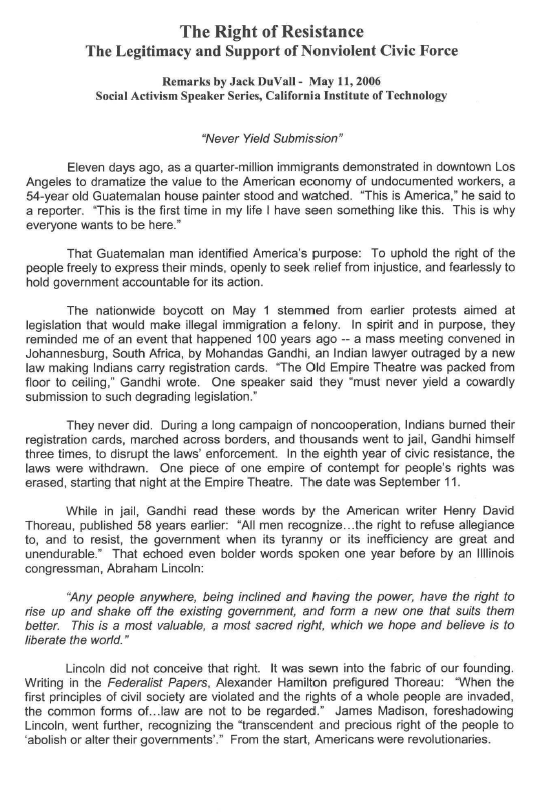
The Right of Resistance: The Legitimacy and Support of Nonviolent Civic Forces

View excerpt
The Right of Resistance: The Legitimacy and Support of Nonviolent Civic Forces
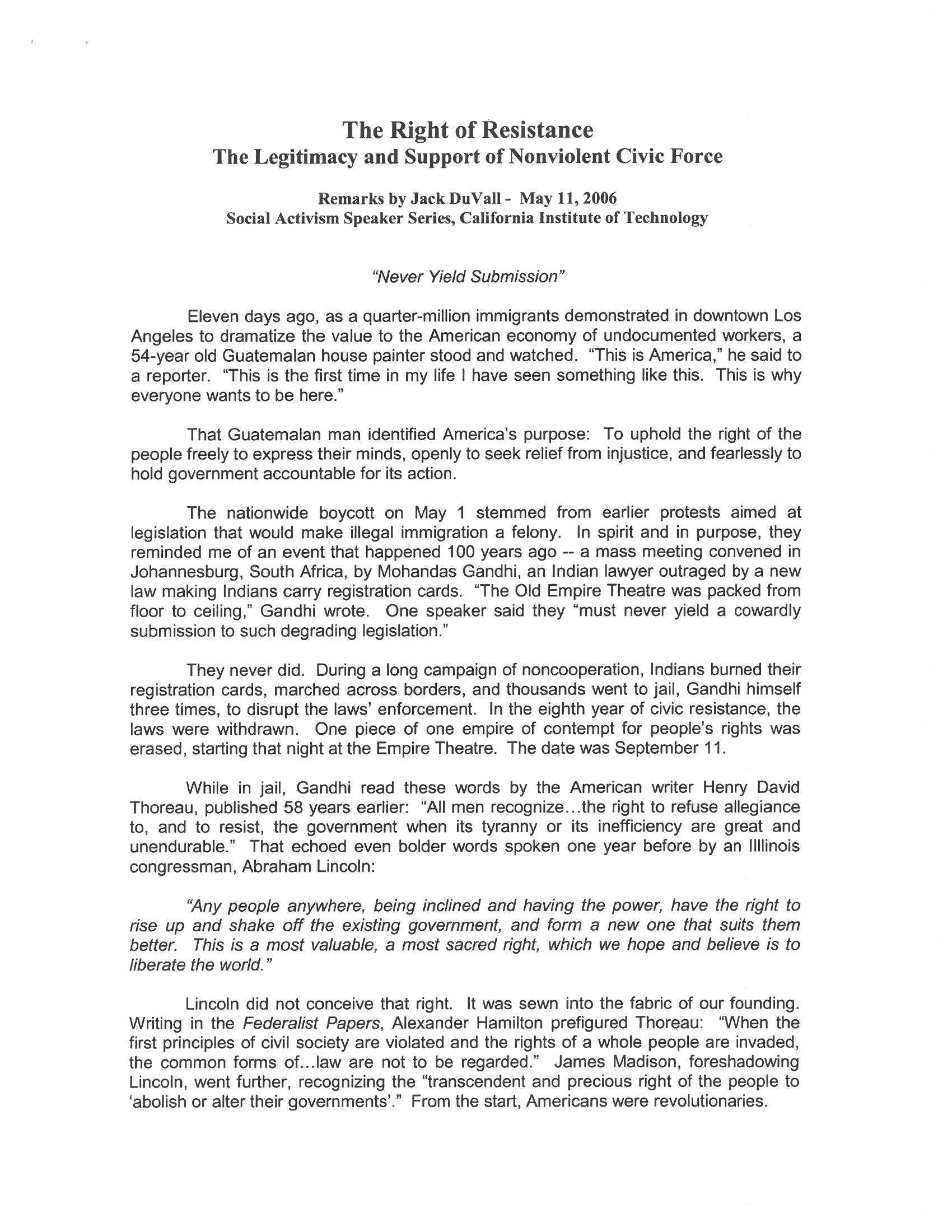
Download the Remarks (PDF, 3 MB)

The Right of Resistance: The Legitimacy and Support of Nonviolent Civic Forces

More than two thousand years ago, Aristotle said that tyrants rule for their own advantage, while legitimate government is for the equal advantage of all who are governed. The American insight, as Lincoln explained, was that equal rights could only be assured if government were based on the people’s consent. Gandhi saw in that equation a strategy for liberation: The British are ruling us for their own benefit, he told Indians, so why should we help them? They can rule only if we let them.

Take away consent and government withers. Resist oppression, drive up its cost, and you divide those who enforce it. Then power flows away from those who deceive the people to those who represent the truth. Vaclev Havel said that the greatest threat to a system based on lies is living in the truth. “By breaking the rules of the game,” he said, the resister “has disrupted the game…He has upset the power structure by tearing apart what holds it together…”

Jack DuVall

Presentation at the California Institute of Technology, as part of the Social Activism Speaker Series
May 2006
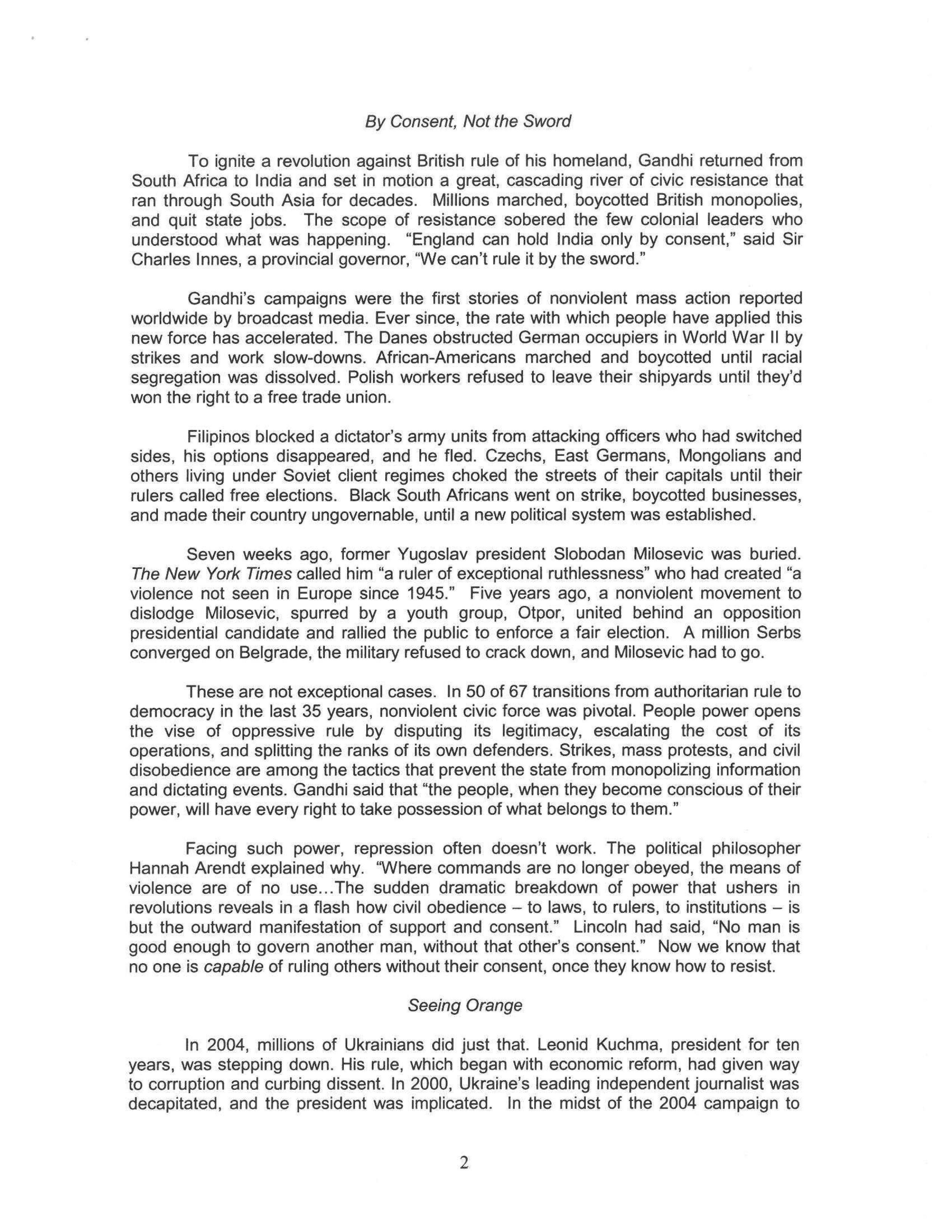
Download the Remarks (PDF, 3 MB)
  • The Right of Resistance: The Legitimacy and Support of Nonviolent Civic Forces
  • The Right of Resistance: The Legitimacy and Support of Nonviolent Civic Forces
  • The Right of Resistance: The Legitimacy and Support of Nonviolent Civic Forces
  • The Right of Resistance: The Legitimacy and Support of Nonviolent Civic Forces
  • The Right of Resistance: The Legitimacy and Support of Nonviolent Civic Forces

You may also be interested in:

  • The Secret to Effective Nonviolent Resistance

    We’re not going to end violence by telling people that it’s morally wrong, says Jamila Raqib, Executive Director of the Albert Einstein In…

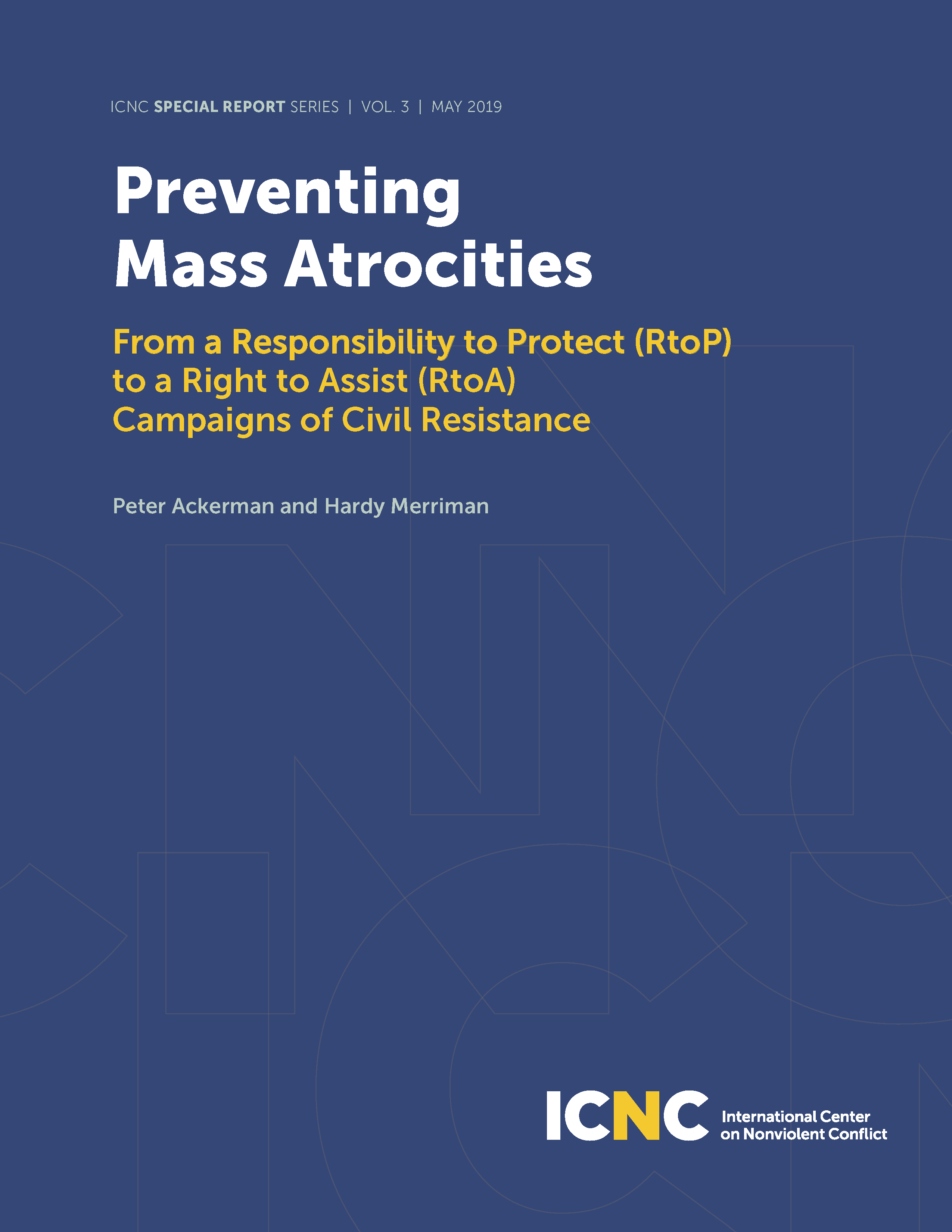
  • Preventing Mass Atrocities: From a Responsibility to Protect (RtoP) to a Right to Assist (RtoA) Campaigns of Civil Resistance

    The Responsibility to Protect (RtoP) was developed as a doctrine to prevent mass atrocities (genocide, ethnic cleansing, war crimes and crimes against…

  • “People Power” and the Problem of Sovereignty in International Law

    Elizabeth Wilson’s paper summarizes the tension between internal and external sovereignty as recognized by international law, and discusses the …

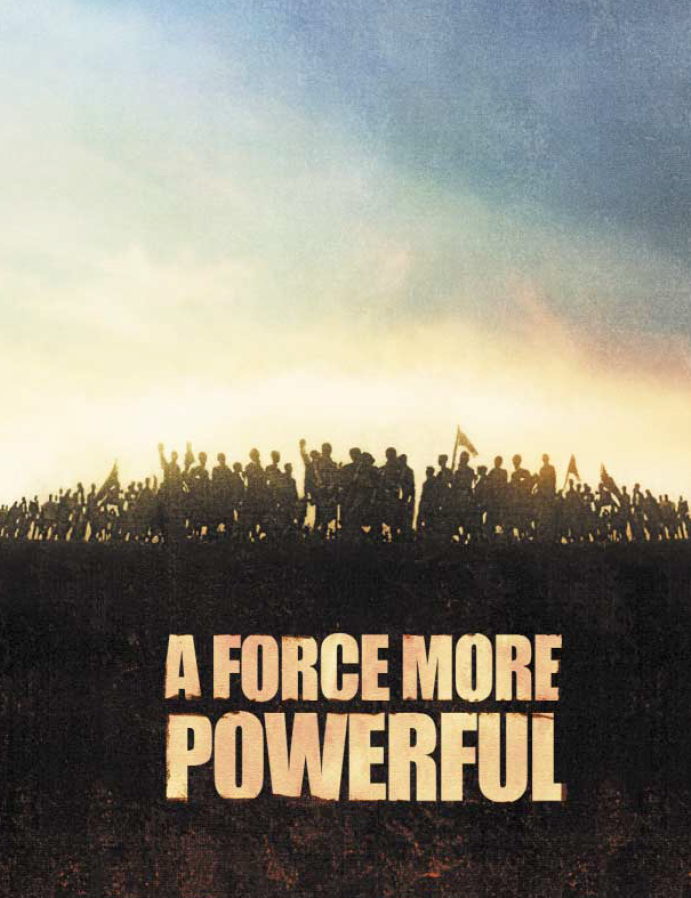
  • A Force More Powerful

    A Force More Powerful explores how popular movements battled entrenched regimes and military forces with weapons very different from guns and bullets.…

Return to Resource Library homepage

International Center on Nonviolent Conflict

600 New Hampshire Avenue NW
Suite 1010
Washington, D.C. 20037, USA

+1 202-596-8845

Other ICNC Affiliated Websites

  • Nonviolent Conflict News
  • Online Courses Platform
  • CivilResistance.net

Copyright ©2025 International Center on Nonviolent Conflict · All Rights Reserved

Note: Search results are listed in alphabetical order.