• Americas
      • Dutch
      • English
      • French
      • Mayan
      • Portuguese (Brazilian)
      • Spanish
    • Central & South Asia
      • Bangla
      • Dari
      • Dhivehi
      • English
      • Farsi
      • Kyrgyz
      See More
    • East Asia & Oceania
      • Indonesian
      • Burmese
      • Chin (Burma)
      • Chinese
      • Portuguese (Continental)
      • English
      See More
    • Europe & Eurasia
      • Armenian
      • Azeri
      • Belarusian
      • Catalan
      • Portuguese (Continental)
      • Croatian
      See More
    • Middle East & North Africa
      • Arabic
      • Azeri
      • Dari
      • English
      • Farsi
      • Hebrew
      See More
    • Sub-Saharan Africa
      • Afaan Oromo
      • Amharic
      • Arabic
      • Portuguese (Continental)
      • English
      • French
      See More
  • Learn More About ICNC's Translations Program
Center for Nonviolent Conflict Research
  • About
    • What Is Civil Resistance?
    • Our Work
    • Our Impact
    • Who We Are
    • Jobs & Internships
    • Join Our Mailing List
    • Contact Us
  • Services
    • Online Courses
    • Interactive Workshops
    • Staff Training
    • Coaching
    • Training of Trainers (ToT)
  • Programs
    • Column 2
      • Minds of The Movement Blog
      • ICNC Publications
      • Nonviolent Conflict News
      • Online Courses
      • Regional Institutes
      • Sign Up
      • ICNC Webinars
      • For Activists & Organizers
      • For Scholars & Students
      • For Policy Community
  • Resource Library
    • English Language Resources
    • Translated Resources
    • ICNC Films
  • Media & Blog
    • For Journalists and Press
    • ICNC Newsmakers
    • Minds of the Movement Blog
  • Translations
    • Afran Oromo
    • Amharic
    • Arabic
    • Armenian
    • Azeri
    • Bahasa Indonesia
    • Bangla
    • Belarusian
    • Burmese
    • Chin (Burma)
    • Chinese
    • Croatian
    • Dutch
    • Estonian
    • Farsi
    • French
    • Georgian
    • German
    • Hebrew
    • Hindi
    • Italian
    • Japanese
    • Jing-Paw (Burma)
    • Karen (Burma)
    • Khmer
    • Kiswahili
    • Kituba
    • Korean
    • Latvian
    • Lingala
    • Lithuanian
    • Macedonian
    • Malagasy
    • Mayan
    • Mon (Burma)
    • Mongolian
    • Nepali
    • Norwegian
    • Pashto
    • Polish
    • Portuguese (Brazilian)
    • Portuguese (Continental)
    • Russian
    • Serbian
    • Sindh
    • Slovak
    • Spanish
    • Tagalog
    • Tamil
    • Thai
    • Tibetan
    • Tigrigna
    • Turkish
    • Ukrainian
    • Urdu
    • Uzbek
    • Vietnamese
    • Xhosa
    • Learn More About ICNC's Translations Program
  • Search
    • Search This Site

Fletcher Summer Institute 2011

February 4, 2016 by intern3

Keynote Address – Rev. James Lawson

Speaker: Rev. James Lawson, Distinguished Scholar at Vanderbilt University

Prolific civil rights leader and trainer of nonviolent action, Rev. James Lawson, delivers the opening banquet keynote address talking about his experience organizing and training the Nashville lunch counter sit-in campaign. Reverend Lawson’s remarks will be preceded by a showing of the Nashville, Tennessee video segment from “A Force More Powerful.”

https://www.youtube.com/watch?v=OkXKam9LfL0

Additional Resources:

  • Civil Resistance: A First Look (video)
  • Lawson, James – Gandhi and Nonviolence (video)
  • Lawson, James – Training for Nonviolent Resistance (video)
  • Merriman, Hardy. The Trifecta of Civil Resistance: Unity, Planning, and Nonviolent Discipline. OpenDemocracy.org.

The Dynamics of Civil Resistance

Presenter: Jack DuVall, President of the International Center on Nonviolent Conflict

The modern practice of civil resistance sprang from ideas about the underlying nature of political power that began to be framed about 170 years ago. As later developed by Gandhi and adopted by scores of movements and campaigns for rights and justice in recent decades, strategies of civil resistance have exhibited a common dynamic, propelled historic changes, and imparted certain political and social properties to their societies. The record of these strategies in liberating oppressed people, when compared to that of violent insurgency or revolt, has been remarkable – and suggests why political violence may substantially be reduced in the future.

Additional Resources:

  • DuVall, Jack.  Civil Resistance and the Language of Power.
  • Hardy Merriman – Why Learn About Civil Resistance? (video)
  • Jack DuVall – Why Learn About Civil Resistance? (video)
  • Dr. Stephen Zunes – Why Learn About Civil Resistance? (video)

Forming a Movement

Presenter: Hardy Merriman, Senior Advisor at the International Center on Nonviolent Conflict

Given political oppression in many regions of the world, what explains the emergence of nonviolent movements in some countries but not others? Furthermore, what are the skills that nonviolent movements use in order to build movements and unify populations? This session will examine these and related questions, and address issues such as the development of movement discourse, capacity building, and the creation and expansion of political space.

Additional Resources:

  • Hardy Merriman – Foundational Ideas of Civil Resistance (video)
  • Hastings, Tom. The Anishinabe and an Unsung Nonviolent Victory in the Twentieth Century.
  • Dr. Peter Ackerman – Key Elements of Civil Resistance (video)

Film Screening: Bringing Down a Dictator

Bringing Down a Dictator tells the inside story of how Milosevic was brought down — not by smoke and flames– but by a courageous campaign of political defiance and massive civil disobedience. Winner of a Peabody Award, the film was narrated by Martin Sheen and premiered on PBS in March 2002.


Sustaining a Movement

Presenters: Ivan Marovic, Core Systems Designer (People Power Game)
York/Zimmerman Productions

Hardy Merriman, Senior Director or Education & Research at International Center on Nonviolent Conflict

Civil resistance movements must be durable and resilient enough to engage in a struggle with entrenched adversaries. What sustains such movements in the face of both internal pressure (in the form of disunity) and external pressure (in the form of repression)? To address this question, Ivan Marovic, drawing from his own experience in the Serbian youth movement that brought down Slobodan Milosevic, examined issues of tactical sequencing and innovation, movement risk assessment, and looked at how movements galvanize support and maintain momentum and initiative against their opponents. In addition, Hardy Merriman examined issues of tactical sequencing and innovation, movement risk assessment, and looked at how movements galvanize support and maintain momentum and initiative against their opponents.

Additional Resources:

  • Dr. Janet Cherry – Consumer Boycotts and the Anti-Apartheid Struggle (video)
  • Merriman, Hardy.  The Trifecta of Civil Resistance: Unity, Planning, and Nonviolent Discipline.

Nonviolent Struggle and Radical Flanks

Presenter: Dr. Howard Barrell, Senior Lecturer at Cardiff University

Dr. Barrell discusses how the struggle against apartheid in South Africa demonstrated that civil resistance can be a more resilient and effective form of struggle against oppression than military action. The case of South Africa shows how the leadership of the ANC, the preeminent South African liberation movement, saw the role of civil resistance as subsidiary to, and creating fertile political conditions for, armed struggle. But events produced an entirely different outcome. Civil resistance that came to be coordinated by the United Democratic Front ended up displacing armed struggle as the main weapon against the oppressive state. This shift occurred through the 1970s and 1980s, the decisive period in the struggle to end racial oppression of black people in that country.

Additional Resources

  • Schock, Kurt. Unarmed Resistance: People Power Movements in Nondemocracies.
  • Walker, Jesse.  Who Killed Apartheid? An Interview with Howard Barrell.

The Palestinian 1987 Intifada

Presenter: Dr. Mary King, Professor of Peace and Conflict Studies at University for Peace

The history of Palestine is by no means dominated by violence. In fact, Palestinians used various methods of nonviolent actions such as protest and persuasion, boycotts, strikes and parallel institution building from the 1920s onward — only to face repression indifference from the colonial British authorities prior to 1948, or from Israel was established. Disregard for historic Palestinian civil resistance had the effect of strengthening Palestinian factions that advocated violent resistance. During the 1970s and 1980s, however, inside the territories militarily occupied by Israel, an extended, multi-year process built the civic capacity of the Palestinians through thousands of committees, thereby enabling the coming mass nonviolent movement. Activist intellectuals spread knowledge about nonviolent strategies throughout Palestinian society, shaping a new politics, with changes in popular thinking about how to transform their situation, including withholding cooperation from a belligerent occupation.

Additional Resources

  • King, Mary Elizabeth.  Mahatma Gandhi and Martin Luther King Jr.: The Power of Nonviolent Action.
  • Dr. Mary King’s website

Backfire and Security Divisions

Presenters: Dr. Lee Smithey, Assistant Professor of Sociology at Swarthmore College

James Greene, Head of NATO Liaison Office in Ukraine

Dr. Smithey explains how nonviolent civil resistance movements that challenge autocratic governments must often deal with repression and intimidation. Regimes depend on the legitimacy they can cultivate. However, when faced with popular resistance, they are forced to weigh the costs and benefits of escalating their use of coercive security measures, and even outright violence, to chill dissent. Though such repression can successfully raise the cost of movement participation and thus undermine challenges, it can also “backfire” and enhance popular mobilization. We consider how the strategic application of nonviolent methods can take advantage of this paradox of repression and raise the likelihood that violence will trigger further mobilization. Much depends on the ability of civil resisters to maintain nonviolent discipline, frame repression, and choreograph actions that help ensure repression will be widely interpreted as reprehensible.

Mr. Greene describes how the effect of backfire can extend beyond civil society to include elements within security institutions that see repression as opposed to their professional ethos and institutional or personal interests. As nonviolent movements seek to shape the environment in ways that maximize the possibility for backfire, it is important that they consider the values, interests, mind-set, and working environment of those who serve within the security sector. These factors vary widely among different institutions (e.g. armed forces, police, and internal security) and elements within these institutions (e.g. conscripts, professional soldiers, and officers at various levels). Various elements also have differing levels of identification with the regime or dissonance in values with it. Nonviolent movements that are willing to take a nuanced view of security institutions, understanding them and relating to them as something other than a monolithic oppressor can use these divisions to reduce the effects of repression and undermine political support for a regime within its own institutions.

Additional Resources

  • Egypt: Seeds of Change (video). Al Jazeera.
  • Kurtz, Les. Repression’s Paradox in China. OpenDemocracy.org.
  • Kurtz, Les. When Repression Backfires (webinar)
  • Kuzio, Taras. Security Forces Begin to Defect to Viktor Yushchenko. The Jamestown Foundation.
  • Kirk, Michael. Revolution in Cairo (video). PBS Frontline.

Transitions and Negotiations

Presenter: Dr. Maciej Bartkowski, Senior Director of Education and Research at the International Center on Nonviolent Conflict

Negotiations and use of nonviolent actions are interlinked and play an important role in forcing bottom-up and also top-down, elite-actor transitions will be reviewed as a segue to a discussion about movement-centered attributes and mechanisms, including openness to negotiations, consultations and coalition building –by which broad-based nonviolent movements facilitate democratization and successful democratic transitions. The talk will draw on historical cases as well as current cases of transition to democracy in the Middle East.

Additional Resources

  • Bartkowski, Maciej & Kurtz, Les.  Egypt: How to Negotiate the Transition. Lessons from Poland and China.
  • Tregub, Olena & Shulyar, Oksana. The Struggle After People Power Wins.

Success in Civil Resistance: The Necessity of Skills

Presenter: Dr. Peter Ackerman, Founding Chair of the International Center on Nonviolent Conflict

Nonviolent conflict is a contest between nonviolent civil resisters and their (often violent) adversaries. In this contest, each side has different strategies and tactics that they can employ to try to win. Civil resistance movements wage their struggle through political, economic, and social pressure, and they have a wide variety of tactics at their disposal to do this. A movement’s adversary often tries to wage its struggle through violent means, which has a completely different dynamic and tactical repertoire than nonviolent methods.

In this asymmetric contest between violent and nonviolent actors, the side that is best organized, most skillful, and most strategic, is more likely to prevail. Therefore, the skillful and strategic choices that civil resistance movements make are of critical importance to their outcome.

Additional Resources:

  • Ackerman, Peter.  Skills or Conditions: What Key Factors Shape the Success or Failure of Civil Resistance?

Third Party Actors and Transnationals

Presenters: Dr. Ian Johnstone, Professor of International Law at Fletcher School of Law and Diplomacy

Dr. Stephen Zunes, Professor of Politics and International Studies at the University of San Francisco

The first part of the session examines the role of international organizations in democracy promotion. It begins by asking whether there is a growing global consensus on the value of democratic governance – perhaps even an emerging “right to democracy.” We then consider how international organizations are both contributing to and acting on that consensus through their normative and operational activities. Among the operational activities, we look at electoral assistance, the good governance agenda of development agencies, peacekeeping and peacebuilding. In addition to these non-coercive approaches, we consider cases of military action to uphold democracy – most recently in Cote d’Ivoire. The central objective of the session is to explore the global normative and political context in which democratic action by non-state actors occurs.

The second talk critically examines some recent cases where there have been charges of foreign interference in popular nonviolent uprisings by foreign governments, NGOs, and other outside actors; explores how outside support can actually harm a movement’s chances of success; and, under what circumstances outside actors can make positive contributions to nonviolent struggles for freedom and justice. In general, autocratic governments, regardless of ideological orientation or geopolitical alliances, have traditionally blamed real or perceived hostile powers for indigenous nonviolent challenges to their regime. However, unlike military coups and armed rebellions, the degree of influence a foreign power can actually have on a popular civil insurrection is rather minimal.


Citizen Journalism and Movement Media

Presenters: Al Giordano, Founder of School of Authentic Journalism

Greg Berger, Independent Media Maker and Founder of Gringoyo.com

Movements that do their own journalism and make their own media have a much greater chance at success than those that rely on commercial or state media. From Mexico to Egypt, Greg Berger and Al Giordano have reported extensively and also studied how journalists and media makers have helped – or hurt – the movements that they cover. Through the Narco News School of Authentic Journalism, they train independent media makers in how to report stories about social movements and nonviolent civil resistance, and how to bring the message to a wider public audience through techniques developed to make videos and news reports “go viral.”

**Video Coming Soon

Additional Resources

  • Giordano, Al.  Authentic Journalism: Weapon of the People.
  • Narco News. How Egyptians “Televised” the Revolution when the Media Would Not (video)

Conventional Media and Civil Resistance

Presenters: Dr. Howard Barrell, Senior Lecturer at Cardiff University

Dr. Cynthia Boaz, Assistant Professor of Political Science at Sonoma State University

In this session, Dr. Boaz introduces several common media frames (or “biases”) that lead to distortions in coverage of civil resistance. She also discusses the role of meta-frames, i.e. deeply held beliefs and assumptions about concepts such as power, conflict and violence, which reinforce misperceptions in media reporting of civil resistance.

Dr. Barrell examines strategies that were developed by two groups of journalists in different parts of the world struggling to reach their audiences despite severe repression. One group was Burmese, the other South African. In Burma, opposition journalists set out in the 1990s to find a way to bypass their government’s tight grip on the media in their country. They ended up creating something entirely new, free of control by the government, that exploited advances in broadcasting technology and the credibility that derives from a ‘public service’ ethos in journalism. In South Africa in the 1970s, there seemed little chance of developing an effective opposition media outside of the state-approved system. A group of journalists asked themselves if they could work within government-imposed constraints yet still get across a militant opposition message.


Civil Resistance and Extreme Violence

Presenters: Dr. Erica Chenoweth, Assistant Professor of Government at Wesleyan University

Nichole Argo, PhD Candidate at The New School University

Dr. Erica Chenoweth contests myths about the effectiveness and necessity of violence as a method of resistance. She also presents evidence that shows that nonviolent resistance can be a superior method of resistance, even against regimes who try to use extreme brutality to silence dissent. She distinguishes between insurgencies (and “terrorist” groups) who may be open to the idea of abandoning violence, and those who are likely to maintain violence even when other alternatives are possible. Chenoweth also discusses how to increase awareness among the policy community and the public about the strategic advantages of nonviolent resistance.

Nichole Argo speaks about the role of sacred beliefs and the impact they have on whether or not movements choose to use violence or nonviolent in their struggle.

Additional Resources:

  • Chenoweth, Erica & Stephan, Maria.  Why Civil Resistance Works: The Strategic Logic of Nonviolent Conflict.

Keynote Address – Gene Sharp

Presenter: Dr. Gene Sharp, Senior Scholar at Albert Einstein Institution

Gene Sharp, Senior Scholar at the Albert Einstein Institution and one of the foremost authorities on nonviolent struggle in recent decades, gives a keynote address to discuss the relevance of civil resistance to the continuing global fight for human rights, democracy, and freedom.

Additional Resources

  • Arrow, Ruaridh. How to Start a Revolution (film website)
  • Sharp, Gene. The Politics of Nonviolent Action (Part One).
  • Sharp, Gene. The Politics of Nonviolent Action (Part Two).
  • Sharp. Gene. The Politics of Nonviolent Action (Part Three).
  • Sharp, Gene. Waging Nonviolent Struggle: 20th Century Practice and 21st Century Potential.

More Articles…

  • Download Flyer

The Fletcher Summer Institute is the only executive education program in the advanced, interdisciplinary study of nonviolent conflict, taught by leading scholars and practitioners of strategic nonviolent action and authorities from related fields. This institute runs from June 19 – 25, 2011 at the Fletcher School (Tufts University) in Medford, Massachusetts, USA.
Filed Under: 2011, Academic Support Initiatives, ICNC Summer Institute

Fletcher Summer Institute 2010

February 1, 2016 by intern3

The Fletcher Summer Institute for the Advanced Study of Nonviolent Conflict is the only executive education program in the advanced, interdisciplinary study of nonviolent conflict, taught by leading scholars and practitioners of strategic nonviolent action and authorities from related fields.

In 2010, international professionals, leaders of indigenous NGOs, journalists, campaign organizers, issue advocates and educators from twenty-nine countries around the world came together for six days at the Fletcher School of Law and Diplomacy in Medford, Massachusetts to learn about and discuss nonviolent conflict and civil resistance.

Be a part of the experience…


Keynote Address

Rev. James Lawson, Distinguished University Professor at Vanderbilt University

Prolific civil rights leader and trainer of nonviolent action, Rev. James Lawson, delivers the opening banquet keynote address talking about his experience organizing and training activists in the Civil Rights Movement, particularly the Nashville lunch counter sit-ins.

Additional Resources:

  • Ackerman, Peter & DuVall, Jack.  A Force More Powerful: A Century of Nonviolent Conflict.  New York, NY: St. Martin’s Press, 2000.
  • York, Steve.  A Force More Powerful (DVD).  September, 2001
  • WATCH Rev. James Lawson talk about training for nonviolent resistance
  • WATCH Rev. James Lawson talk about Gandhian nonviolence

  • The Dynamics of Civil Resistance

    Presenter: Jack DuVall, President of the International Center on Nonviolent Conflict

    Jack DuVall looks at how the modern practice of civil resistance sprang from ideas about the underlying nature of political power that began to be framed about 150 years ago. As pioneered by Gandhi and adopted by scores of movements and campaigns for rights and justice in the 20th century, strategies of civil resistance have exhibited a common dynamic, propelled historic changes — and imparted certain political and social properties to the societies they often transformed. The record of the effectiveness of these nonviolent strategies in liberating oppressed people, when compared to that of violent insurgency or revolt, has been remarkable — and suggests why political violence could largely be displaced in the future.

    Additional Resources:

    • Ackerman, Peter & DuVall, Jack.  A Force More Powerful: A Century of Nonviolent Conflict.  New York, NY: St. Martin’s Press, 2000.
    • Ackerman, Peter & DuVall, Jack.  The Right to Rise Up: People Power and the Virtue of Civic Disruption.  Fletcher Forum of World Affairs. Tufts University, May 2006.
    • Stephan, Maria & Chenoweth, Erica.  Why Civil Resistance Works: The Strategic Logic of Nonviolent Conflict.  International Security.  Volume 33, Issue 1.
    • LISTEN to a podcast of this presentation

    Strategic Planning and Tactical Choices

    Presenter: Hardy Merriman, Senior Advisor at the International Center on Nonviolent Conflict

    Strategic planning and tactical choice are essential considerations in effective civil resistance. This session offers a strategic framework with which to analyze civil resistance movements. It also examines the diversity of tactics available to civil resisters, and explores issues involved in tactical choice, success and failure.

    Additional Resources

    • Strategic Planning and Tactical Choices (Power Point)

    Mobilization, Leadership, and Coalition Building

    Presenter: Dr. Janet Cherry, Senior Lecturer in Development Studies at Nelson Mandela Metropolitan University

    These three critical phases in the work of most nonviolent movements are examined in this session, with examples — as in South Africa with the United Democratic Front — illustrating the trajectory of organizing and building a diverse, representative mass movement; the way in which broad unity with a range of allies is constructed; and the nature of leadership.


    Social Movements: Power from Above and Below

    Presenter: Dr. Doug McAdam, Professor of Sociology at Stanford University

    Using the U.S. civil rights movement as the principal example, McAdam talks about the typical mix of top down environmental facilitation and bottom up grassroots activism that fuel successful social movements. Appropriately, FSI puts the emphasis on the latter, but a full understanding of the prospects for significant social change requires that activists understand the critical reciprocal relationship between people power and the shifting environmental circumstances they confront.


    Costs and Risks in Nonviolent Conflict

    Presenters: Hardy Merriman, Senior Advisor at the International Center on Nonviolent Conflict

    Jack DuVall, President of the International Center on Nonviolent Conflict

    Every civil resistance movement can be understood as engaging in a contest with an adversary, whether that is a government or other institutional source of injustice or oppression. Movements may use tactics that deny their adversaries legitimacy and material resources, as well as reduce the loyalty of the adversary’s supporters. Conversely, a movement’s adversary may take actions to deny a movement legitimacy, material resources, or the loyalty of the movement’s supporters. All these effects can be understood as costs to the operational capacity of either side. There are also certain risks inherent in the choice of strategy and tactics; imposing costs always entails taking risks. This module will frame civil resistance from the perspective of three kinds of costs and risks: material/economic; political/legitimacy-related; and social/psychological. Successful civil resistance customarily requires planning, which should take costs and risks into account.


    The Quiet Revolution in the First Intifada

    Presenter: Dr. Mary King, Distinguished Scholar at American University for Global Peace

    Mary King offers an overview of the remarkable and previously untold account of the first intifada as a massive nonviolent social mobilization. The Palestinians’ deliberately chosen methods for resisting the Israeli occupation effectively debunk the widely held notion of the first intifada as violent. King will discuss the decades-long spread of knowledge about nonviolent strategies throughout Palestinian society shaped the uprising, which was years in the making, and will offer details on the intifada’s ability to continue despite harsh reprisals. Through the determination of thousands of “popular committees,” often started and run by women, and the ability to sustain communities under curfew or strike, the nonviolent movement during the first intifada was a “quiet revolution” which emerged as the most cogent pressure to date to create a Palestinian state alongside Israel.


    Civil Resistance and Democratic Transitions

    Presenter: Dr. Maciej Bartkowski, Senior Director, Education and Research at the International Center on Nonviolent Conflict

    Dr. Victoria Tin-Bor Hui, Assistant Professor of Political Science at Notre Dame University

    Does the use of civil resistance create long-lasting effects on civil society and political life? Does participation in broad-based nonviolent movements instill democratic values, which make democracy more sustainable after a transition? These and other questions help explore what kind of social capital may be created by nonviolent movements, using the case of the Polish Solidarity movement in communist Poland and its residual effect on the Polish society and politics in the immediate and long term perspectives following the 1989 changes.


    Citizen Journalism and Digital Resistance

    Presenters: Al Giordano, Founder of The Narco News Bulletin

    Noha Atef, Founder of TortureinEgypt.net
    A movement that makes its own media has considerable advantages and better chances of success than those that must depend on commercial media to tell their story and define their narrative. Narco News publisher Al Giordano and Torture in Egypt publisher Noha Atef, both of the School of Authentic Journalism, share practical tips on citizen media with an emphasis on strategies, tactics and tools for organizers and participants in social movements, nonviolent campaigns and civil resistance.

    Additional Resources

    • Newhouse, Kara.  Building an Authentic Journalism Movement.  The Narco News Bulletin.  February 21, 2010.

    Budrus Film Screening

    Presenters: Ayed Morrar, Community Organizer at Budrus

    Julia Bacha, Director at Budrus

    “Budrus” is an award-winning feature documentary film about a Palestinian community organizer, Ayed Morrar, who unites local Fatah and Hamas members along with Israeli supporters in an unarmed movement to save his village of Budrus from destruction by Israel’s Separation Barrier. Success eludes them until his 15-year-old daughter, Iltezam, launches a women’s contingent that quickly moves to the front lines. Struggling side by side, father and daughter unleash an inspiring, yet little-known, movement in the Occupied Palestinian Territories that is still gaining ground today.

    After the screening, participants were joined by Ayed Morrar, the film’s protagonist, and Julia Bacha (via Skype) to hear them speak more about the experience of nonviolent resistance in Budrus and the making of the film.


    Burma VJ Film Screening

    Released in 2008, Burma VJ is a documentary film that looks at brave citizen journalists risking torture and life in jail in order to live the essence of journalism as they insist on keeping up the flow of news from their closed country. The film offers a unique insight into high-risk journalism and dissidence in a police state, while at the same time providing a thorough documentation of the historical and dramatic days of September 2007, when the Buddhist monks started marching. Burma VJ was a Best Documentary nominee at the 2009 Academy Awards.

    After the screening, two FSI participants who work with Burmese activists on the Thai/Burma border, spoke about their experience working with individuals and groups involved in the nonviolent struggle against the military junta.

    https://www.youtube.com/watch?v=Q2VNqC4xxAU


    MEET SOME OF THE PARTICIPANTS

    Abebe Gellaw

    Abebe Gellaw is an exiled Ethiopian journalist; he is currently a visiting scholar at the Centre on Democracy, Development and the Rule of Law at Stanford University. He is working on a book project, “Ethiopia under Meles: Why the transition from military rule to democracy failed.” He is also a steering committee member of the Solidarity Movement for a New Ethiopia, an organization that seeks to bring about drastic socio-political changes through nonviolent struggle.

    Gellaw holds a bachelor’s degree in Political Science and International Relations from the Addis Ababa University and a post-graduate diploma in law from London Metropolitan University. He began his career in journalism in 1993 as a freelance writer focusing on human rights and political issues. He has worked for various print and online publications including the Ethiopian Herald, the only English daily in the country. Most recently he was a recipient of Stanford University’s Knight Journalism Fellowship and Yahoo’s International Fellowship in 2009. His op-eds, stories, articles and interviews have appeared in the Wall Street Journal, The Guardian, the Far East Review, and Global Integrity’s “The Corruption Notebooks 2008.”

    My interest in nonviolent struggle was first sparked “…when I got involved in the student union at the Addis Ababa University that was struggling for academic and political freedom. In 1993, 42 professors were fired from the university and the student union was disbanded. I’ve been personally involved in nonviolent action, when as a student I along with others took part in a number of protest rallies, sit-ins and hunger strikes. I have been particularly successful in using journalism as a vehicle of advocacy, mobilizing for a cause and as a means of exposing the abuse of power. I’ve learned that nonviolence is a powerful means to challenge tyranny and dissolve violence.”

    https://www.youtube.com/watch?v=ZHlZdgXK_sc


    Dr. Mohamed Fouad Bergigui

    Dr. Mohamed Fouad Bergigui is the head of rural development for the Moroccan Foundation for Youth, Initiative and Development. He received a Doctor of Veterinary Medicine at the Agronomic and Veterinary Institute. At the foundation, Bergigui is in charge of conception, achievement and follow-up of socio-economic development programs targeting especially rural areas and underprivileged populations. He has participated in many rural development projects such as the creation of six beekeeping cooperatives in Tiznit and Chtouka in southern Morocco, and two Veterinarian Civic Action Projects for poor farmers rural Morocco.

    My interest in nonviolent struggle was first sparked “…when I led a rural development project to ensure better living conditions for destitute Berber populations that have no access to the basic necessities of life in the countryside of Morocco. I was personally involved in nonviolent action when I participated in a COP15 youth climate march in Copenhagen. I hope to learn how to empower youth and underprivileged populations to act for the change they need.

    https://www.youtube.com/watch?v=3RJ9OKvTj7A&feature=youtu.be


    Natalia Lozano Mancera

    Nathalie Janne d’Othée was born in Antwerp, Belgium. She studied History and International Relations at the Catholic University of Louvain (UCL) in Belgium. During her university years, her interest in the Middle East increased. She studied at the University of Galatasaray in Istanbul for one year. Then she lived for a year in Cairo to learn Arabic. Coming back to Belgium, she decided to begin a PhD on the Palestinian nonviolent resistance movement, which really impressed her. She also works in a research institute on Euro-Arab relations, called MEDEA. In 2008, she participated in a ten-day project called “Samen in Zee” (Dutch for “Together at sea”) with Europeans, Palestinians and Israelis in the Netherlands. The group received training in nonviolent communication. In 2009, Nathalie travelled three weeks around Israel/Palestine. She is also involved in Belgium with a working group of the International Civil Service, which is an NGO. The working group focuses its work on the Mediterranean region, especially Palestine. It organizes conferences, trainings for volunteers leaving for the region, and participates in demonstrations of solidarity with the Palestinian people and their nonviolent struggle.

    My interest in nonviolent struggle was first sparked “…by visiting the numerous blogs of Palestinians telling about their daily life under occupation, and then by a human chain created around the Gaza Strip in the beginning of 2008. I was personally involved in nonviolent actions in Jerusalem and the West Bank in 2009. For instance, I attended a festival meant to show the settlers that a piece of land called Ush Graib was “occupied” by the local Palestinian population. I’ve visited Palestine and participated in nonviolent actions and have learned that the media coverage of a nonviolent action is fundamental for its effectiveness. What I hope to take away from the Fletcher Summer Institute is a better understanding of nonviolent resistance and the role of the media, and also the importance of foreign support to nonviolence.”

    https://www.youtube.com/watch?v=L0RQl1jcLqk&feature=youtu.be


    Ramesh Chandra Sharma

    Ramesh Chandra Sharma has worked with Ekta Parishad, a nonviolent mass movement in India, as a Campaign Coordinator for the past 12 years. He has been involved in campaigning and training rural youth to lead struggles in villages for the past 40 years. He is also in charge of International Coordination for Ekta Parishad. Ramesh is also a member of various groups such as the Task Force for Land Reforms, the Central Enquiry Committee on Tribal Self Rule, and the National Land Reforms Committee. As a campaigner he has been involved in many foot marches, mass movements and negotiations with concerned groups. Ramesh has also delivered lectures at Cambridge University, the London School of Economics, and Oxford University as well as the British Parliamentary Committee. He has been involved in and offered assistance to many similar international nonviolent movements in Paraguay, Argentina, Chile, Venezuela, Bolivia, Colombia, Peru, Costa Rica, Panama, Mexico, Brazil, Bangkok, and Uganda. Currently, he is engaged in building a mass movement in India called Jan Satyagraha 2012 when 100,000 landless and deprived people will walk to claim their land, livelihood, rights and dignity.

    “In every nonviolent movement there should be individuals who are part of constructive work while simultaneously strengthening local campaigns. These advocacy efforts lend a transformative, long-term resilience to all stakeholders who are involved with the daily tasks and short-term goals of an organization.”

    https://youtu.be/dahGfnZCLA4


    Nathalie Janee D’Othée

    Natalia Lozano Mancera was born in Bogotá, Colombia, where she grew up surrounded by her father’s large family who were all at some point of their lives politically active in leftist movements. Inspired by her family she studied Political Science at the National University of Colombia. Her BA degree thesis was called “Musical Consumption and Production in Internally Displaced People in Bogotá.” Some years afterwards she worked for a govermental organization in charge of reparations for victims of paramilitary groups. Being so close to the situations of the different victims she realized she did not want to work in processes of reparations but in processes that allow people to escape from being victimized. In 2007 she became a student in the MA program in Peace Studies at the University of Innsbruck. She graduated last January with a thesis called “Playing Music Performing Resistance, the dynamics of resistance through music in the Colombia south Pacific coast” in which she analyzes little acts of resistance related to the marimba music. Currently, she works for a NGO in Colombia in which she gives workshops on Conflict Transformation and Peace Education to vulnerable populations. She recently enrolled in the PhD program of Media and Communications of the European Graduate School, where she wants to continue working with the concepts of resistance and revolution in relation to arts and creativity.

    My interest in nonviolent struggle was first sparked “…by living in a country where violence is so overwhelming. My interest was also sparked by having the conviction that we as creative human beings have the capacity to transform those violent realities. I’ve been personally involved in nonviolent action, when the current Colombian president wanted to reform the National Constitution in order to run for a third term (he already had changed it to run for the second one). I participated in an organization called Civil Alliance for Democracy that worked against that reform, and any other reform that would threaten the principles of freedom and plurality proclaimed by the Constitution. I’ve learned that there is nothing that can justify the use of violence. There are not fair causes in the name of which violence can be used. I hope to take away from the Fletcher Summer Institute shared moments and knowledge about others’ experiences and about resistance theories that will give me the will to keep on studying and acting in nonviolent movements.”

    https://www.youtube.com/watch?v=0flzQOw8o1g&feature=youtu.be


    Musa Isah Salmanu

    Musa Isah Salmanu is a serving Squadron Leader in the Nigerian Air Force, with an MA in Conflict Security and Development from King’s College London and an MSc in Political Science from Ahmadu Bello University Zaria-Nigeria. He is an African Peace and Security Fellow at the African Leadership Center and the Conflict, Security and Development Group, King’s College London. He is presently deployed as a military observer in South Kivu, Democratic Republic of Congo.

    My interest in nonviolent struggle was first sparked “…by the conviction that the ability to exercise our rights to freedom of expression and association is an important step towards achieving a viable and progressive society. I’ve been personally involved in nonviolent action, when as a high school student I worked with other students to organize and challenge a tuition increment by the government, a move we viewed as anti-poor. I’ve lived or worked in a conflict environment, and have learned that the traditional notion of seeing security personnel as pro-establishment and anti-popular movements is erroneous. There is thus the need for security forces to be carried on board and to be more informed about the logic, principles, and ideals behind nonviolent conflict. Presently in the Eastern part of the DR Congo, I have witnessed firsthand how the denial of basic rights and the curtailing of civil liberty can bring about violent resistance and anarchy. What I hope to take away from the Fletcher Summer Institute is a better understanding of the modes and reasons for actions involving nonviolent conflict as this will enable me to deal with situations in a more professional way. This I believe will engender the spirit of mutual understanding between the practitioners of nonviolence and the security agents sent to maintain law and order. Furthermore, I will be better equipped to explain these issues to my colleagues and thereby beginning a process of change in perception and action.”

    https://youtu.be/jCdktOLmbUU


    Tamar Zhvania

    Tamar Zhvania received her Sociology MA degree from the Iv. Javakhishvili Tbilisi State University. She is an Expert/Consultant in the United Nations Development Program (UNDP), Electoral Assistance Project since November 2007, acting as the Project Manager. During the last three years she has actively worked on public awareness and civic education, supported capacity building of different institutions as well as promoted improved legal framework for effective democratic processes.

    From 2004-2007, Tamar worked at a well-known Georgian NGO called the International Society for Fair Elections and Democracy (ISFED) as an Executive Director. In 2001-2004, before assigning as an ISFED Executive Director, Tamar worked for ISFED as a Press-Secretary and then was promoted as a PR Director. In 2000, she worked as an ISFED representative in the Central Election Commission (CEC) of Georgia. Tamar has experience of working in Bangladesh as NDI election consultant, in Ukraine under ENEMO observation missions, in Kazakhstan under OSCE observation missions and in Norway under NUPI short-term electoral mission.

    “Since 2008 there have been frequent rallies and public meetings in Georgia, especially election related public protests and boycotts. Many political parties, particularly opposition ones, encouraged people to be involved in the public protests to demand government change through snap elections to be conducted in free and fair manner. People also were raising concerns related to social and political problems. Those protests were organized in terms of representing the different parties, social groups and the public in general.”

    https://www.youtube.com/watch?v=bivdnlAkCYU&feature=youtu.be


    Ashley Renders

    ashleyr_video_grab
    Read more…

Filed Under: 2010, Academic Support Initiatives, Fletcher Summer Institute, ICNC Summer Institute

ICNC Summer Institute 2016

January 28, 2016 by intern3

The ICNC Summer Institute at the Fletcher School of Law and Diplomacy, (formerly FSI, the Fletcher Summer Institute) is the leading professional education program in the world focusing on the advanced, interdisciplinary study of civil resistance.

Civil resistance campaigns for rights, freedom, and justice are capturing the world’s attention as never before. Nonviolent campaigns against corruption in countries such as Guatemala, Moldova, and Cambodia; against dictatorship in Burkina Faso; to protect democracy in Hong Kong; for police accountability in the United States; for indigenous rights in Latin America; and for women’s rights in India are all examples in recent years of a profound global shift in how political power is developed and applied.

Since 2006, more than 450 participants from nearly 100 countries have gathered at the ICNC Summer Institute to learn and share knowledge. The program is taught by leading international scholars, practitioners, organizers and activists from past and current struggles. It provides both a firm academic grasp of the subject of civil resistance as well as a practical understanding of the use of nonviolent struggle in a variety of conflicts for a wide range of goals.

Organized by the International Center on Nonviolent Conflict (ICNC) in conjunction with the Fletcher School of Law and Diplomacy at Tufts University, the program offers a certificate in the Advanced Study of Nonviolent Conflict.

When: June 19-24, 2016
Where: The Fletcher School, Tufts University, Boston, Massachusetts, USA
Cost: Registration fees for participants are listed below.
Almost all sessions of the ICNC Summer Institute were recorded, and videos of the presentations can be viewed below.


Civil Resistance in Historic Context

Presenter: Hardy Merriman
Date: June 20, 2016

Civil resistance movements over the last two decades in Asia, Oceania, Africa, the Middle East, Europe, and the Americas reveal how ordinary people can use nonviolent tactics—such as strikes, boycotts, mass demonstrations and other actions—to achieve rights, freedom and justice. Building on this legacy, in recent years the frequency of movements has accelerated, and they increasingly shape societies, countries, and international politics. Yet, the phenomenon of civil resistance often remains overlooked or misunderstood by external observers. It defies the conventional wisdom that unarmed people mobilizing by the thousands or millions can defeat armed, wealthy and organized adversaries who seem to have all the advantages. This presentation will focus on why civil resistance works, what its long-term record and outcomes are and how it will increasingly affect social, economic and political change.


Movement Emergence and Sustainability

Presenters: Dr. Mary King and Philippe Duhamel
Date: June 20, 2016

Great expectations without the ability to sustain a movement will not produce tangible change. Most successful movements that can bring about tangible social and political change have a capacity to sustain mass participation, often over a number of years and despite repression and interruption. What are some of the skills, approaches, understandings, and practices that support movement resilience and success? In this session, we will seek to throw light on the remarkably important challenge of sustaining a mobilization. A group exercise will elicit knowledge from the experiences of participants. The session’s organizers will also share some firsthand insights based on those experiences.


Strategy and Tactics

Presenters: Ivan Marovic and Katherine Hughes-Fraitekh
Date: June 20, 2016

In this session, we will introduce strategic planning, campaigning and tactical choice as essential components of effective civil resistance and offer a strategic framework for analyzing social movements.  We will look into different elements of a strategic plan and see how different movements approached the process of developing strategies. We will also examine different tactics available to organizers and explore issues involved in tactical choice. During this session special emphasis will be put on strategic goals and campaign objectives, against which a movement’s success should be evaluated.

We will also examine how movement’s methods, structure and organization relate to its strategy and how participation of the general public, defections on the opponent’s side and other factors relate to movement’s strategy. Last, we will introduce two practical tools of analysis to use when developing a strategic plan, campaign, and tactics: Pillars of Support and Spectrum of Allies. Attendees will participate in an activity designed to practice using these tools.


Nonviolent Discipline and Violent Flanks

Presenters: Dr. Erica Chenoweth and Philippe Duhamel
Date: June 21, 2016

This session will look at the impact of violent flanks on the success rates of unarmed mass movements. What happens when groups start using violent means of insurrection — such as targeted kidnappings, assassinations, guerrilla ambush, etc. — alongside civil resistance movements? What happens when less lethal forms of violence — such as the use of projectiles against police lines or indiscriminate and anonymous vandalism against public and private goods — start to fray nonviolent discipline? Do violent flanks increase the leverage of nonviolent campaigns? Or does violence against the regime, even when provoked, undermine the necessary public participation, and the potential for regime repression to backfire? This session will present the latest research about the interplay between unarmed civil resistance movements and violent flanks. Finally, an exercise will invite participants to look at potential ways nonviolent discipline can be buttressed and sustained by specific interventions.


Panel: Gender and Civil Resistance

Presenters: Anne-Marie Codur, Dr. Mary King, and Althea Middleton-Detzner
Date: June 21, 2016

Although the term gender refers to women and men, this panel will initially seek to fill in perceptional gaps concerning the contribution of women to civil resistance and will provide an historical exploration of examples of women’s activism, which have too often been ignored or downplayed by official historical records. Most women’s activism has been nonviolent direct action, and has been instrumental in developing the techniques of civil resistance.

In the modern era, their involvement in the political and social struggles of their times, on behalf of their own communities or on behalf of oppressed communities other than their own, has been a catalyst to spur them to organize and fight for women’s rights as equal citizens to men. Despite acute repression, women have provided the crucial driving dynamism in countless struggles. They possess strategic advantages and under varying circumstances have been able to accomplish what their male peers could not. Even in deeply patriarchal societies, women have been able to exploit successfully tradition and customary political space, allowing them to take action as wives, mothers, and nurturers. The panel will also raise questions about gender justice within movements and, moreover, mention how examining the intersection of women and civil resistance can illuminate issues of intersectionality in movements across the globe.


How and Why Movements Cause Defections

Presenter: Sharon Nepstad
Date: June 21, 2016

The central strategy of a civil resistance struggle is two-fold: 1) to devise campaigns in which citizens withhold various forms of power from the opponent; and 2) to persuade the state’s traditional supporters to defect, cutting ties to the regime and casting their support with the movement. Precisely who are these traditional allies?  What factors can cause them to defect? In this breakout session, we will examine the factors that can persuade business leaders, religious leaders, and security forces to cut their ties to the state. In terms of security forces, we will explore the various responses that troops can take when faced with organized civil resistance and an unjust regime. We will reflect on the positive and potentially negative consequences of military defections on civil resistance struggles.


External Actors

Presenter: Maria Stephan
Date: June 22, 2016

Local nonviolent activists and movements, along with the tactics and strategies they use, will always be the primary drivers of bottom-up change. However, external actors, both governmental and non-governmental, can play an important role in supporting those activists and movements and shaping the environment for civic activism. At the same time, there are challenges and risks inherent in external support for local nonviolent movements. This session will problematize external support and address the following questions: What are the principles that should guide external support? Which criteria should be used to determine which groups/movements to support? What are some of the most important external actors? Which tools (diplomatic, financial, technical, advocacy, etc.) do governmental and non-governmental actors have to support nonviolent activists and movements? What are examples where those tools have been used effectively, or ineffectively? What are the most significant risks and opportunities involving external support to movements? How can the former be mitigated and the latter seized upon?


James Lawson Award Luncheon

Date: June 22, 2016

Founded in 2011, the James Lawson Award for Achievement in the Practice, Study or Reporting of Nonviolent Conflict is presented annually during the ICNC Summer Institute. It is awarded to practitioners, scholars, international actors and journalists whose work serves as a model for how nonviolent resistance can be developed, understood and explained.

For this award, we recognize one or more individuals or organizations who:

  • Demonstrate strategic insight and creativity in waging nonviolent struggle;
  • Capture the dynamics of nonviolent civil resistance through media and bring greater attention to this phenomenon; or
  • Provide education and teaching that generates interest, passion, and in-depth thinking about the history, theories and strategies of nonviolent civil resistance.

The award itself is named after Reverend Dr. James Lawson, one of the foremost strategists of the US Civil Rights Movement in the 1960s and the organizer of one of the most significant campaigns in that movement—the 1960 Nashville Lunch Counter Sit-ins. Dr. Martin Luther King, Jr. called James Lawson “the leading theorist and strategist of nonviolence in the world.”


The Language of Truth: Mind and Meaning in Nonviolent Movements

Presenter: Jack DuVall
Date: June 23, 2016

The understanding of how nonviolent movements can be effective has focused mainly on strategic planning, tactical diversity and sequencing, mobilization, muting repression, and other elements of nonviolent conflict. These are all important, but equally so is the content of what the movement stands for, shown through ideas and language used by participants, leaders and citizens. This language can and should reflect the deepest sources of believing in the movement’s purpose, otherwise its intensity and endurance may ebb, along with its meaning for those whose hopes have been raised. South African Archbishop Desmond Tutu said, “When people decide they want to be free – once they make up their minds to that – there is nothing that can stop them.” Movements are built in shared conscious space, and require cognitive formation, reason, subjective force, and truth-telling. Fannie Lou Hamer, the great US civil rights campaigner, said, “If we want to be a free society…we have to stop telling lies.” Vaclev Havel, the leader of the “Velvet Revolution” in Czechoslovakia, called it “living in the truth.”


Nonviolent Defense against External Aggression

Presenters: Dick Shultz and Dr. Maciej Bartkowski
Date: June 23, 2016

This presentation will highlight how some authoritarian regimes destabilize their regional neighbors relying on unconventional or hybrid methods that include overt and covert political, psychological and paramilitary actions to augment their military strength and project their power. Russia has spearheaded the use of hybrid warfare methods to annex Crimea and de-stabilize the eastern Ukraine that posed serious challenges for NATO and, in particular, its three Baltic state members. For the Baltic states, developments in Ukraine has led each to consider possibly adopting the Civilian-Based Defense (CBD) strategies as a possible deterrent and defense against Russian hybrid operations. This presentation will discuss the key assumptions, concepts, and requirements of CBD as they were conceptualized prior to and during the Cold War, reflect on why the Baltic States developed post-1991 national security strategies that included civilian resistance and CBD, why they moved away from it after joining NATO, and why they are now reconsidering it as part of a mixed strategy. The second part of this session will present results of the national surveys that are relevant to understanding societal potential for civil resistance actions in the context of national defense, discuss briefly historical cases of nonviolent defense and conclude by looking into challenges and opportunities for adopting nonviolent defense strategies as part of national security planning and policies.


Civil Resistance Strategies for Peacebuilding and Transitional Justice

Presenters: Katherine Hughes-Fraitekh, Nicola Barrach-Yousefi, Simon Robins, Ram Kumar Bhandari, and Chaminda Dilhanake Hettiarachchi

Nicola and Katherine Breakout SessionNonviolent struggle and conflict transformation strategies share a common commitment to “social change and increased justice through peaceful means” (Lederach, 19956, 15). This interactive session will discuss the complementary and overlapping aspects of nonviolent resistance, peacebuilding and transitional justice within a broad definition of conflict transformation. Via case studies and presentation of the latest research, participants will receive and share timely, practical and cutting edge ideas and information about strategies that integrate top-down and bottom-up approaches to nonviolent change and positive peace. ICNC Associate Director Katherine Hughes-Fraitekh and Senior Advisor Nicola Barrach-Yousefi and specialist Simon Robins (via skype from London) will present and frame the issue based on new field research, participant Ram Kumar Bhandari from Nepal will share stories of his work and efforts to integrate both nonviolent action and peacebuilding strategies in conflict and post-conflict contexts, and Chaminda Dilhanake Hettiarachchi will discuss the transitional justice process in Sri Lanka.


Diasporas and Civil Resistance

Presenters: Amber French, Bekele Woyecha, and Daniel Tulibagenyi
Date: June 23, 2016

This session will explore the roles that diasporas play in civil resistance movements. We will examine them as unique actors who function as movement actors and as external actors in the transnational space – both on the inside and out. We will first discuss an analytical framework for understanding diaspora engagement in civil resistance, and examine some active diasporas and the types of civil resistance activities in which they engage. Moving further from the conceptual to the concrete, participants Bekele Woyecha and Daniel Tulibagenyi will present on the activities of the Ethiopian and Nigerian diaspora, respectively. During this session will also engage in peer learning through facilitated discussion on key questions such as, what types of civil resistance methods do successful diaspora groups engage in? What factors impact the spaces in which diasporas engage in these activities? What are the processes or mechanisms by which diasporas bring about change?


Civilian Agency in Disrupted Societies and Countering Violent Non-State Actors

Presenters: Alex de Waal and Oliver Kaplan
Date: June 24, 2016

Civilians would seem powerless when facing violent and heavily armed actors in settings of civil conflict, and yet communities in various countries have found ways to avoid violence. The first half of this presentation will discuss the various strategies that communities from around the world have used to retain autonomy and self-rule in the face of competition among multiple armed groups. It focuses on how social cohesion among civilian communities affords them greater chances to implement collective strategies to deceive and influence armed actors and defend their communities. We will explore how these strategies vary in their organizational requirements, contentiousness, and probable effectiveness and consider the conditions under which they are most likely to succeed.

In the second part of this presentation, we will focus on the war-affected societies of north-east Africa with particular attention to South Sudan. In order to understand and promote the role of nonviolent civilian agency, we need first to understand the nature of power and the dynamic of armed conflict. The men who organize violent politics use a political business model, buying or renting political services and loyalties. Those who most successfully resist, and who promote alternative methods of political conduct, need comparable political business skills. The key qualities of the effective nonviolent political businessperson include a wide personal network of contacts, good political intelligence and assessment, and a reputation for reliability and personal integrity. Nonviolent action is a vocation rather than a profession. Effective anti-violent strategies may call upon those elements in society most resistant to monetization, such as attachment to land and respect for the dead.


Campaigns against Corruption

Presenter: Shaazka Beyerle
Date: June 24, 2016

Corruption undermines democracies and characterizes dictatorships. It’s linked to poverty, inadequate provision of social services, lax safety standards, human rights abuses, environmental destruction, land grabbing, organized crime, and violent conflict. Over two decades of top-down efforts to curb it have yielded modest outcomes. But when citizens flex their people power muscles in organized campaigns and movements, they often impact graft, gain improvements in their communities, practice bottom-up democracy, and start the process of shifting norms and practices. This session will highlight some of these cases that expand the arena of nonviolent action. We’ll also touch on alternative definitions of corruption and the dynamics of civil resistance to impact corruption and impunity – which involve disrupting and transforming systems of injustice.

Filed Under: 2016, Academic Support Initiatives, Fletcher Summer Institute, ICNC Summer Institute, Scholars and Students

People Power: The Game of Civil Resistance

January 27, 2016 by intern3

Produced by York Zimmerman, Inc. in association with the International Center on Nonviolent Conflict

Language: English, but the game is designed to be easily translatable

Game website: www.peoplepowergame.com

Purchase the game

Game Release Date: June 2010
Scenario Builder Release Date: August 9, 2010
Platform: Windows and Mac
Media: Downloadable
DESCRIPTION:

People Power is about politics, about strategy and about social change. As a leader of a popular movement you fight against tough adversaries who control the police, the army and bureaucracy, even the media. The only weapon in your hand is your strategic skill and ingenuity.

But People Power is more than just a game. It’s an opportunity to join a community of others who want to learn about civil resistance and nonviolent strategies. The game allows you to design and play your own custom scenarios by using a Scenario Builder (available on August 9, 2010). Everyone can design scenarios and post them on a forum, available to the whole People Power community, where you can exchange ideas with other players and scenario writers.

Filed Under: Uncategorized

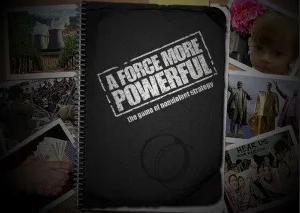
A Force More Powerful: The Game of Nonviolent Strategy

January 27, 2016 by intern3

A co-production of The International Center on Nonviolent Conflict (ICNC) and York Zimmerman Inc.
Language: English

This game is now out of date, but a sequel game called People Power: The Game of Civil Resistance is available for free download online.

Release Date: March 1, 2006
Platform: Windows
Media: CD-ROM
ASIN: B0018S20BK

DESCRIPTION:

Can a computer game teach how to fight real-world adversaries—dictators, military occupiers and corrupt rulers, using methods that have succeeded in actual conflicts—not with laser rays or AK47s, but with non-military strategies and nonviolent weapons? Such a game, A Force More Powerful (AFMP), is now available. A unique collaboration of experts on nonviolent conflict working with veteran game designers has developed a simulation game that teaches the strategy of nonviolent conflict. A dozen scenarios, inspired by recent history, include conflicts against dictators, occupiers, colonizers and corrupt regimes, as well as struggles to secure the political and human rights of ethnic and racial minorities and women.

A Force More Powerful is the first and only game to teach the waging of conflict using nonviolent methods. Destined for use by activists and leaders of nonviolent resistance and opposition movements, the game will also educate the media and general public on the potential of nonviolent action and serve as a simulation tool for academic studies of nonviolent resistance.

Filed Under: Uncategorized

Orange Revolution

January 27, 2016 by intern3

Director and Producer: Steve York
Executive Producer: Peter Ackerman
Managing Producer: Miriam A. Zimmerman
Released: 2007

WATCH THIS FILM ON AMAZON INSTANT VIDEO

English language and translated DVDs (in both PAL and NTSC format) can be purchased from York Zimmerman Inc.
The English language NTSC DVD can also be purchased from Amazon.com

Languages: Arabic, English, Farsi, Spanish, Ukrainian, Vietnamese

Format: NTSC or PAL
Number of discs: 1
Studio: A Force More Powerful Films
DVD Release Date: November 15, 2007
Run Time: 92 minutes
ASIN: B000YQ4BI2

Film website: www.OrangeRevolutionMovie.com
A free study guide for the series is available for download here.

If you are interested in arranging a screening in your area, please send your request to: orange@yorkzim.com

DESCRIPTION:

It was just after 2 a.m. on November 22, 2004, when the call went out: “The time has come to defend your life and Ukraine. Your victory depends upon how many people are ready to say ‘No’ to this government, ‘No’ to a total falsification of the elections.”

Regime-controlled media claimed victory for Viktor Yanukovych, handpicked by the corrupt sitting president. But credible exit polls showed Viktor Yushchenko, the opposition candidate, had won.

It was shocking enough that Yushchenko had been poisoned — and nearly killed– while on the campaign trail. When reports came in of blatant voter intimidation and damaged ballots, people were outraged. When they realized election officials were in on the fraud, the people had had enough.

In freezing temperatures, over one million citizens poured into the streets of Kyiv and took up residence there. They marched in protest and formed human barricades around government buildings, paralyzing all state functions. Restaurants donated food, businessmen sent tents, and individuals brought blankets, clothing, and money. At night, rock bands energized the protesters.

For 17 days, a group of ordinary citizens engaged in extraordinary acts of political protest. Capturing the songs and spirit of this moment in history, Orange Revolution tells the story of a people united, not by one leader or one party, but by one idea: to defend their vote.

REVIEWS AND AWARDS:

Orange Revolution premiered April 1, 2007 at the Chicago International Documentary Film Festival where it won the Chicago Doc President’s Award. Other Festival Screenings: Hot Docs, San Francisco, Seattle, Milwaukee, Hot Springs, United Nations Association – Stanford University, AFI, Anchorage, Melbourne Human Rights, Ukraine’s International Rights Protection Festival, DOCNZ of New Zealand, and the 7islands International Film Festival in Mumbia, India.

“Steve York pays testament to the true power of democracy with this informative investigation.”
–All Movie Guide

“[A] lively account of the mass demonstrations that gripped Ukraine in 2004. York … nicely captures the excitement and volatility of the events on the ground, and his access to the uprising’s key players makes for a timely and fascinating look at grassroots democracy in action.”
–Chicago Reader

“The broad scope of the film and the brilliant way it is shot and put together makes of it almost a thriller where truth is stranger– and more exciting — than fiction. … Besides being an exciting historical documentation of a very recent series of events “Orange Revolution” will resonate strongly with the American electorate which sat in front of their TV sets helplessly as Mr. Bush stole the American presidential election in 2000!”
–Filmfestivals.com

“This excellent documentary chronicles the events before and after the disputed election with interviews with all the key players and superb footage of the protestors, braving Kiev’s cold weather to claim their democratic rights. …Plaudits are due both to the work of Steve York and the bravery of the Ukrainian people.”
–Prostamerika.com

“It feels like a repeat of the sordid U.S. election scandals, where voters were barred from doing their democratic duty and blame was placed on ballots and the process. But during the 2004 elections in the Ukraine — where citizens had endured a visibly corrupt governing under President Kuchma and his endorsed, equally criminal successor, they refused to accept the lies. … a fascinating look at how true leveling power comes with unifying under an umbrella of a belief.”
–The Seattle Post-Intelligencer

Orange Revolution has been officially selected for showing at:

Los Angeles International Film Festival (American Film Institute)
Chicago International Documentary Festival (President’s Award)
Columbus International Film Festival (2007 Bronze Plaque)
HotDocs Festival Toronto
San Francisco International Film Festival
Seattle International Film Festival
DOCNZ New Zealand International Film Festival
United Nations Association Film Festival
Calgary International Film Festival
St. Louis International Film Festival
Milwaukee International Film Festival
Hot Springs Documentary Film Festival

Filed Under: Uncategorized

A Force More Powerful

January 26, 2016 by intern3


Written, Produced & Directed by Steve York

Series Editor: Peter Ackerman
Executive Producer: Jack DuVall
Managing Producer: Miriam A. Zimmerman

Languages: Amharic, Arabic, Burmese, Chinese (Mandarin), English,Farsi, French, Hebrew, Indonesian, Italian, Nepali, Pashto, Polish,Russian, Spanish and Vietnamese

Format: NTSC or PAL
Number of discs: 2
Studio: A Force More Powerful Films
DVD Release Date: September 1, 2000
Run Time: 154 minutes
ASIN: B0013A1IH0

Film website: www.aforcemorepowerful.org
A free study guide for the series is available for download here
Buy the English NTSC version now from Amazon
All translated versions and PAL copies are available here

                                                                  DESCRIPTION:
A Force More Powerful explores how popular movements battled entrenched regimes and military forces with weapons very different from guns and bullets. Strikes, boycotts, and other actions were used as aggressive measures to battle opponents and win concessions. Petitions, parades, walkouts and demonstrations roused public support for the resisters. Forms of non-cooperation including civil disobedience helped subvert the operations of government, and direct intervention in the form of sit-ins, nonviolent sabotage, and blockades have frustrated many rulers’ efforts to suppress people.

The historical results were massive: tyrants toppled, governments overthrown, occupying armies impeded, and political systems that withheld human rights shattered. Entire societies were transformed, suddenly or gradually, by nonviolent resistance that destroyed opponents’ ability to control events. These events and the ideas underlying nonviolent action are the focus of this three-hour documentary production.

The series begins in 1907 with a young Mohandas Gandhi, the most influential leader in the history of nonviolent resistance, as he rouses his fellow Indians living in South Africa to a nonviolent struggle against racial oppression. The series recounts Gandhi’s civil disobedience campaign against the British in India; the sit-ins and boycotts that desegregated downtown Nashville, Tennessee; the nonviolent campaign against apartheid in South Africa; Danish resistance to the Nazis in World War II; the rise of Solidarity in Poland; and the momentous victory for democracy in Chile. A Force More Powerful also introduces several extraordinary, but largely unknown individuals who drove these great events forward.

Few who relied on nonviolent sanctions in the 20th century did so because of a principled attachment to nonviolence. For some, arms were unavailable as a way to fight. Others had seen a violent insurrection fail, at devastating cost to life and property. They had no desire to be passive: they wanted passionately to overturn the rulers or the laws that subjected them, and they found a way.

The greatest misconception about conflict is that violence is the ultimate form of power, surpassing other methods of advancing a just cause or defeating injustice. But in conflict after conflict throughout the 20th century, people have proven otherwise. At a time when violence is still too often used by those who seek power, A Force More Powerful dramatizes how ordinary people throughout the world, working against all kinds of opponents, have taken up nonviolent weapons and prevailed.

Originally released as a feature-length film that played in festivals worldwide, A Force More Powerful was expanded into a 3-hour television series now available on DVD in both the NTSC and PAL television systems, and in the following languages:


                            REVIEWS AND AWARDS FOR THE TELEVISION SERIES:
“Journalistically, A Force More Powerful brings much honor to PBS and the individuals and groups that funded the film. The film is a work of art because, first, it is a work of fact.”
–Colman McCarthy, The National Catholic Reporter
“Outstanding…”
–Jim Hoagland, The Washington Post
“Gripping…”
–The Wall Street Journal
“In a time when there are so few authentic heroes, A Force More Powerful shows all of us – young and old alike – people who take principled risks far beyond their own self-interest.”
–Nat Hentoff, Syndicated Columnist
“An important, carefully made, and fascinating documentary that investigates nonviolent resistance movements that have succeeded around the world.”
–The Christian Science Monitor
“…rich in archival footage and thoughtful interviews….The stories are inspiring, sometimes awesome.”
–The Washington Post
“Expect more than a passive chronicle of nonviolence… A Force More Powerful’s stark footage and personal stories add drama to the history of a 20th century movement.”
–The Los Angeles Times
“Smartly made…”
–L.A. Weekly
“A triumphant chronicle…”

–Los Angeles Sentinel
“Splendid work. It explains and elucidates – just about the best missions that television can achieve.”
–The Hollywood Reporter
Emmy Nomination – Outstanding Historical Program
Gold Hugo Award – Chicago International Television Competition
Chris Award – Columbus International Film and Video Festival
Silver Screen Award – U.S. International Film and Video Festival
Jan Karski Award for Films of Moral Courage
Telly Award

REVIEWS AND AWARDS FOR THE FILM:
“Outstanding… a veritable manual on how to mount a successful nonviolent resistance movement… .”
–The Los Angeles Times
“…beautiful footage… this film is eloquent testimony to the power of the people’s desire to be free.”
–Time Out New York
“…this is a lovely, rich documentary.a rousing look at 90-some years of nonviolence….”
–Seattle Weekly
“A thoughtful new documentary that magnifies the moral victories of the 20th century… remarkable archival footage… there are no fictional characters or trumped up dialogue here; the filmmakers let participants speak in their own voices…”
–The Christian Science Monitor
“…passionately instructive and ferociously interesting…”
–Brent Simon, Entertainment Today

Gold Special Jury Award – WorldFest Houston International Film Festival
Moxie Award for Best Documentary – The Santa Monica International Film Festival

Official Selections: Seattle International Film Festival, Human Rights Watch Film Festival-London, Nashville Independent Film Festival, Maine International Film Festival, Newport Beach International Film Festival, Sedona International Film Festival, Santa Barbara Film Festival

Filed Under: Uncategorized

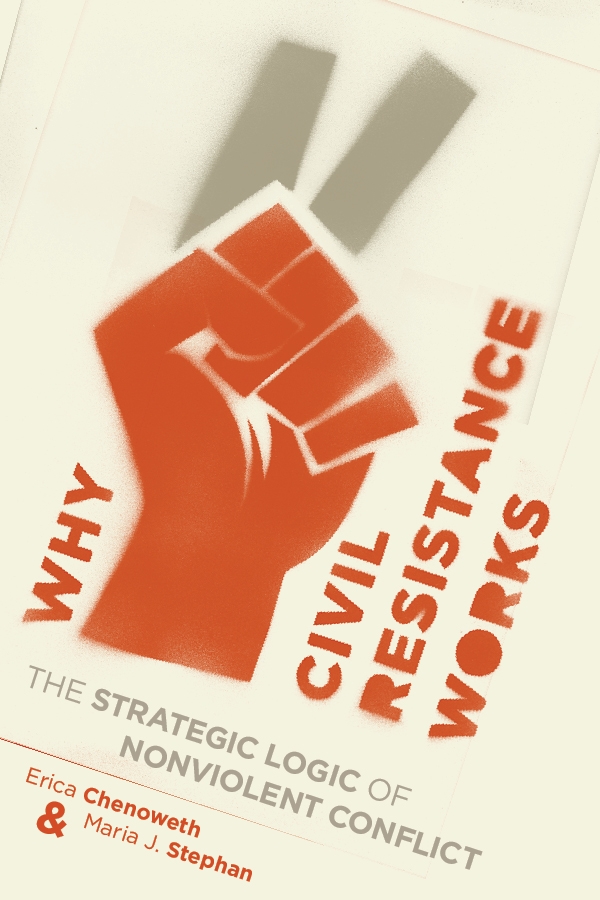
Why Civil Resistance Works: The Strategic Logic of Nonviolent Conflict (Book)

January 26, 2016 by intern3

wcrw
Why Civil Resistance WorksErica Chenoweth and Maria J. Stephan
(New York: Columbia University Press, forthcoming August 2011)

Visit Erica Chenoweth’s website to learn more about this book.

Pre-order the book from Columbia University Press or Amazon.com

DESCRIPTION:

Though it defies consensus, between 1900 and 2006, campaigns of nonviolent resistance were more than twice as effective as their violent counterparts. Attracting impressive support from citizens that helps separate regimes from their main sources of power, these campaigns have produced remarkable results, even in the contexts of Iran, the Palestinian Territories, the Philippines, and Burma.

Combining statistical analysis with case studies of these specific countries and territories, Erica Chenoweth and Maria J. Stephen detail the factors enabling such campaigns to succeed-and, at times, causing them to fail. They find that nonviolent resistance presents fewer obstacles to moral and physical involvement, information and education, and participator commitment. Higher levels of participation then contribute to enhanced resilience, a greater probability of tactical innovation, increased opportunity for civic disruption (and therefore less incentive for the regime to maintain the status quo), and shifts in loyalty among opponents’ erstwhile supporters, including members of the military establishment. They find successful nonviolent resistance movements usher in more durable and internally peaceful democracies, which are less likely to regress into civil war. Presenting a rich, evidentiary argument, this book originally and systematically compares violent and nonviolent outcomes in different historical periods and geographical contexts, debunking the myth that violence occurs because of structural and environmental factors and is necessary to achieve certain political goals. Instead, Chenoweth and Stephan find violent insurgency is rarely justifiable on strategic grounds.

PDF LINK TO THE MANUSCRIPT PRÉCIS

ADVANCE PRAISE FOR WHY CIVIL RESISTANCE WORKS:

“This is the first major scholarly book that makes a well-supported argument that, contrary to what many people believe, nonviolent resistance is more effective than armed resistance in overthrowing regimes, an advantage that is maintained even when the target is not democratic.”
–Robert Jervis, Columbia University

Filed Under: Uncategorized

A Force More Powerful: A Century of Nonviolent Conflict

January 21, 2016 by intern3

Peter Ackerman and Jack DuVall
(Hardback: New York: St. Martin’s Press, 2000)
(Paperback: New York: Palgrave, 2001)

Language: English

ISBN-10: 0756767326 (hardcover)
ISBN-13: 978-0756767327 (hardcover)
ISBN-10: 0312240503 (paperback)
ISBN-13: 978-0312240509 (paperback)

560 pages

Visit the A Force More Powerful website for ordering information and to learn about the companion film and other resources on nonviolent conflict.

DESCRIPTION:

This nationally-acclaimed book shows how popular movements used nonviolent action to overthrow dictators, obstruct military invaders and secure human rights in country after country, over the past century. Peter Ackerman and Jack DuVall depict how nonviolent sanctions–such as protests, strikes and boycotts–separate brutal regimes from their means of control. They tell inside stories–how Danes outmaneuvered the Nazis, Solidarity defeated Polish communism, and mass action removed a Chilean dictator–and also how nonviolent power is changing the world today, from Burma to Serbia.
–taken from the publisher

REVIEWS:

“A Force More Powerful challenges a longstanding myth that lies at the heart of much of the turmoil of the 20th century: that power comes from the barrel of a gun; based on convincing detail, Ackerman and Duvall dare to claim that nonviolent movements lead to more secure democracies.”
–Christian Science Monitor

“A skillful blend of sweeping narrative and tightly focused case studies, the book fills a vacuum in historical studies of the 20th century, which all too often stress the themes of total war and bloody revolutions…If there is one lesson that Ackerman and DuVall emphasize in their splendid book, it is the necessity of maintaining nonviolent discipline in the face of frequently savage response by the governing elites…”
–Philadelphia Inquirer

“This thoroughly researched and highly readable book underlines the contrast between stable democratic societies created by nonviolent movements and tyrannical regimes born of violent revolution. Recommended…”
–Library Journal

“…this book is an important documentation of non-violence as an attested historical force.”
–The Times Higher Education Supplement

“[A Force More Powerful] is a comprehensive and lucidly written addition to the literature of peace… Ackerman and DuVall, deserving of praise for writing nonideologically when they might easily and self-indulgently not have…use fourteen chapters to document and analyze history-altering reforms created by nonviolent strategies… A Force More Powerful will likely stand as a book more powerful than any guts-and-glory war memoirs by generals or gun-toters, or any extollings of military might by one-note historians.”
–The Nation

“These are powerful stories–about truth overcoming lies, love dissolving evil, and life eclipsing death. Nonviolent valor can end oppression, and the world of the 21st century will be safer, freer and more humane if it heeds the lessons of this book.”
–Jimmy Carter, former President of the United States

“In their well-written, often moving book, A Force More Powerful, Peter Ackerman and Jack DuVall deliver a compelling argument for the efficacy of nonviolent resistance to tyranny…. This book explains how profoundly history has been shaped by men and women who had the courage to act for a cause greater than their self-interest, and, thus, could not be conquered by the most ruthless, well-armed adversaries. I recommend it to anyone who believes that power only flows from the barrel of a gun.”
–John McCain, United States Senator

“Peter Ackerman’s and Jack DuVall’s informative and absorbing study on the inspired use of nonviolence as a force for peace lends meaning to Vaclav Havel’s praise of ‘the power of the powerless.'”
–Elie Wiesel, Nobel Peace Prize laureate

“Hope is a rare commodity in the struggle for justice. This book offers hope, but of a spare, hard-headed kind – the kind that appeals to the partisan as readily as the prophet – and it does so with eloquence and grace. If nonviolent resistance is a righteous strategy, this book is holy writ!”
–Dr. William F. Shultz, Executive Director, Amnesty International USA

“This book is a masterful revelation of the way that nonviolent resistance has created the power to overcome even the most extreme suppression of human rights, even the most dictatorial invasions of private life, even the most authoritarian rule. We have all looked at the clashes of arms of the past century as the primary drivers of political change. Ackerman and DuVall show us that, surprisingly, we also have much to learn from the lessons of nonviolent conflict. This is a book that all of us will want to read.”
–General John R. Galvin (U.S. Army, retired), former Supreme Allied Commander, Europe (NATO)

“A Force More Powerful challenges the misguided notion that violence is the ultimate form of power. Peter Ackerman and Jack DuVall provide dramatic examples of how people have been empowered through strategic use of nonviolent action, depriving their armed oppressors of political control and creating the conditions for democracy.”
–Richard H. Solomon, President, United States Institute of Peace

“A Force More Powerful tells the compelling stories of 20th century movements that made democracy a reality in the face of repression and cruelty. Peter Ackerman and Jack DuVall have engagingly chronicled the efforts of people as diverse as Polish shipyard workers and South African blacks to win their freedom through force of civic action rather than arms. This book will be valued by scholars and casual readers alike for its succinct, moving portrayal of some of the most important struggles of the past century.”
–Warren Christopher, former U.S. Secretary of State

TABLE OF CONTENTS:

List of Photographs
List of Maps
Acknowledgments
Introduction

PART ONE: MOVEMENT TO POWER
1. Russia, 1905: The People Strike
2. India: Movement for Self-Rule
3. Poland: Power from Solidarity

PART TWO: RESISTANCE TO TERROR
4. The Ruhrkampf, 1923: Resisting Invaders
5. Denmark, the Netherlands, the Rosenstrasse: Resisting Nazis
6. El Salvador, 1944: Removing the General
7. Argentina and Chile: Resisting Repression

PART THREE: CAMPAIGNS FOR RIGHTS
8. The American South: Campaign for Civil Rights
9. South Africa: Campaign against Apartheid
10. The Philippines: Restoring Democracy
11. The Intifada: Campaign for a Homeland
12. China, Eastern Europe, Mongolia: The Democratic Tide

PART FOUR: VIOLENCE AND POWER
13. The Mythology of Violence
14. The New World of Power
Conclusion: Victory without Violence

Notes
Index

Filed Under: Uncategorized

Anti-Corruption Campaigns

January 21, 2016 by intern3

Presenter: Shaazka Beyerle / Senior Advisor with the International Center on Nonviolent Conflict

Date: Thursday, June 11th, 2015
Time: 9:00am – 10:30am

Description: Now that the links between corruption and violent conflict, authoritarianism, poverty, inequality and human rights abuses are clear, the key issue is how to curb it. What options exist beyond traditional approaches? What strategic value do citizens bring to the anticorruption struggle? How do bottom-up campaigns and movements complement and reinforce top-down anticorruption efforts? In this session we’ll consider these questions, explore how people power impacts corruption and impunity, analyze a few of the creative tactics carried out by millions of citizens around the world, and apply what we’ve learned in an interactive, group format.

  • Watch this Presentation

Filed Under: 2015, ICNC Summer Institute

Guest Speaker: Dr. Peter Ackerman

January 19, 2016 by intern3

Speaker: Dr. Peter Ackerman / Founding Chair, International Center on Nonviolent Conflict

Title: “Why Skills Can Make Civil Resistance a Force More Powerful”

Date: Thursday, June 20th, 2013
Time: 12:30pm – 2:00pm

Description: Nonviolent conflict is a contest between nonviolent civil resisters and their (often violent) adversaries. In this contest, each side has different strategies and tactics that they can employ. Civil resistance movements wage their struggle through political, economic, and social pressure, and they have a wide variety of tactics at their disposal. A movement’s adversary often tries to wage its struggle through violent means, which has a completely different dynamic and tactical repertoire. In this asymmetric contest between violent and nonviolent actors, the side that is best organized, most skillful, and most strategic, is more likely to prevail. Therefore, the skillful and strategic choices that civil resistance movements make are of critical importance to their outcome.

Watch this Presentation:

Additional Resources:

  • Download presentation slides

Filed Under: 2013, ICNC Summer Institute

Dr. King’s Letter from Birmingham Jail: Lessons for Civil Resistance Movements

January 15, 2016 by intern3

MLK_Webinar_Banner_Photo-150x150This Academic Webinar took place on Friday, Jan. 15, 2016 at 12 p.m. EST.

This live academic webinar will be presented by Tom Hastings, faculty in the graduate program of Conflict Resolution at Portland State University and an ICNC Academic Advisor.

This webinar is transcribed into Chinese

Watch webinar below:

https://youtu.be/U9HX7OAf28M

Webinar content

1. Introduction of the Speaker: 00:00- 01:25
2. Presentation: 01:26 – 32:50
3. Questions and Answers: 32:51 – 53:59


Webinar Summary

This webinar looks at timeless lessons included in Dr. King’s letter dated on April 16, 1963, and smuggled out of a Birmingham jail where King and nearly 50 other protesters stayed imprisoned.

Dr. King participated in several movements in opposition to desegregation, finally even committing civil resistance, but had been primarily a movement spokesperson and strategic planner. In Birmingham, however, it was clear that the terrorists—the Ku Klux Klan and affiliated hoodlums, arguably the most violent in the US—were deterring most from participating in what was meant to be mass action, so on Good Friday 1963, King joined the demonstration, which became resistance when many protesters were arrested and King went to jail.

Eight Birmingham white clergy publicly criticized his actions and the demonstrations, calling them unwise and ill-timed. Four days later, King’s letter was made public which changed the national discourse then, and still provides important lessons for today’s social movements.

This webinar will primarily consider some of the generalizable concepts drawn from the letter, related to some of the issues and challenges of movements today.

You can follow us on Twitter directly (@nvconflict) or by searching for #ICNCWebinars. We will be live-Tweeting the webinar with Robert Press so come join us to ask questions for the presenter!


Presenter

tom-hastingsTom Hastings, Ed.D., is co-coordinator of the undergraduate program in Conflict Resolution at Portland State University. He is a former member of the Governing Council of the International Peace Research Association (IPRA), former co-chair of the Peace and Justice Studies Institute, as well as the Academic Advisor Council of the International Center on Nonviolent Conflict. He is founding director of PeaceVoice, a program of OPI, and has written several books and many articles about nonviolence and other peace and conflict topics. He is a former Plowshares resister, a founding member of two Catholic Worker communities, and currently lives in Whitefeather Peace House.


Recommended Readings

  • Aeschliman, M. D. (2005). Enduring documents and public doctrines: Martin Luther King’s “Letter from Birmingham Jail” after forty years. Journal of Education, 186(1), 29-46.
  • Berry, E. (2005). Doing time: King’s “Letter From Birmingham Jail”. Rhetoric & Public Affairs, 8(1), 109-131.
  • Branch, Taylor (1998). Pillar of fire: America in the King Years 1963-65. New York, NY: Simon & Schuster.
  • Chernus, Ira (2004). American nonviolence: The history of an idea. Maryknoll, NY: Orbis Books.
  • Dyson, Michael Eric (2000). I may not get there with you: The true Martin Luther King Jr. New York, NY: The Free Press.
  • Fisher, Roger, & Ury, William (2011). Getting to yes: Negotiating agreement without giving in. (3rd ed.). New York, NY: Penguin.
  • Harding, Vincent (1996). Martin Luther King: The inconvenient hero. Maryknoll, NY: Orbis.
  • Herman, A.L. (1999). Community, violence, & peace: Aldo Leopold, Mohandas K. Gandhi, Martin Luther King Jr., and Gautama Buddha. Albany, NY: State University of New York Press.
  • Houck, D. W. (2004). Ed King’s jaw—or, reading, writing, and embodying civil rights. Rhetoric & Public Affairs, 7(1), 67-90.
  • King, Jr., Martin Luther (1958). Stride toward freedom: The Montgomery story. New York, NY: Harper.
  • King, Jr., Martin Luther (1963). Strength to love. New York, NY: Harper & Row.
  • King, Jr., Martin Luther (1964). Why we can’t wait. New York, NY: Harper & Row.
  • King, Jr., Martin Luther (1968). Where do we go from here: Chaos or community? New York: Bantam (original Harper & Row, 1967).
  • Larson, D. (2010). Toward a prison poetics. College Literature, 37(3), 143-166.
  • Lynd, Staughton & Lynd, Alice (1995). Nonviolence in America: A documentary history (2nd ed.). Maryknoll NY: Orbis Books (original 1966).
  • McNeil, G. R. (2015). Martin Luther King, Jr: Diplomat, prophet, and global visionary. Journal of African American History, 100(1), 119-134.
  • Miller, J. (2009). Integration, transformation and the redemption of America: The Fire Next Time and ‘A Letter from Birmingham Jail’. European Journal of American Culture, 28(3), 245-262. doi:10.1386/ejac.28.3.245_1
  • Osborn, M. (2004). Rhetorical distance in “Letter from Birmingham Jail”. Rhetoric & Public Affairs, 7(1), 23-35.
  • Patron J. (2004). A transforming response: Martin Luther King Jr.’s “Letter from Birmingham Jail”. Rhetoric & Public Affairs 7(1):53-65.
  • Gaipa, M. (2007). A creative psalm of brotherhood”: The (de)constructive play in Martin Luther King’s “Letter from Birmingham Jail. Quarterly Journal of Speech, 93(3), 279-307. doi:10.1080/00335630701426769
  • Rieder, Jonathan (2013). Gospel of freedom: Martin Luther King, Jr.’s Letter from Birmingham Jail and the struggle that changed a nation. New York, NY: Bloomsbury.
  • Rosenberg, M. B. (2003). Nonviolent communication: A language of life (2nd ed.). Encinitas, CA: PuddleDancer Press.
  • Walker, J. (1994). The body of persuasion: A theory of the enthymeme. College English, 56(1), 46-65.
  • Zinn, Howard, et alia (2002). The power of nonviolence: Writings by advocates of peace. Boston: Beacon.


Filed Under: Webinars

Civil Resistance and Human Rights

January 13, 2016 by intern3

Presenters:

Dr. Mary King / Professor of Peace and Conflict Studies, University for Peace

Dr. Kim Wilson / Lecturer, Fletcher School for Law and Diplomacy

Nicola Barrach / Director for Civic and New Media Initiatives, International Center on Nonviolent Conflict

Date: Wednesday, June 27th, 2012
Time: 4:00pm – 5:30pm

Description: This session is an interactive discussion about civil resistance and human rights, exploring the fundamental role that nonviolent movements have played in securing and codifying most of the rights that are today recognized as universal. It is no exaggeration to say that civil resistance is both the creation and exercise of universal human rights. This includes preventing and opposing new forms of oppression. It is also the means by which new rights can be claimed and already established rights must be defended. Nonviolent movements can play a pivotal role in monitoring and reporting violations of rights, revealing abusive practices that have been concealed from view, and exerting pressure by leveraging global public opinion. In addition, nonviolent practitioners can utilize and improve both human rights law and the relationship between activists and existing networks of human rights professionals.

  • Watch this Presentation

    Watch this Presentation:

https://www.youtube.com/watch?v=9vJ1rDLyQIM

Additional Resources:

  • Curation of Key Tweets and Resources

Filed Under: 2012, ICNC Summer Institute

A Conversation on Leadership in Civil Resistance

January 13, 2016 by intern3

Presenter: Dr. Deborah Nutter / Senior Associate Dean, The Fletcher School of Law and Diplomacy

Date: Wednesday, June 27th, 2012
Time: 2:00pm – 3:30pm

Description: To give effective leadership to a civil resistance movement, an organizer must be able to strategically organize and plan, visualize a future that the movement wants to achieve, elicit sustained and value-driven participation, and effectively negotiate with disparate parts of a coalition for action, and with other institutions. The leader must articulate ideas and generate tactical actions that build the movement in order to shift perceived legitimacy from the current system to a new society sought by the people. Dean Deborah Winslow Nutter leads a discussion on leadership, based on these and other ideas, with two leaders of civil resistance: Czeslaw Bielecki of Poland, and Lhadon Tethong on behalf of Tibet.

  • Watch this Presentation
  • Download Additional Resources
  • Join the Conversation

    Watch this Presentation:

https://www.youtube.com/watch?v=bEQKqKIq-4Y

Additional Resources:

  • Curation of Key Tweets and Resources


Filed Under: 2012, ICNC Summer Institute

Film Screening: Bringing Down a Dictator

January 12, 2016 by intern3

Bringing Down a Dictator tells the inside story of how Milosevic was brought down — not by smoke and flames– but by a courageous campaign of political defiance and massive civil disobedience. Winner of a Peabody Award, the film was narrated by Martin Sheen and premiered on PBS in March 2002.

Watch the trailer:

https://www.youtube.com/watch?v=PJfE_KCtbug

Filed Under: Uncategorized

The Dynamics of Civil Resistance

January 12, 2016 by intern3

Jack DuVall
President
International Center on Nonviolent Conflict

The modern practice of civil resistance sprang from ideas about the underlying nature of political power that began to be framed about 170 years ago. As later developed by Gandhi and adopted by scores of movements and campaigns for rights and justice in recent decades, strategies of civil resistance have exhibited a common dynamic, propelled historic changes, and imparted certain political and social properties to their societies. The record of these strategies in liberating oppressed people, when compared to that of violent insurgency or revolt, has been remarkable – and suggests why political violence may substantially be reduced in the future.

Additional Resources:

  • DuVall, Jack.  Civil Resistance and the Language of Power.
  • Hardy Merriman – Why Learn About Civil Resistance? (video)
  • Jack DuVall – Why Learn About Civil Resistance? (video)
  • Dr. Stephen Zunes – Why Learn About Civil Resistance? (video)

Filed Under: Academic Support Initiatives, Fletcher Summer Institute

Ramesh Chandra Sharma

January 12, 2016 by intern3

https://youtu.be/dahGfnZCLA4

Ramesh Chandra Sharma has worked with Ekta Parishad, a nonviolent mass movement in India, as a Campaign Coordinator for the past 12 years. He has been involved in campaigning and training rural youth to lead struggles in villages for the past 40 years. He is also in charge of International Coordination for Ekta Parishad. Ramesh is also a member of various groups such as the Task Force for Land Reforms, the Central Enquiry Committee on Tribal Self Rule, and the National Land Reforms Committee. As a campaigner he has been involved in many foot marches, mass movements and negotiations with concerned groups. Ramesh has also delivered lectures at Cambridge University, the London School of Economics, and Oxford University as well as the British Parliamentary Committee. He has been involved in and offered assistance to many similar international nonviolent movements in Paraguay, Argentina, Chile, Venezuela, Bolivia, Colombia, Peru, Costa Rica, Panama, Mexico, Brazil, Bangkok, and Uganda. Currently, he is engaged in building a mass movement in India called Jan Satyagraha 2012 when 100,000 landless and deprived people will walk to claim their land, livelihood, rights and dignity.

“In every nonviolent movement there should be individuals who are part of constructive work while simultaneously strengthening local campaigns. These advocacy efforts lend a transformative, long-term resilience to all stakeholders who are involved with the daily tasks and short-term goals of an organization.”

Filed Under: Academic Support Initiatives, Fletcher Summer Institute

Tamar Zhvania

January 12, 2016 by intern3

https://www.youtube.com/watch?v=bivdnlAkCYU&feature=youtu.be

Tamar Zhvania received her Sociology MA degree from the Iv. Javakhishvili Tbilisi State University. She is an Expert/Consultant in the United Nations Development Program (UNDP), Electoral Assistance Project since November 2007, acting as the Project Manager. During the last three years she has actively worked on public awareness and civic education, supported capacity building of different institutions as well as promoted improved legal framework for effective democratic processes.

From 2004-2007, Tamar worked at a well-known Georgian NGO called the International Society for Fair Elections and Democracy (ISFED) as an Executive Director. In 2001-2004, before assigning as an ISFED Executive Director, Tamar worked for ISFED as a Press-Secretary and then was promoted as a PR Director. In 2000, she worked as an ISFED representative in the Central Election Commission (CEC) of Georgia. Tamar has experience of working in Bangladesh as NDI election consultant, in Ukraine under ENEMO observation missions, in Kazakhstan under OSCE observation missions and in Norway under NUPI short-term electoral mission.

“Since 2008 there have been frequent rallies and public meetings in Georgia, especially election related public protests and boycotts. Many political parties, particularly opposition ones, encouraged people to be involved in the public protests to demand government change through snap elections to be conducted in free and fair manner. People also were raising concerns related to social and political problems. Those protests were organized in terms of representing the different parties, social groups and the public in general.”

Filed Under: Academic Support Initiatives, Fletcher Summer Institute

Natalia Lozano Mancera

January 12, 2016 by intern3

https://www.youtube.com/watch?v=0flzQOw8o1g&feature=youtu.be

Natalia Lozano Mancera was born in Bogotá, Colombia, where she grew up surrounded by her father’s large family who were all at some point of their lives politically active in leftist movements. Inspired by her family she studied Political Science at the National University of Colombia. Her BA degree thesis was called “Musical Consumption and Production in Internally Displaced People in Bogotá.” Some years afterwards she worked for a govermental organization in charge of reparations for victims of paramilitary groups. Being so close to the situations of the different victims she realized she did not want to work in processes of reparations but in processes that allow people to escape from being victimized. In 2007 she became a student in the MA program in Peace Studies at the University of Innsbruck. She graduated last January with a thesis called “Playing Music Performing Resistance, the dynamics of resistance through music in the Colombia south Pacific coast” in which she analyzes little acts of resistance related to the marimba music. Currently, she works for a NGO in Colombia in which she gives workshops on Conflict Transformation and Peace Education to vulnerable populations. She recently enrolled in the PhD program of Media and Communications of the European Graduate School, where she wants to continue working with the concepts of resistance and revolution in relation to arts and creativity.

My interest in nonviolent struggle was first sparked “…by living in a country where violence is so overwhelming. My interest was also sparked by having the conviction that we as creative human beings have the capacity to transform those violent realities. I’ve been personally involved in nonviolent action, when the current Colombian president wanted to reform the National Constitution in order to run for a third term (he already had changed it to run for the second one). I participated in an organization called Civil Alliance for Democracy that worked against that reform, and any other reform that would threaten the principles of freedom and plurality proclaimed by the Constitution. I’ve learned that there is nothing that can justify the use of violence. There are not fair causes in the name of which violence can be used. I hope to take away from the Fletcher Summer Institute shared moments and knowledge about others’ experiences and about resistance theories that will give me the will to keep on studying and acting in nonviolent movements.”

Filed Under: Academic Support Initiatives, Fletcher Summer Institute

Musa Isah Salmanu

January 12, 2016 by intern3

https://youtu.be/jCdktOLmbUU

Musa Isah Salmanu is a serving Squadron Leader in the Nigerian Air Force, with an MA in Conflict Security and Development from King’s College London and an MSc in Political Science from Ahmadu Bello University Zaria-Nigeria. He is an African Peace and Security Fellow at the African Leadership Center and the Conflict, Security and Development Group, King’s College London. He is presently deployed as a military observer in South Kivu, Democratic Republic of Congo.

My interest in nonviolent struggle was first sparked “…by the conviction that the ability to exercise our rights to freedom of expression and association is an important step towards achieving a viable and progressive society. I’ve been personally involved in nonviolent action, when as a high school student I worked with other students to organize and challenge a tuition increment by the government, a move we viewed as anti-poor. I’ve lived or worked in a conflict environment, and have learned that the traditional notion of seeing security personnel as pro-establishment and anti-popular movements is erroneous. There is thus the need for security forces to be carried on board and to be more informed about the logic, principles, and ideals behind nonviolent conflict. Presently in the Eastern part of the DR Congo, I have witnessed firsthand how the denial of basic rights and the curtailing of civil liberty can bring about violent resistance and anarchy. What I hope to take away from the Fletcher Summer Institute is a better understanding of the modes and reasons for actions involving nonviolent conflict as this will enable me to deal with situations in a more professional way. This I believe will engender the spirit of mutual understanding between the practitioners of nonviolence and the security agents sent to maintain law and order. Furthermore, I will be better equipped to explain these issues to my colleagues and thereby beginning a process of change in perception and action.”

Filed Under: Academic Support Initiatives, Fletcher Summer Institute

Dr. Mohamed Fouad Bergigui

January 12, 2016 by intern3

https://www.youtube.com/watch?v=3RJ9OKvTj7A&feature=youtu.be

Dr. Mohamed Fouad Bergigui is the head of rural development for the Moroccan Foundation for Youth, Initiative and Development. He received a Doctor of Veterinary Medicine at the Agronomic and Veterinary Institute. At the foundation, Bergigui is in charge of conception, achievement and follow-up of socio-economic development programs targeting especially rural areas and underprivileged populations. He has participated in many rural development projects such as the creation of six beekeeping cooperatives in Tiznit and Chtouka in southern Morocco, and two Veterinarian Civic Action Projects for poor farmers rural Morocco.

My interest in nonviolent struggle was first sparked “…when I led a rural development project to ensure better living conditions for destitute Berber populations that have no access to the basic necessities of life in the countryside of Morocco. I was personally involved in nonviolent action when I participated in a COP15 youth climate march in Copenhagen. I hope to learn how to empower youth and underprivileged populations to act for the change they need.

Filed Under: Academic Support Initiatives, Fletcher Summer Institute

Nathalie Janee D’Othée

January 12, 2016 by intern3

https://www.youtube.com/watch?v=L0RQl1jcLqk&feature=youtu.be

Nathalie Janne d’Othée was born in Antwerp, Belgium. She studied History and International Relations at the Catholic University of Louvain (UCL) in Belgium. During her university years, her interest in the Middle East increased. She studied at the University of Galatasaray in Istanbul for one year. Then she lived for a year in Cairo to learn Arabic. Coming back to Belgium, she decided to begin a PhD on the Palestinian nonviolent resistance movement, which really impressed her. She also works in a research institute on Euro-Arab relations, called MEDEA. In 2008, she participated in a ten-day project called “Samen in Zee” (Dutch for “Together at sea”) with Europeans, Palestinians and Israelis in the Netherlands. The group received training in nonviolent communication. In 2009, Nathalie travelled three weeks around Israel/Palestine. She is also involved in Belgium with a working group of the International Civil Service, which is an NGO. The working group focuses its work on the Mediterranean region, especially Palestine. It organizes conferences, trainings for volunteers leaving for the region, and participates in demonstrations of solidarity with the Palestinian people and their nonviolent struggle.

My interest in nonviolent struggle was first sparked “…by visiting the numerous blogs of Palestinians telling about their daily life under occupation, and then by a human chain created around the Gaza Strip in the beginning of 2008. I was personally involved in nonviolent actions in Jerusalem and the West Bank in 2009. For instance, I attended a festival meant to show the settlers that a piece of land called Ush Graib was “occupied” by the local Palestinian population. I’ve visited Palestine and participated in nonviolent actions and have learned that the media coverage of a nonviolent action is fundamental for its effectiveness. What I hope to take away from the Fletcher Summer Institute is a better understanding of nonviolent resistance and the role of the media, and also the importance of foreign support to nonviolence.”

Filed Under: Academic Support Initiatives, Fletcher Summer Institute

Abebe Gellaw

January 11, 2016 by intern3

https://youtu.be/ZHlZdgXK_sc

Abebe Gellaw is an exiled Ethiopian journalist; he is currently a visiting scholar at the Centre on Democracy, Development and the Rule of Law at Stanford University. He is working on a book project, “Ethiopia under Meles: Why the transition from military rule to democracy failed.” He is also a steering committee member of the Solidarity Movement for a New Ethiopia, an organization that seeks to bring about drastic socio-political changes through nonviolent struggle.

Gellaw holds a bachelor’s degree in Political Science and International Relations from the Addis Ababa University and a post-graduate diploma in law from London Metropolitan University. He began his career in journalism in 1993 as a freelance writer focusing on human rights and political issues. He has worked for various print and online publications including the Ethiopian Herald, the only English daily in the country. Most recently he was a recipient of Stanford University’s Knight Journalism Fellowship and Yahoo’s International Fellowship in 2009. His op-eds, stories, articles and interviews have appeared in the Wall Street Journal, The Guardian, the Far East Review, and Global Integrity’s “The Corruption Notebooks 2008.”

My interest in nonviolent struggle was first sparked “…when I got involved in the student union at the Addis Ababa University that was struggling for academic and political freedom. In 1993, 42 professors were fired from the university and the student union was disbanded. I’ve been personally involved in nonviolent action, when as a student I along with others took part in a number of protest rallies, sit-ins and hunger strikes. I have been particularly successful in using journalism as a vehicle of advocacy, mobilizing for a cause and as a means of exposing the abuse of power. I’ve learned that nonviolence is a powerful means to challenge tyranny and dissolve violence.”

Filed Under: Academic Support Initiatives, Fletcher Summer Institute

2015 ICNC Monograph Awardees

January 8, 2016 by David Reinbold

 This year’s awardees include:

jonathan_pinckneyJonathan Pinckney is a Ph.D. student at the Josef Korbel School of International Studies in the fields of International Relations and Comparative Politics and a Research Fellow at the Sie Cheou-Kang Center for International Security and Diplomacy, where he supervises the Nonviolent and Violent Campaigns and Outcomes (NAVCO) 3.0 project.  His research interests focus on extra-institutional means of political contention, primarily nonviolent civil resistance and political violence. Jonathan’s work has been published in the Journal of Peace Research, Foreign Policy Magazine’s Democracy Lab, and the Encyclopedia of Social and Behavioral Sciences. Jonathan received his BA in International Affairs from Gordon College, graduating summa cum laude with special honors, and his MA from the Korbel School in 2014.  He was a 2012 recipient of the Korbel School’s Sié Fellowship.

Making or Breaking Nonviolent Discipline in Civil Resistance Movements

Abstract: How can we understand when nonviolent movements will stay nonviolent? When are they likely to break down into violence? In this monograph, Jonathan Pinckney analyzes both what promotes and undermines nonviolent discipline in civil resistance movements. Combining quantitative research on thousands of nonviolent and violent actions with a detailed comparison of three influential cases of civil resistance during the “Color Revolutions,” Pinckney’s study provides important lessons for activists and organizers on the front lines, as well as for practitioners whose work may impact the outcomes of nonviolent struggles. We learn how repression consistently induces violence, as do government concessions. On the flip side, we see that structuring a campaign in an inclusive and non-hierarchical way is conducive to greater nonviolent discipline.

____________________________

elizabeth_wilsonElizabeth A. Wilson is visiting faculty at Rutgers Law School in New Jersey, USA. She is currently a Fulbright-Nehru Senior Scholar at the Centre for Policy Research in New Delhi, India. Her areas of specialization include public international law and international human rights law. She holds a J.D. from Harvard Law School and a Ph.D. from the University of Pennsylvania, USA.

People Power Movements and International Human Rights: Creating a Legal Framework

Abstract: International human rights law did not come into existence top-down, out of the benevolent intentions of states, even though states eventually began to recognize that large-scale human rights abuses could pose a threat to the international order. Rather, it came into existence from the bottom-up efforts of ordinary people in civil society to ally with each other in solidarity and demand their rights, often through organized nonviolent campaigns and movements that pressured elites and powerholders to recognize or grant individual rights (freedom for slaves, women’s rights, labor rights, and children’s rights, to name a few). Unlike international law generally, the real source of international human rights law has been the coordinated, organized and nonviolently forceful efforts of individuals—in other words, what one can refer to as people power.

Filed Under: Academic Support Initiatives, Scholars and Students

  • Prev
  • 1
  • …
  • 11
  • 12
  • 13
  • 14
  • 15
  • 16
  • Next
Center for Nonviolent Conflict Research

Center for Nonviolent Conflict Research

600 New Hampshire Avenue NW
Suite 1010
Washington, D.C. 20037, USA

+1 202-596-8845

Other ICNC Affiliated Websites

  • Nonviolent Conflict News
  • Online Courses Platform
  • CivilResistance.net

Copyright ©2026 Center for Nonviolent Conflict Research · All Rights Reserved

Note: Search results are listed in alphabetical order.